

Highlights
Corporate greenhouse gas (GHG) reporting is set for significant change as the GHG Protocol (GHGP) and the International Organization for Standardization (ISO) plan to combine the GHGP and ISO corporate GHG reporting standards into a single, co-branded standard.
The aim is to reduce fragmentation and create a more coherent standard for GHG emissions measurement and reporting that would be suitable for mandatory reporting and consistent with target-setting initiatives.
Current GHGP standards are relied on extensively, including in IFRS® Sustainability Disclosure Standards and European Sustainability Reporting Standards (ESRS). The International Sustainability Standards Board (ISSB) and European Commission would need to separately consider and consult on whether and when to embed a revised GHGP standard in their respective requirements.
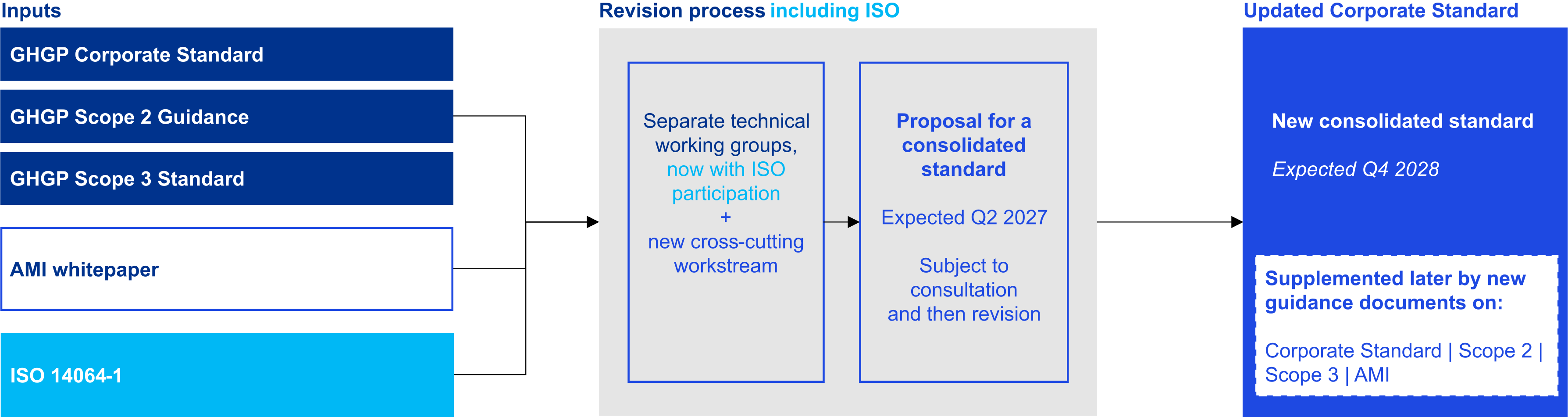
A proposal for the new standard is expected in Q2 2027 and a final standard by Q4 2028.

What is proposed?
The proposed consolidated standard would bring together the following.
- The GHGP Corporate Standard and its:
- Scope 2 guidance (including newly published feedback on the GHGP Scope 2 proposals); and
- Scope 3 Standard.
- The GHGP Actions and Market Instruments (AMI) workstream1.
- ISO 14064-1 Greenhouse gases.
ISO 14064-1 specifies principles and requirements for quantifying and reporting organisation-level GHG emissions and removals, and is widely used as a basis for verification.
The work builds on and consolidates current work by the GHGP to overhaul its standards. However, until now, it planned separate updates for each existing standard, plus a workstream for AMI.
What could change in reporting?
The GHGP workplan integrates and builds on the work done to date to suggest changes that could be significant. For example, it could involve:
- updating descriptions of organisational boundaries in the Corporate Standard to better align with current financial accounting principles;
- refining measurement principles in the Scope 2 standard to add rigour to accounting for renewable energy procurement arrangements and contractual instruments, including energy attribute certificates (EACs);
- requiring disclosure of all categories of scope 3 emissions, subject to a minimum threshold; and
- updating guidance on reporting scope 3 category 15 emissions to reshape which types of emissions are required for financial institutions.
Incorporating the AMI workstream into the single consolidated standard could significantly broaden the information companies report – e.g. introducing market-based emissions beyond scope 2 emissions and reporting on the consequences of decarbonisation action.
What’s next?
The GHGP and ISO are planning an integrated public consultation on the future corporate standard in Q2 2027. To develop the proposed standard, the GHGP will continue its development work; considering feedback from previous consultations and aligning the work with ISO.
Actions for management
- Continue to report GHG emissions under the current standards while the consolidated standard is developed and any transition arrangements are confirmed.
- Monitor project developments to assess potential implications for your measurement and disclosure.
- Look out for updates from the ISSB and European Commission or other regulators on how they might plan to use the new consolidated standard.
- Review systems, controls and assurance readiness once detailed proposals are available.
1 The published AMI whitepaper proposed a multi-statement reporting format that would complement the existing statement of ‘physical emissions’ with reporting on the use of contractual instruments via market-based methods, and a GHG impact statement. In this impact statement, a company would use consequential methods (broadly, estimating the change in global emissions caused by an action) to report on its actions.
© 2026 KPMG IFRG Limited, a UK company, limited by guarantee. All rights reserved.