

Highlights
The European securities regulator, ESMA1, has issued its priorities and reminders for 2026 annual reporting, highlighting the areas for companies to focus on.

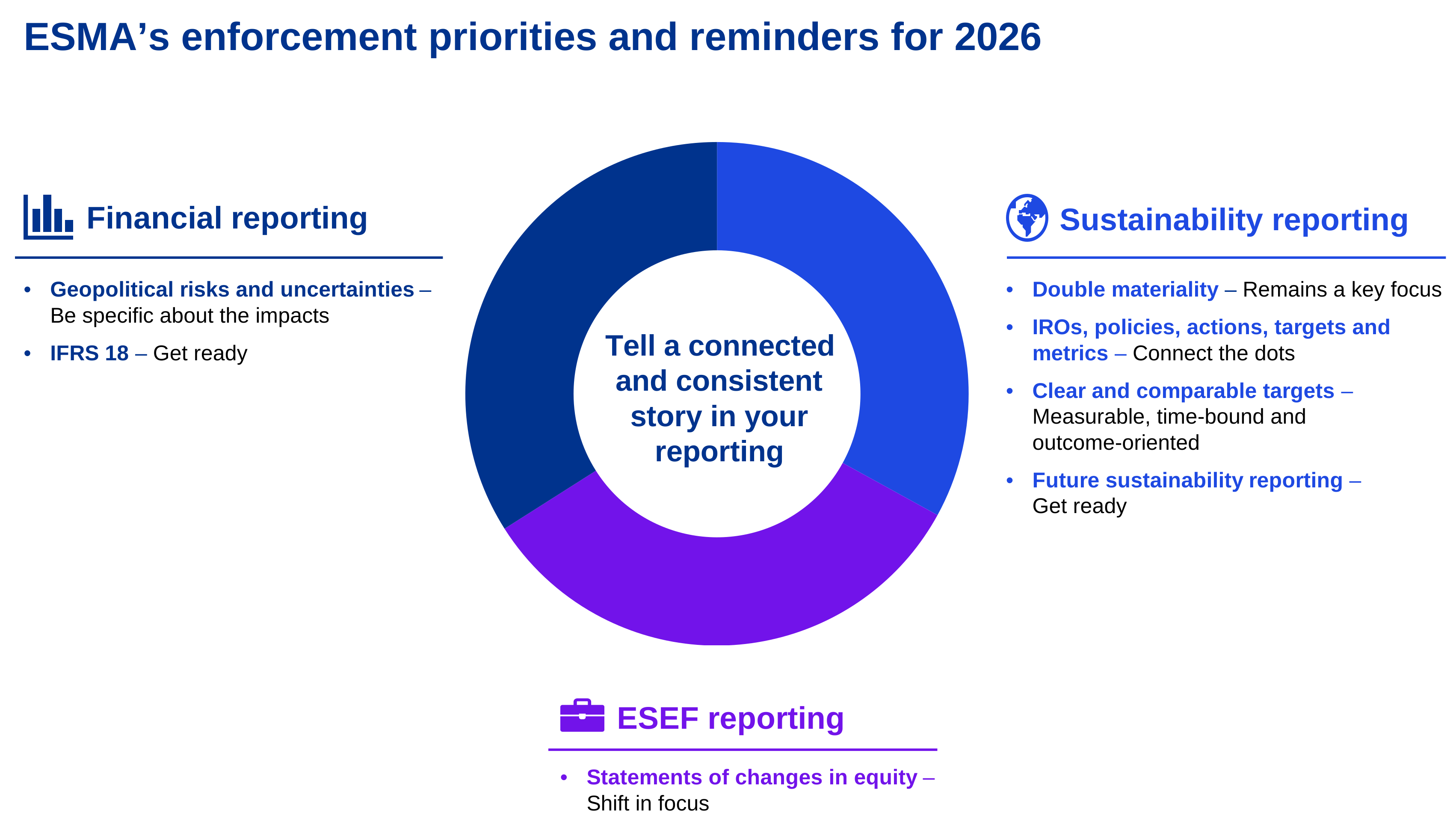
For financial reporting, regulatory bodies outside the EU are also likely to focus on similar topics.
Financial reporting
Companies continue to face heightened geopolitical risks and uncertainties. ESMA continues to view these as some of the most significant challenges affecting financial reporting. Therefore, companies need to assess:
- how geopolitical tensions, trade policies, sanctions, shifting trade flows and regional conflicts affect their own operations, financing, asset valuations and cash flow projections;
- how their estimates and judgements may be impacted; and
- what information is relevant to users of their financial statements.
ESMA highlights the following financial reporting areas for particular attention by companies, reminding them of the importance of meaningful disclosures about risks, uncertainties and judgements made.
Area | Focus |
Operations |
|
Financing |
|
Asset valuations |
|
ESMA urges companies to ensure high-quality, timely implementation of IFRS 18 Presentation and Disclosure in Financial Statements, including transparent and meaningful disclosure of the expected impacts ahead of its effective date of 1 January 2027. The new presentation and disclosure requirements will also affect the first interim reporting period in 2027. ESMA refers companies to its Statement on implementation of IFRS 18.
Transition
For 2026 financial statements, companies are expected to provide specific information about the anticipated impacts of IFRS 18. This may include:
- quantitative changes to the income statement, where possible;
- significant judgements, including the assessment of specified main business activities;
- expected management-defined performance measures (MPMs), including any changes to measures currently used in public communications; and
- other significant judgements and key accounting policy decisions.
Ongoing developments
ESMA also urges companies to monitor IFRS Interpretations Committee discussions and decisions relating to IFRS 18 as they may provide clarity on specific application issues.
Other public communications
IFRS 18 implementation can extend beyond the financial statements. ESMA notes that it may affect a company’s public communications, performance metrics and European Single Electronic Format (ESEF) reporting.
Companies are also reminded to consider ESMA’s Guidelines on Alternative Performance Measures (APMs). They need to carefully assess new APMs and any adjustments to existing APMs, particularly for performance measures based on hypothetical income and expenses. Measures used need to:
- enhance, rather than reduce, transparency, comparability and reliability; and
- provide decision-useful information for investors.
Sustainability reporting
2026 is a transitional year for sustainability reporting. Eligible companies can apply European Sustainability Reporting Standards (ESRS) Set 12, revised ESRS3, or ESRS Set 1 with specified revised ESRS reliefs4. ESMA expects companies to clearly disclose which version of ESRS they apply, helping users to understand the basis of their reporting. ESMA also reminds companies moving from ESRS Set 1 to revised ESRS that the transition relief for comparative information applies only to quantitative metrics that differ between the two versions of ESRS.
ESMA calls for balance in reporting positive and negative impacts and for a comparable level of detail in related disclosures. It highlights the need for companies to:
- consider both own operations and their upstream and downstream value chain; and
- disclose materiality thresholds, particularly if they differ by impact type.
ESMA expects concise, company-specific disclosures about the double materiality assessment process, including significant differences in the process used for different sustainability topics. It also expects companies to use the topics and subtopics specified in ESRS 1 General Requirements to categorise material impacts, risks or opportunities (IROs), wherever possible. Companies use the ‘entity-specific’ category only when the topic-specific ESRS does not adequately cover the IRO.
ESMA expects companies to:
- provide aligned disclosures on IROs and related policies, actions and targets, together with associated metrics5;
- explain how policies and targets address identified IROs, keeping consistent levels of detail; and
- clearly state if no policy, action or target exists for a material IRO, or if the company addresses only certain aspects of the IRO.
ESMA also reminds companies to be transparent about the link between their reported actions and the current and future resources, including capex and opex, allocated to implement them.
ESMA reminds companies who choose to include an executive summary in their sustainability statement that the qualitative characteristics of information in ESRS 1 (e.g. neutrality) also apply to this summary.
ESMA emphasises that disclosures about targets are most useful when they are measurable, time-bound and outcome-oriented, and include relevant information about methodologies applied. Reporting may include:
- progress towards a target;
- explanations of targets achieved, missed, abandoned or unlikely to be met; and
- changes to baselines, target years or values.
Climate-related targets described as ‘science-based’ or aligned with limiting global warming to 1.5°C need to be accompanied by clear, supporting information about how they meet these characteristics. ESMA recommends disclosing absolute values together with intensity values and distinguishing gross GHG emissions reduction targets from targets presented on a net basis.
Companies also need to be clear about whether they disclose broad commitments or actual targets.
As 2030 target deadlines approach, ESMA expects companies to disclose when they become aware that they can no longer achieve previously set sustainability targets.
Companies not applying revised ESRS in 2026 need to prepare for their application in 2027.
ESEF reporting
ESMA’s 2026 ESEF priorities address common filing errors in the statement of changes in equity, including the following areas:
- correct, complete and consistent tagging (i.e. mark-ups);
- consistent structure and presentation;
- appropriate use of extensions; and
- correct signs, scales and balances.
Find out more
- Use our 2026 guides to financial statements to help you tell your own connected and consistent story across your reporting.
- Use resources on our IFRS 18 hub, including our Illustrative disclosures that reflect the initial application of IFRS 18.
- See our EU sustainability page for our latest insights and guidance on ESRS.
- See our digital hubs on Uncertain times and Clear on climate reporting for further practical guidance.
1 European Securities and Markets Authority (the EU’s financial markets regulatory body).
2 Under Commission Delegated Regulation (EU) 2023/2772, as corrected and amended.
3 Under Commission Delegated Regulation (EU) 2026/1563. Referred by ESMA as ‘ESRS Set 2’.
4 Reliefs specified under Commission Delegated Regulation (EU) 2026/1563, Article 2.
5 In 2026, enforcers are expected to focus on ESRS E1 Climate change and ESRS S1 Own workforce.
© 2026 KPMG IFRG Limited, a UK company, limited by guarantee. All rights reserved.