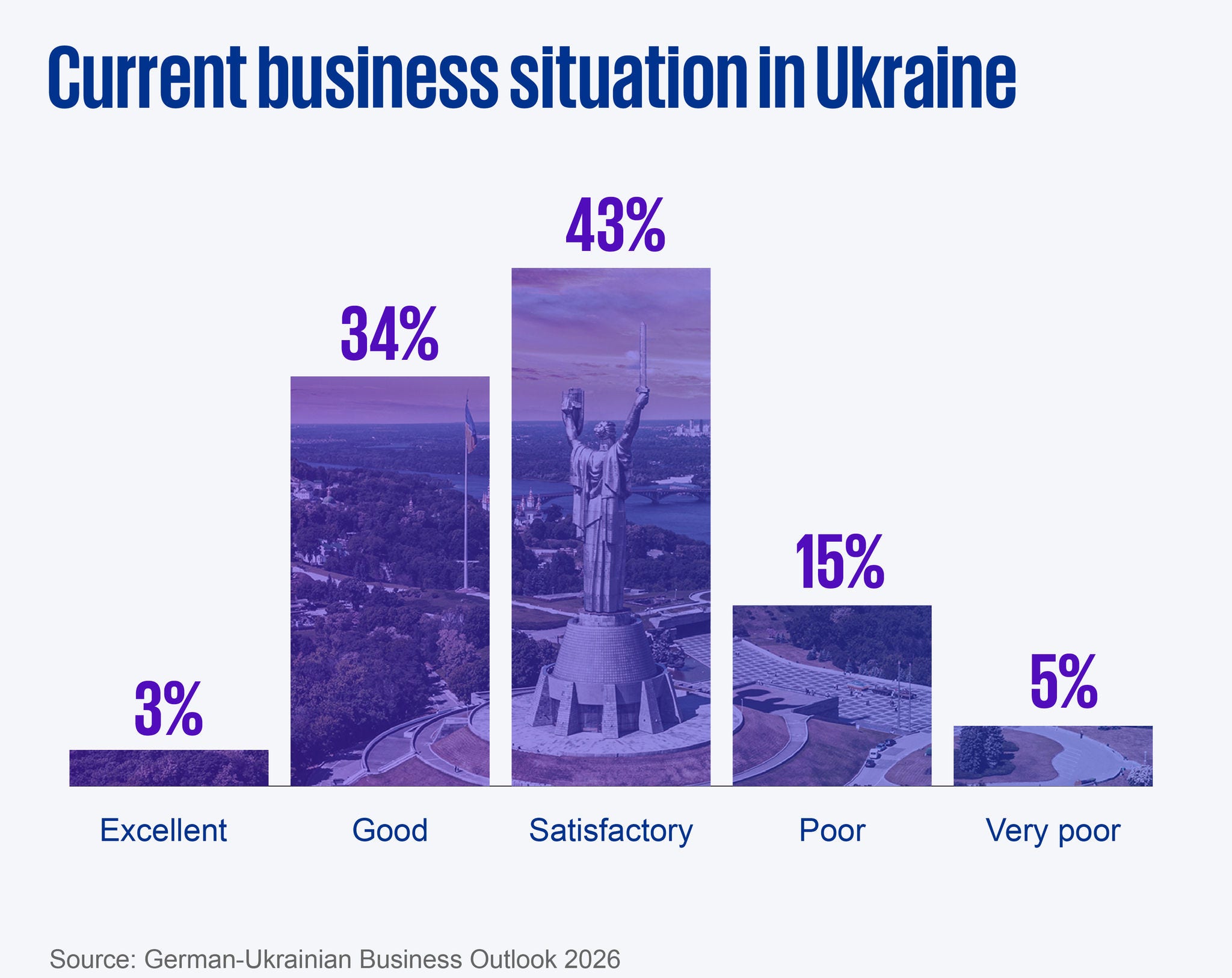
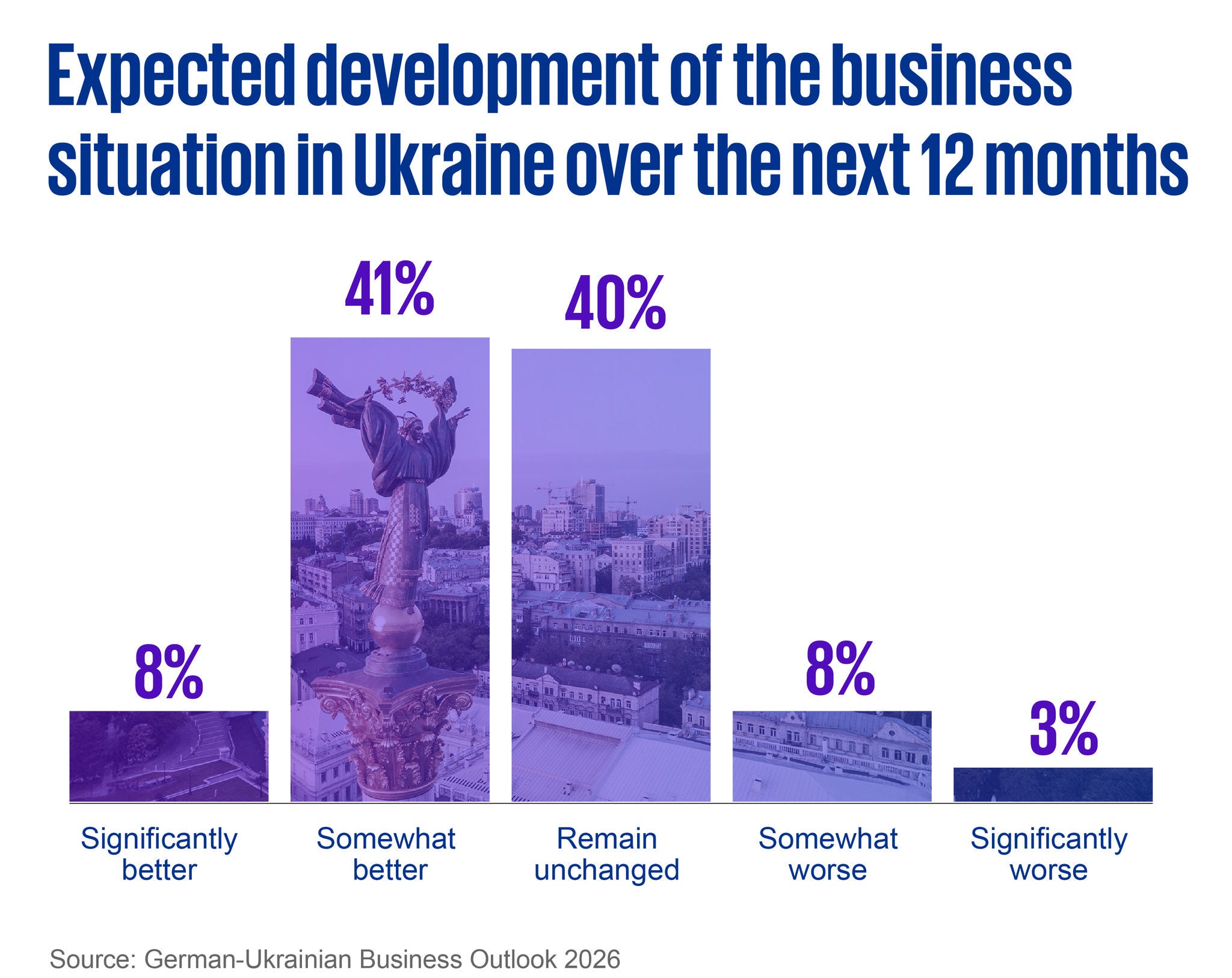
Despite the ongoing war, the survey points to resilient business sentiment among German companies in Ukraine: most respondents report a stable or positive current situation, and around half expect the business environment to improve over the next 12 months.

      The German-Ukrainian Business Outlook was prepared by the German Chamber of Commerce and Industry in Ukraine in cooperation with KPMG in Germany. The survey was conducted between 31 March and 10 May 2026 via an online questionnaire. Its purpose was to establish a realistic picture of German–Ukrainian business activities and business potential. The target group was German companies with business activities in or relations with Ukraine, with 102 valid responses received. 

      Executive Summary

      • Companies remain broadly positive about doing business in Ukraine: 8 out of 10 rate the current situation as satisfactory or better, and around half expect conditions to improve over the next 12 months.

      • Despite the war, expansion remains on the agenda: 38% of companies plan to expand or enter the Ukrainian market, supported by Ukraine’s market potential (54%), skilled workforce (50%) and competitive labour costs (36%).

      • Nearly half (47%) plan to increase employee numbers, despite difficulties in finding skilled labour.

      • Looking ahead, two-thirds (63%) of companies intend to increase investment after the war, including almost one in four (23%) significantly. This points to steady but measured growth rather than a large-scale investment boom.

      • Investment decisions remain challenged by war-related risks (56%), employee safety and security concerns (40%) and energy supply issues (32%).

      • Risk mitigation is a key priority. Companies see war-risk insurance (71%) and government guarantees (60%) as particularly important, while EU and German funding programmes are still underused: only 10% have accessed them so far, though 34% have applied or plan to do so.

      • Companies expect reforms from politics in Ukraine that improve the rule of law (63%), EU-compliant reforms (50%) and strengthening of security and defense (50%).

      The findings indicate that many international companies no longer view Ukraine solely as a post-war opportunity. They are making business decisions today, investing in talent, technology, and local operations despite ongoing challenges. These decisions reflect growing confidence in Ukraine’s long-term economic prospects and its path towards deeper integration with European markets.
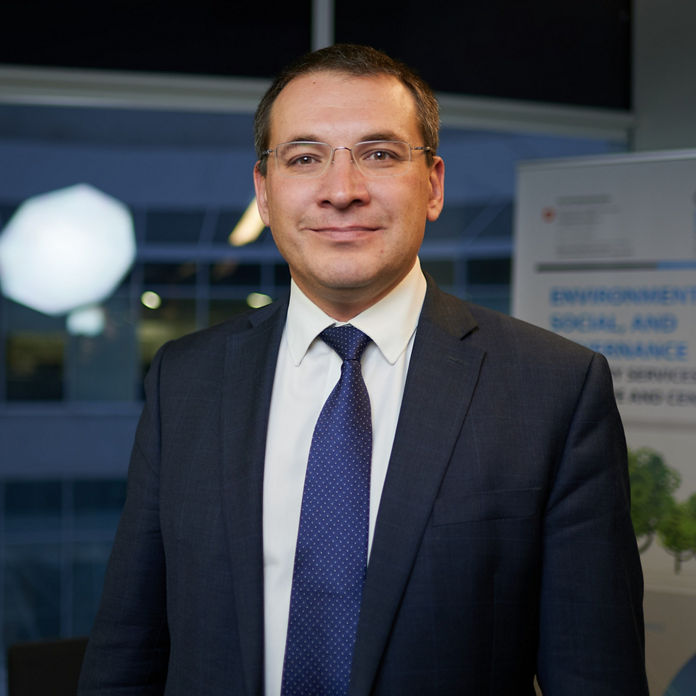
       Andriy Tsymbal
      Andriy Tsymbal

      Managing Partner

      KPMG in Ukraine

      Companies adapt to wartime conditions

      • 8 out of 10 surveyed companies are satisfied and view their current business situation positively, despite the ongoing war.
      • The results indicate that companies have adapted to the current conditions.
      • One in five companies is dissatisfied with its current business situation, as the war has taken its toll on particular sectors. 


      Short-term outlook is optimistic

      • Nearly half of the respondents (49%) expect their business situation to improve over the next 12 months, only one in ten (11%) expects the situation to get worse.
      • In our 2024 survey, 42% of companies expected improved business over the following twelve months, while 10% anticipated a deterioration. Thus, expectations are better than 2 years ago.
      • This shows that companies look optimistically to the coming months and signals a positive sentiment about Ukraine’s future.
      • The overall business environment in Ukraine is, despite challenges, expected to improve. 

      For a more detailed overview of the German business survey results, please read the full report.

      Business in Ukraine: More than one in three German companies are planning to expand. Full report

      Survey: How companies assess the business climate, opportunities and obstacles in Ukraine

      How German business assess Ukraine’s investment attractiveness – and which factors shape those decisions