The Iran conflict: From geopolitical event to valuation risk 
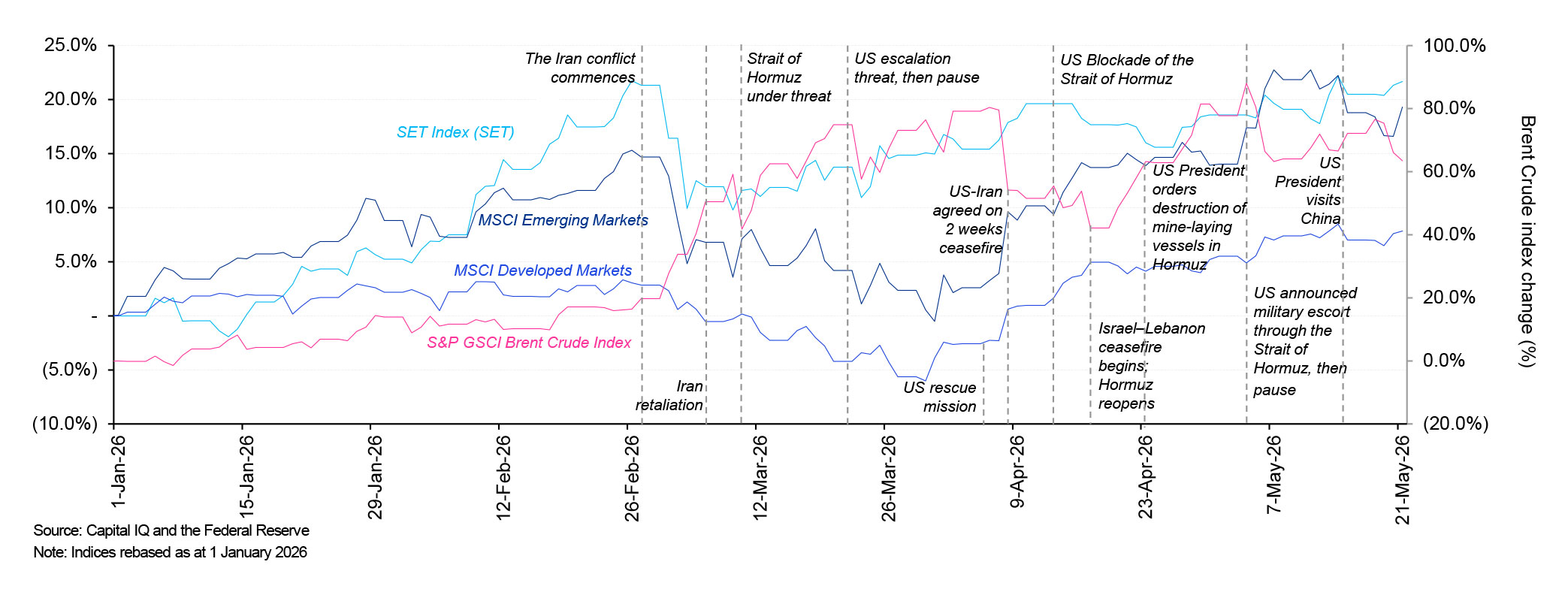
      The Iran conflict has evolved from a geopolitical event into a source of material operational risk, with developments in the Persian Gulf affecting trade routes, energy markets, and business planning assumptions. Ceasefire pauses have created limited political space but have not translated into commercial normalization, with persistent security, insurance, policy and supply-chain frictions  likely to shape short, medium and long-term operating performance, risk premia and valuations.


      Line chart showing Brent Crude index change (%) > Click on the image to enlarge it

      Current status: There is no defined ceasefire or resolution timeline. Commercial shipping through the Persian Gulf and Strait of Hormuz remains restricted. Insurance premia, freight costs and security surcharges remain elevated across affected trade corridors, which in turn put downward pressure on equities across most regions.

      Thai markets weathering the Iranconflict
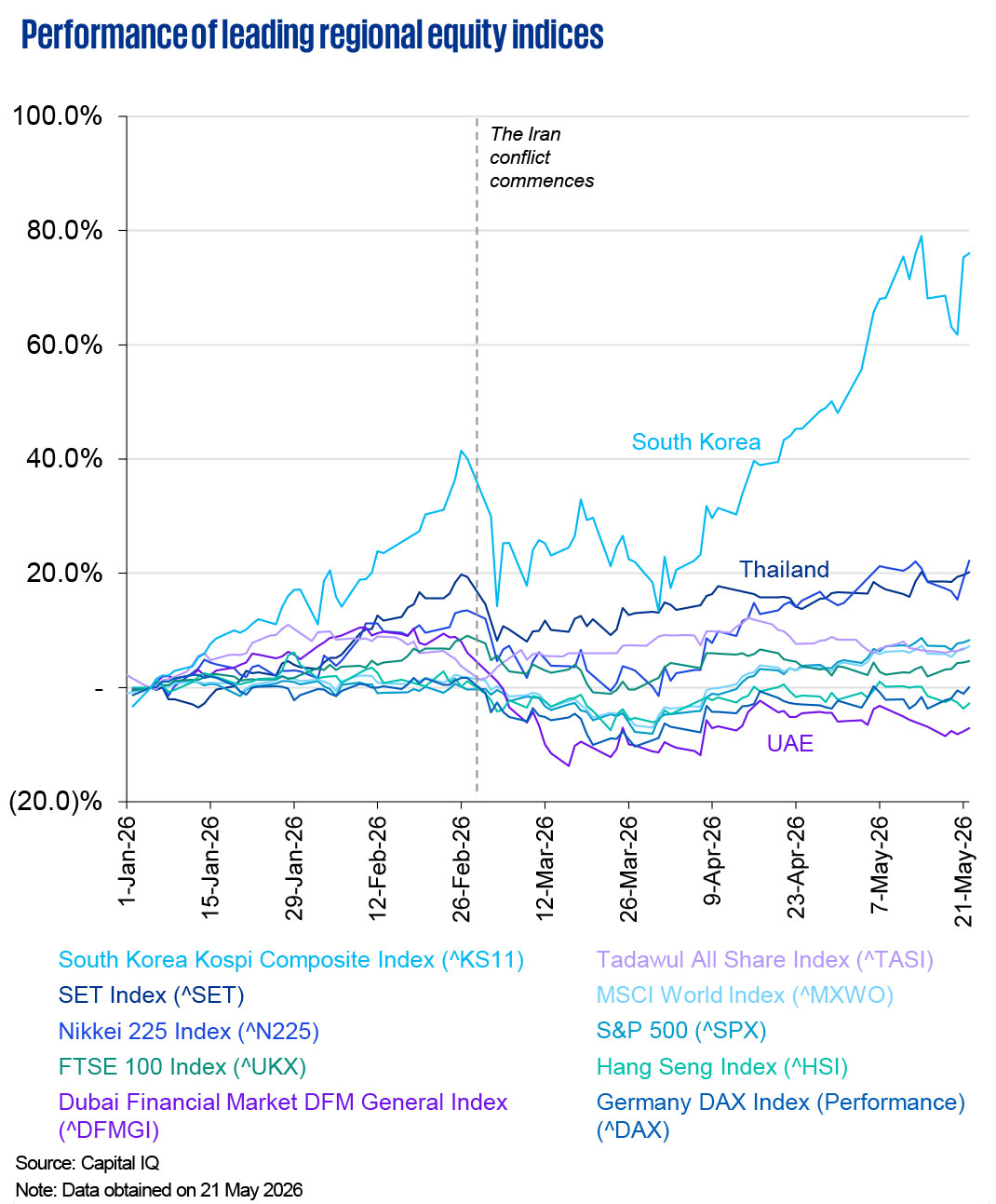
      Line chart showing performance of leading regional equity indices > Click on the image to enlarge it

      SET remained resilient with stable valuations and index performance driven mainly by tech and energy stocks and portfolio inflows.
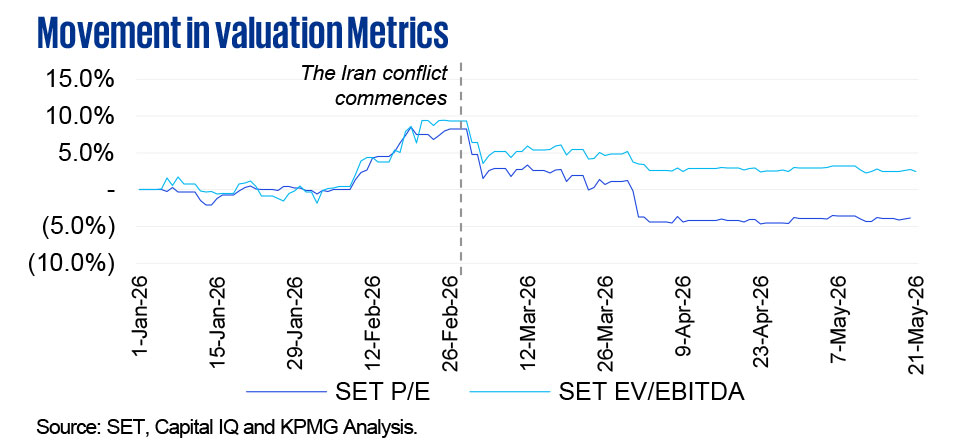
      Line chart showing movement in valuation metrics > Click on the image to enlarge it

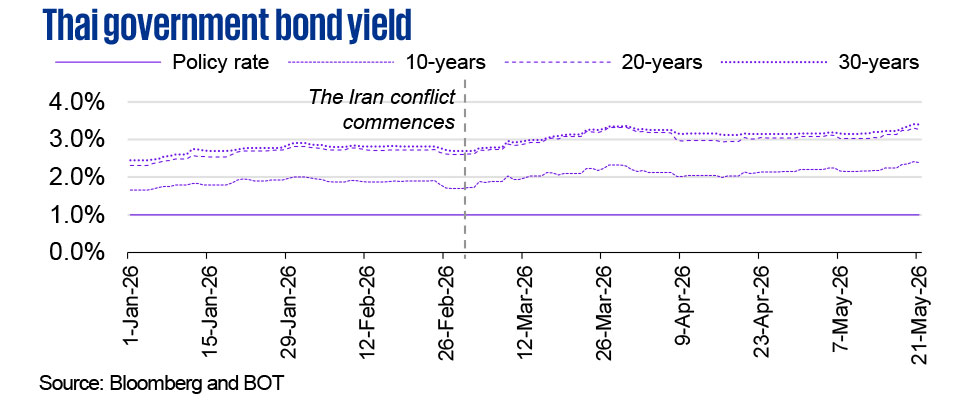
      Line chart showing Thai government bond yield > Click on the image to enlarge it

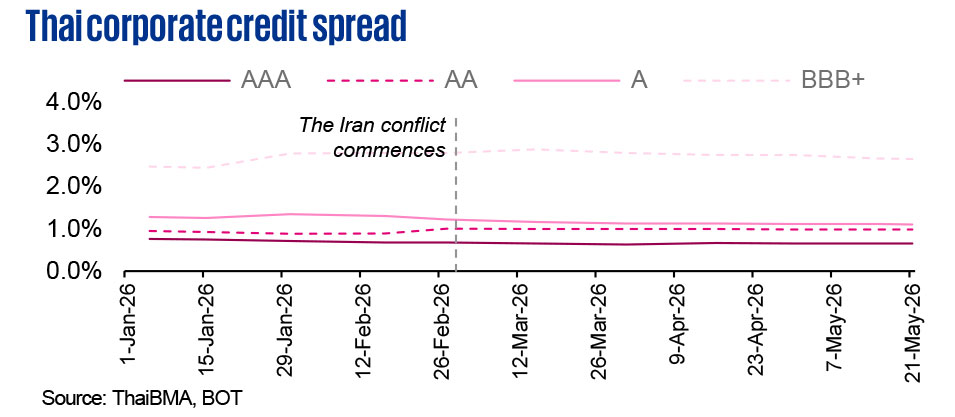
      Line chart showing Thai corporate credit spread > Click on the image to enlarge it

      Since the conflict began, market valuation multiples have contracted while Thai government bond yields have increased. However, credit spreads across investment-grade bonds have remained broadly stable, aside from a modest widening in the BBB+ segment, indicating that the repricing is largely systemic rather than credit-specific.


      Thailand perspective

      travel_explore

      Regional context

      Across Asia, the conflict is reinforcing vulnerabilities linked to heavy reliance on imported energy, global shipping chokepoints and extended supply chains, with higher oil prices, freight disruption and insurance costs continuing even under a ceasefire.

      announcement

      Thailand's exposure

      For Thailand, these dynamics translate into sustained pressure on energy costs, inflation and trade balances. Elevated costs weigh on manufacturing, petrochemicals, transport and tourism, with businesses facing greater earnings uncertainty, volatile cash flows and elevated business and financial risk.

      Valuation considerations

      • Cash flow projections

        Anchor models on forward curves rather than spot prices, with explicit base, upside and downside scenarios

        Elevated oil prices reflect a geopolitical risk premium rather than a new long-term equilibrium price. Valuation models should be anchored on forward curves with explicit base, upside and downside scenarios, incorporating disruption driven volume risk, normalization expectations, delivery delays and working capital volatility. 

      • Discount rate assumptions

        Persistent instability supports higher risk premia and places upward pressure on WACC

        Volatile betas and tightening debt pricing conditions may persist despite near-term earnings growth, particularly for oil and gas businesses. Assets dependent on vulnerable trade routes or situated in impacted regions warrant additional risk assessment where risks are not already probability-weighted in cash flows.

      • Spill-over effects

        Shipping and insurance cost amplification may feed through risk-free rates, credit spreads and market multiples, heightening double counting risk within valuation inputs

        Supply-chain disruption and elevated shipping and insurance costs can amplify inflationary pressures, affecting risk-free rates, credit spreads and market multiples. Inventory revaluation and cash conversion volatility further heighten liquidity and valuation sensitivity across exposed sectors, which may also feed into market inputs.

      • Impairment and valuation sensitivity

        Rising discount rates and capex delays heighten impairment risk, while market inputs become headline-driven, both requiring careful consideration

        Higher discount rates, economic slowdown, capex slippage and weakened forward visibility materially elevate impairment risk for goodwill and long-duration assets, accelerating impairment triggers ahead of reporting date. Market multiples risk distortion where driven by near-term price signals rather than through-cycle fundamentals, increasing reliance on Level 3 inputs under TFRS.

      Brent future prices

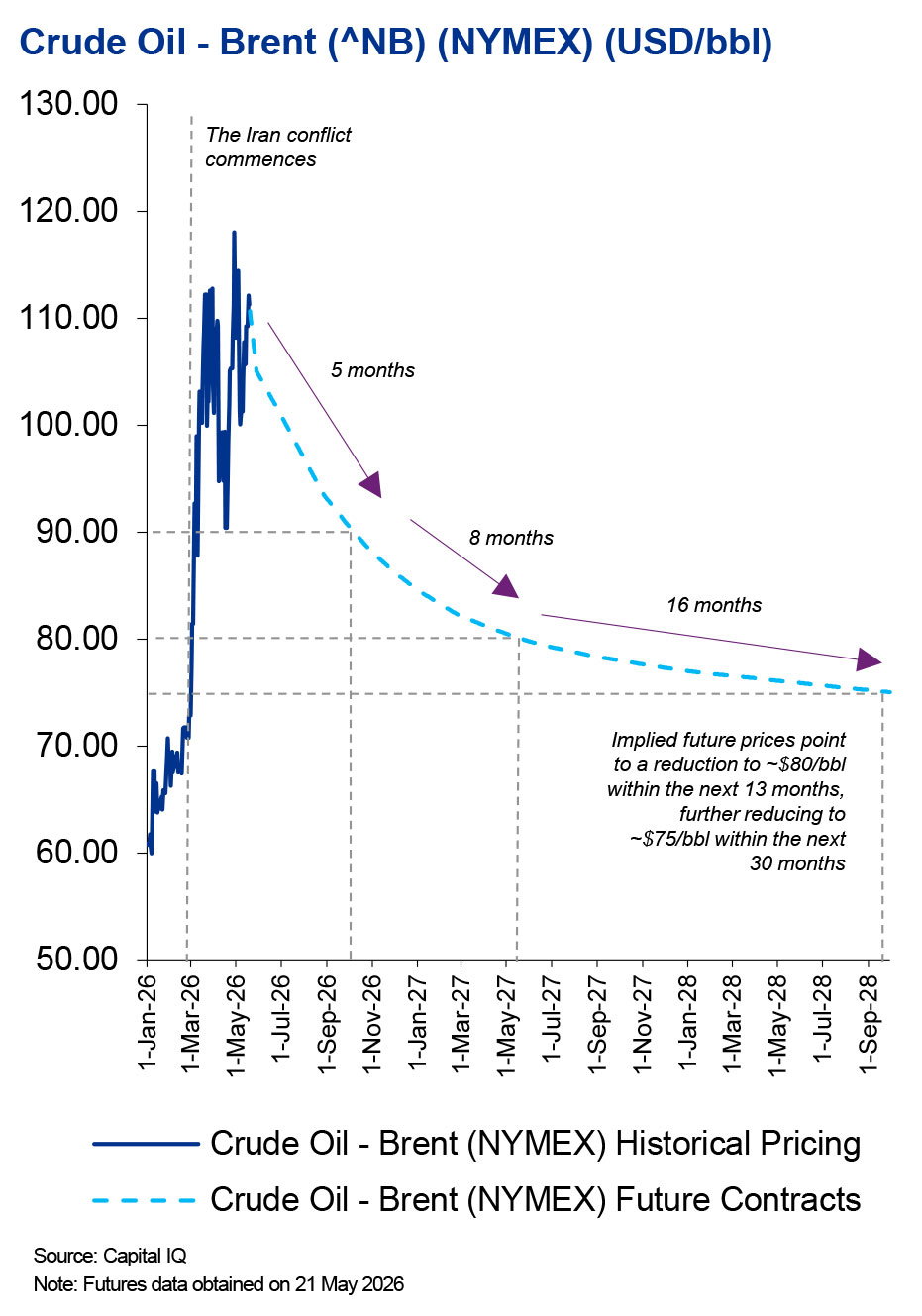
      Line chart showing Brent future prices > Click on the image to enlarge it

      Futures curve indicates an uncertainty‑led upward reset of crude prices by 2028: Futures prices spiked above USD 110/bbl, with an implied reduction to USD 90/bbl within first 5 months, 80/bbl within the next 8 months and USD 75/bbl within 16 months thereafter.

      Recovery assumptions appear directionally aligned to market estimates: Recovery assumptions implicit within future prices appear to reflect market base‑case pricing under a sustained ceasefire. However, any further escalation would delay normalisation, with risk premia unwinding more gradually and extending price and earnings impacts beyond current expectations.

      KPMG Deal Advisory

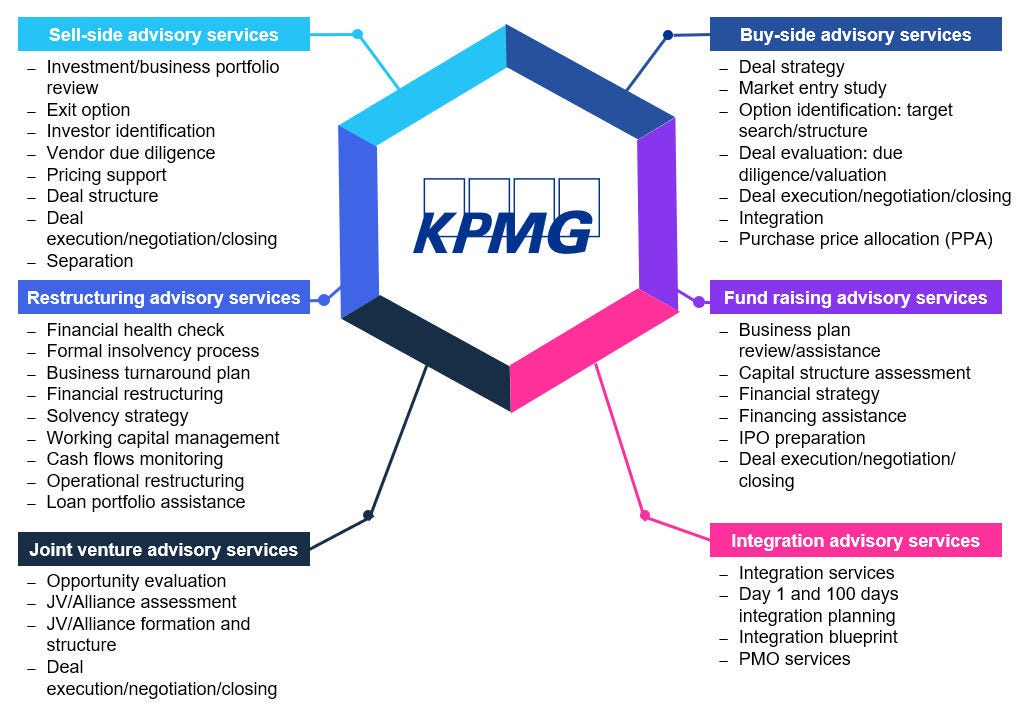
      "KPMG provides a full range of valuation services for all sell-side, buy-side, tax restructuring, fund raising, and joint venture transactions."
      Download the newsletter

      Capital market and business valuation insights - May 2026

      Special edition from Deal Advisory services, KPMG in Thailand


      Key contacts

      Related content

      Insights from from Deal Advisory Services, KPMG in Thailand

      KPMG’s suite of Deal Advisory services provide assistance from strategy through to execution of your business transaction.