

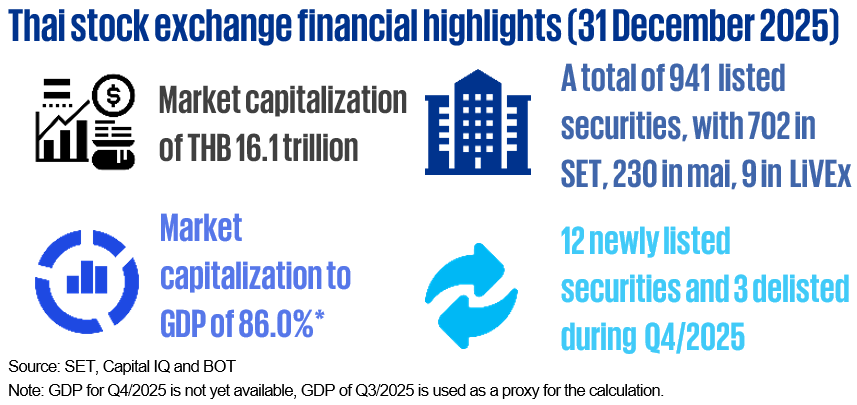
- In Q4 2025, the Thailand Capital Market (SET Index) showed a reversal from the previous quarter reflecting weak economic momentum and reduced trading activity, though some sectors outperformed and dividend yields remained relatively high at 4.0%.
- The SET Index has experienced a recovery in Q1 2026 but has shed gains as energy supply and price uncertainties loom on the economy following the start of war in the Middle East.
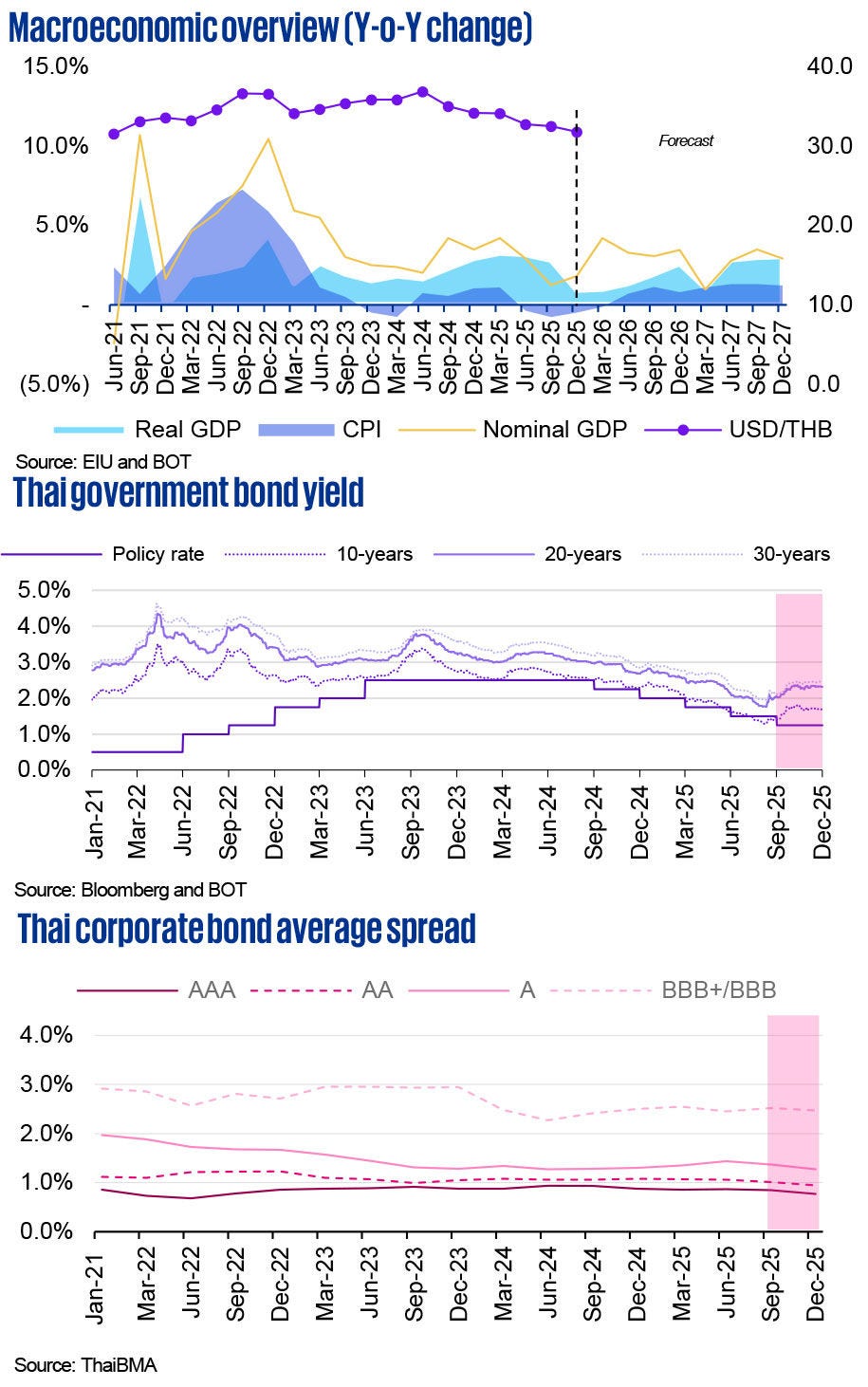
- Thailand’s GDP growth is projected to slow from 2.2% in 2025 to 1.6% in 2026, before recovering to 2.3% in 2027. The moderation reflects softer private consumption, slower merchandise exports, and reduced fiscal support, with election-related delays in budget disbursement weighing on 2026 growth. Growth is expected to be partially supported by a gradual tourism recovery and increased private investment driven by FDI. The impact of the war will weigh heavily on the economic outlook.
- The Thai baht appreciated from 32.5 in the previous quarter to 31.7 against the US dollar as at 30 December 2025, according to the Bank of Thailand’s (BOT) average selling rates. This strength reflected broader dollar weakness, though volatility persisted around global risk events.
Capital market performance
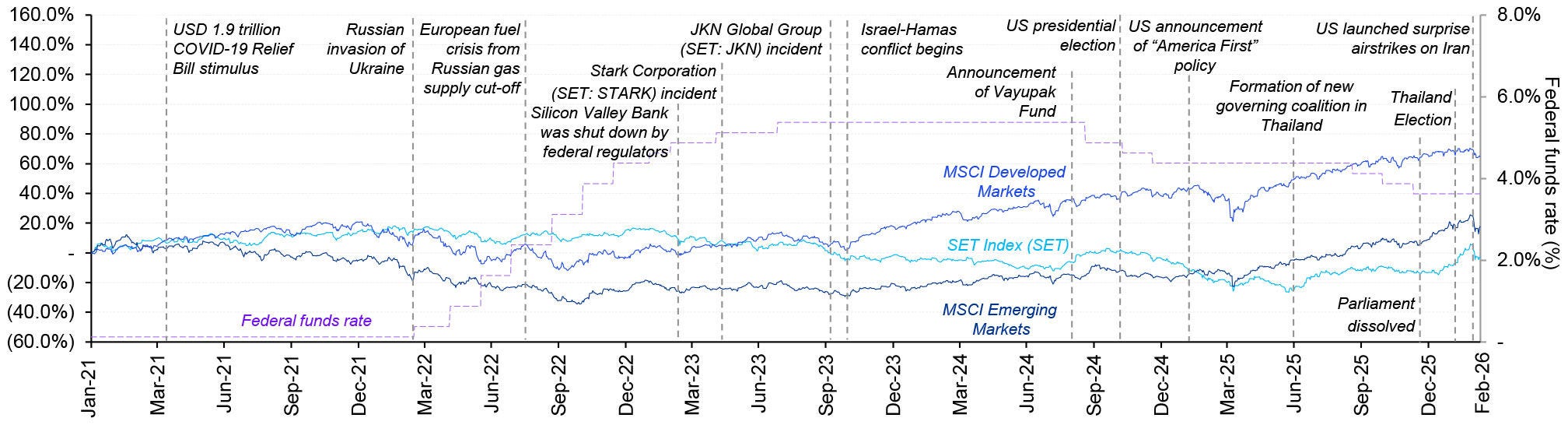
- US federal funds rate: At the December meeting, the Federal Open Market Committee (FOMC) reduced the target range for the federal funds rate by 0.25 percentage points, setting it at 3.50% to 3.75%. The Committee plans to closely monitor incoming data, the evolving economic outlook and the balance of risks in evaluating future adjustments.
- Thai policy interest rate: The MPC cut the policy rate by 0.25 percentage points to 1.00% in February 2026. Thailand’s economy is expected to slow in 2026–27 due to weaker consumption and exports, though tourism is recovering. Inflation remains low, credit conditions are tight for SMEs, and further easing is possible if risks increase.
- Inflation: Headline inflation is projected to remain low at -0.1% in 2025, driven mainly by supply-side factors, rising to 0.3% in 2026 and 1.0% in 2027, before gradually returning to the 1.0–3.0% target range in the first half of 2027. A prolonged conflict in the Middle East will likely accelerate inflation through energy prices.
- Yield and spread: Thailand government bond yields rose in 4Q2025 despite broadly lower US Treasury yields. The relatively stable maturity spreads suggest the upward shift reflected domestic factors such as bond supply dynamics and local risk premium adjustments rather than changes in global rate expectations.
Source: BOT and Federal Reserve
SET valuation metrics by sector (last five quarters)
The SET has eight key sector categories for listed entities. The three most common valuation multiples across five quarters in these sectors illustrate movement due to both economic fundamentals and the impact of global events on market sentiment.
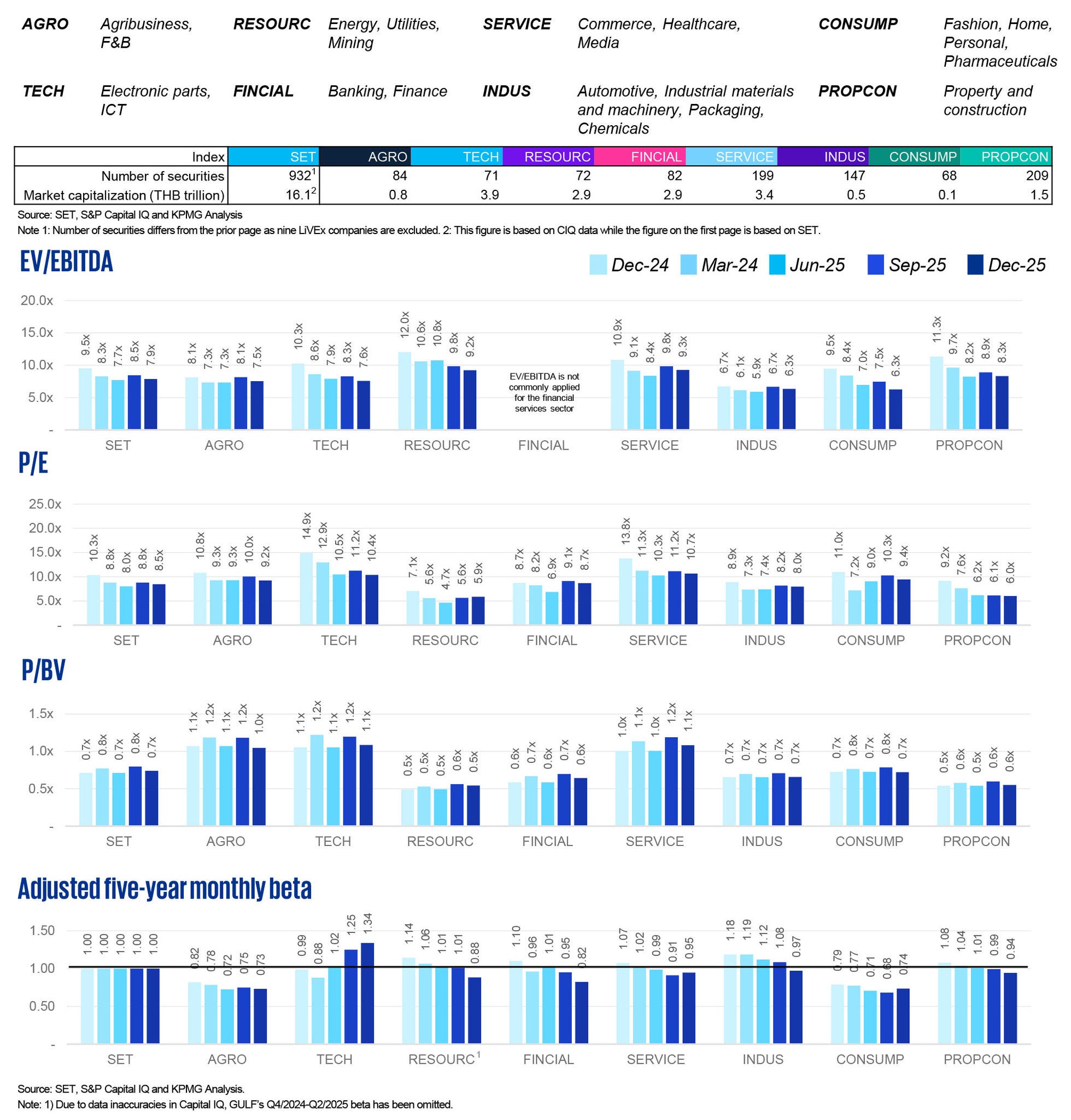
The multiples in Q4/2025 decreased compared with previous quarters across all sectors, reflecting the overall stock market decline and increased market uncertainty.
Sector betas represent relative riskiness to the market portfolio. The stock prices of companies in the TECH sector experienced a significant increase in Q4/2025, driving a higher beta. The betas for the RESOURC and FINCIAL sectors declined while the beta movements for other sectors remained mixed.
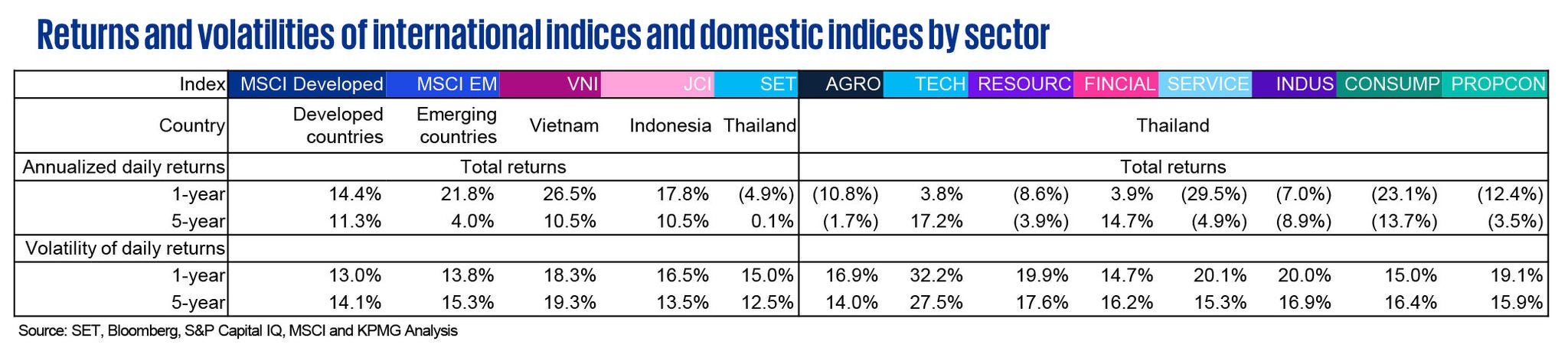
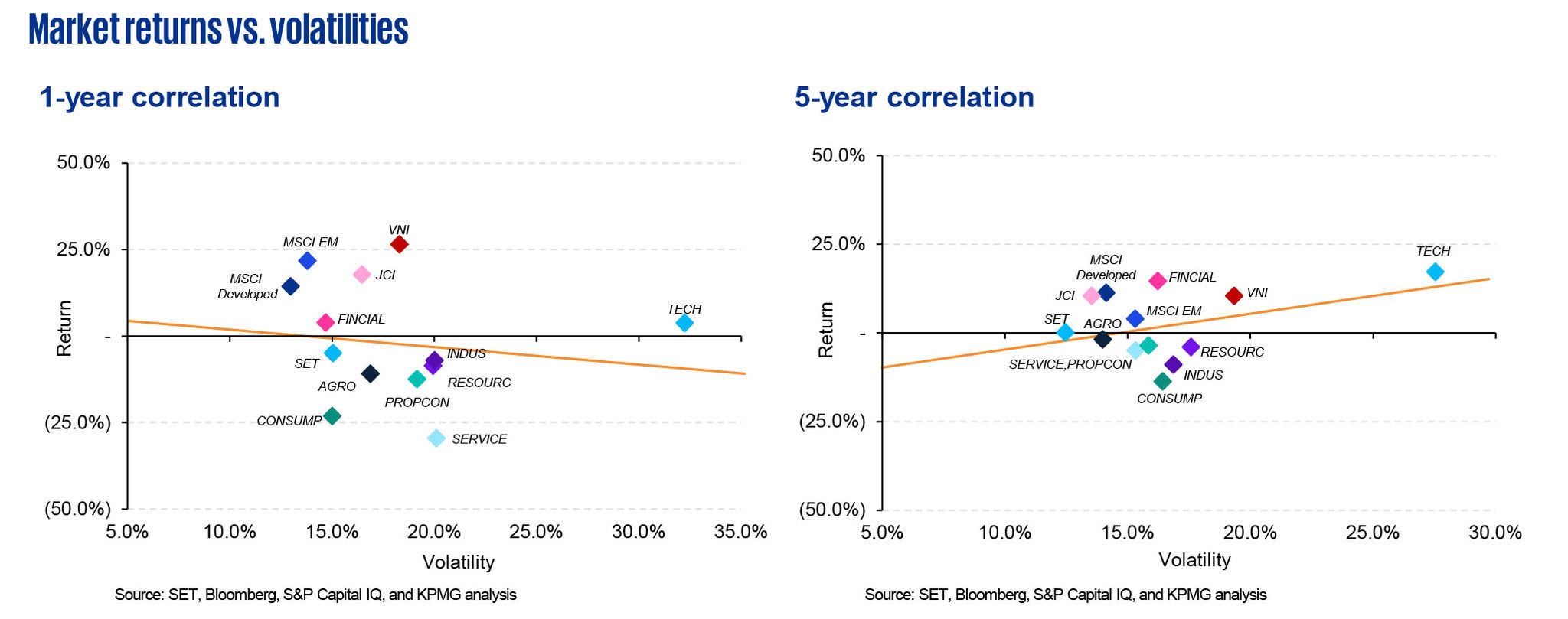
- Over both the one-year and five-year periods, the SET has underperformed relative to other indices. Within Thailand, the TECH sector recorded a sharp decline in its one-year performance compared to previous quarter, although it remains the top performer over the five-year horizon. In contrast, the SERVICE and CONSUMP sectors delivered the weakest returns for the 1-year and 5-year groups, respectively.
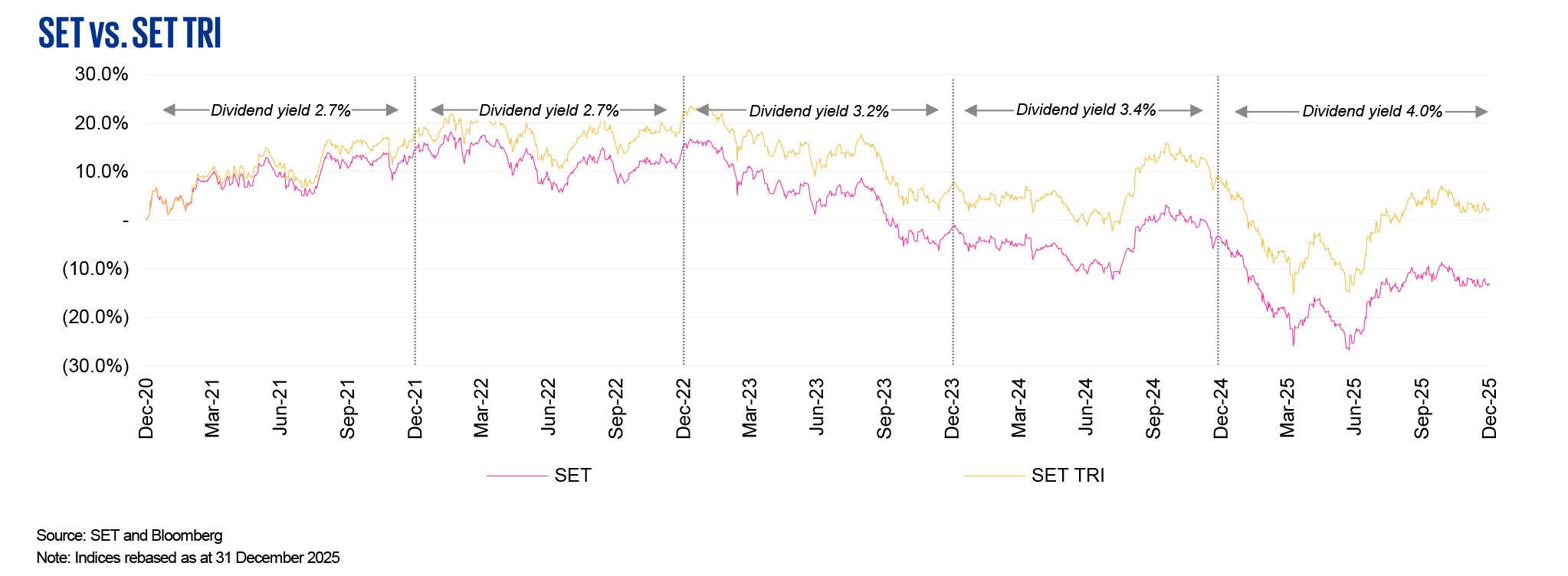
- The Total return index (TRI) is an index that measures the total return from investing in securities. It comprises (1) a return arising from the change in value of the securities or “capital gain/loss”, and (2) dividends paid, assuming they are reinvested in the securities.
- Dividend yields for 2025 continue to remain high largely due to depressed prices.
Data criteria
Thailand valuation multiples by sector
- The SET sector classification serves as the principal criterion for the illustrated sectors.
- The sector valuation multiples are based on the respective median.
- 12-month trailing multiples are derived from Q4/2024 to Q4/2025.
- The Q4/2025 multiple is based on the latest available financial statement information as at Q3/2025.
- The sectors’ betas are based on market capitalization-weighted adjusted betas, excluding securities with negative beta values.
- Data in historical periods may change according to Capital IQ’s retrospective adjustments.
Regression on returns and volatilities
- The total number of trading days per year is assumed to be 252 days.
- The period in the study is 1 January 2021 to 31 December 2025.
SET and SET TRI
- Annual dividend yields are based on dividend yields from Bloomberg.
KPMG Deal Advisory
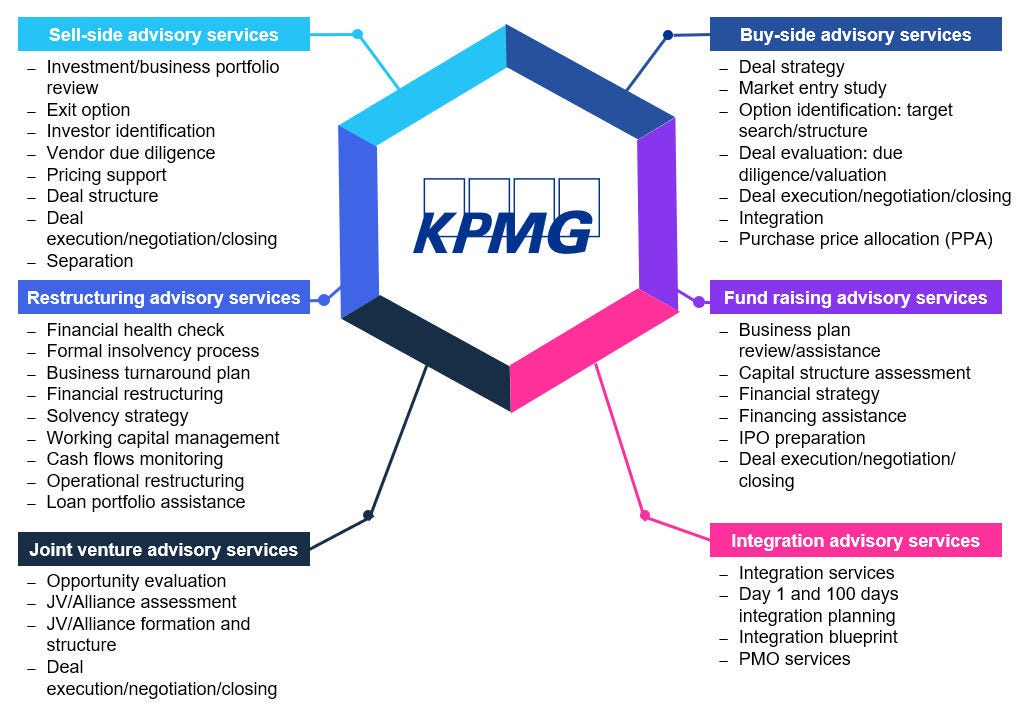
"KPMG provides a full range of valuation services for all sell-side, buy-side, tax restructuring, fund raising, and joint venture transactions."
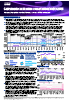
Capital market and business valuation insights | Q4/2025
The quarterly update from Deal Advisory services, KPMG in Thailand
Key contacts


- Ian Thornhill
- Canopus Safdar
- Surayos Chuepanich
- Boonyaporn Donnapee
- Theraphol Saikaew
- Dominic Kobel
- Nalinnit Satsri
- Worachit Sirikajornkij
- Ming Ern Chew

