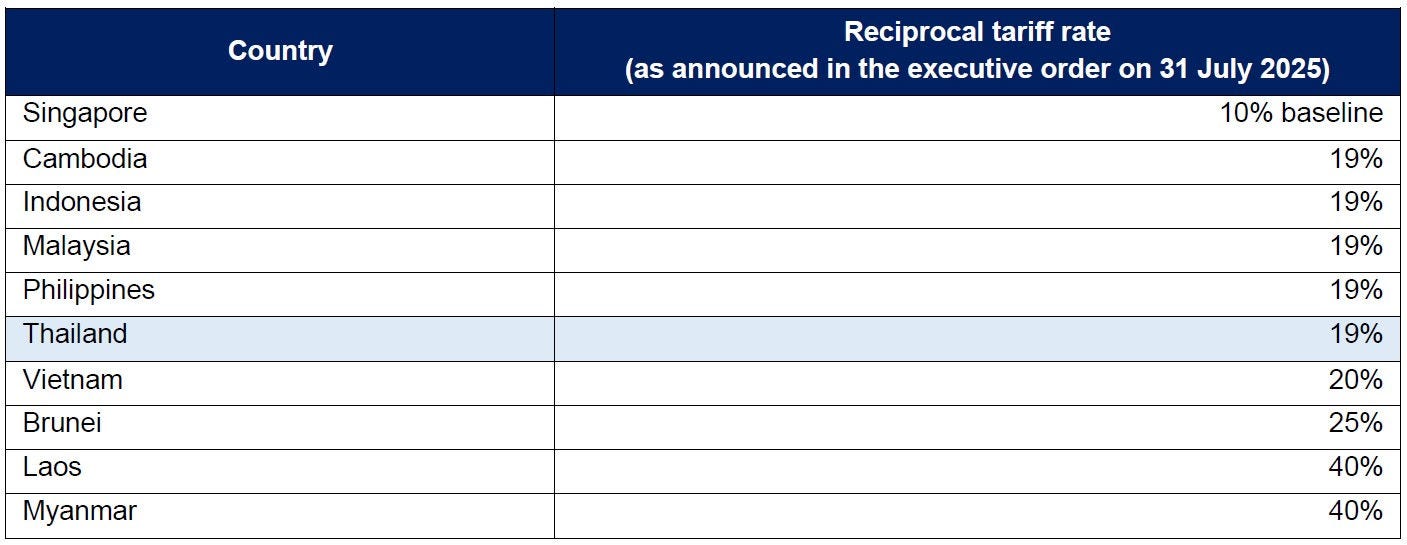
As for Thailand, the key commitments proposed by the Thai government, based on the latest news, are as follows:
- Tariff exemptions for US goods: Approximately 90% of tariff lines (~10,000 items) will be exempted from import duties. These include goods that are not produced domestically or for which supply is insufficient, such as medical instruments, advanced automotive components and specialized food products.
- Reduction of non-tariff barriers (NTBs): Thailand will relax certain sanitary and phytosanitary (SPS) measures, customs procedures and product certification requirements for US imports. A post-clearance audit system will be introduced to allow goods to be released prior to inspection, with the objective of expediting customs clearance.
- Opening of the Eastern Economic Corridor (EEC) and infrastructure projects: Thailand will grant fast-track services and Board of Investment (BOI) incentives to US companies investing in the clean energy, semiconductor/ICT and logistics sectors.
- Procurement of US energy and aircraft: The Thai public and private sectors will jointly increase procurement of liquefied natural gas (LNG) and US-made aircraft (i.e. Boeing).
- Commitment to reduce the trade surplus: Thailand has pledged to reduce its trade surplus with the United States by 70% within three to five years.
- Stricter origin verification rules: Thailand will adopt stricter origin verification rules to prevent transshipment or circumvention of origin requirements.
- Temporary relief from digital services tax: Thailand will offer US tech companies, such as AWS and Google Cloud, a temporary reduction of the digital/cloud service tax.
- Expanded agricultural quotas: Thailand will increase import quotas for US corn, barley and soybeans.
- Tariff retention on strategic sectors: Import duties will be maintained on essential commodities such as rice, sugar, processed fruits and other goods from Thailand’s competitive agri-food sector, in order to protect domestic producers and farmers.
- Commitment to regional stability: As part of broader diplomatic assurances, Thailand has reaffirmed its adherence to the Thai-Cambodian ceasefire, supporting regional peace and economic stability.
KPMG in Thailand has extensive experience in helping Thai and foreign MNEs navigate major changes in the tariff landscape and reduce the impacts on their supply chains. If you have any questions or would like to discuss how the tariffs volatility may affect your business, please feel free to contact us.
Kindly note that this Tax News Flash is based on publicly available information as of 1 August 2025 (GMT+7). We recommend monitoring official channels for updates or changes. For consistency purposes, all dates mentioned above are in EST unless otherwise specified.