Skip to navigation

      Organizations operate in an environment of continuous, multidimensional disruption. Geopolitical shifts, cyber threats and AI-driven change are reshaping how value chains and operations function, while regulatory expectations continue to increase.

      Critical systems can fail without warning, suppliers may become unavailable, and cyber incidents can spread rapidly across interconnected environments, often when organizations are most dependent on them.

      Despite this, expectations remain unchanged: organizations must continue operating, serve customers and maintain financial stability under pressure.

      Enterprise resilience is the ability to deliver critical services during disruption while strengthening organizational resilience and long-term sustainability. It takes an end-to-end view across technology, data, third-party relationships, operations and people.

      At KPMG, we help organizations build resilience in a structured and practical way, reducing operational disruption and strengthening response capabilities under stress.

      Operational disruption quickly translates into financial impact through revenue loss, cost escalation, liquidity pressure and regulatory exposure. Leading organizations therefore treat business resilience as an integrated enterprise risk management capability across operations, finance and governance.

      Matthias Bossardt

      Partner, Head of Cyber & Digital Risk Consulting

      KPMG Switzerland

      René Koets

      Partner, Head of Management Consulting

      KPMG Switzerland

      Why resilience matters now

      Regulation is fundamentally reshaping how organizations approach resilience.

      Requirements such as the Digital Operational Resilience Act (DORA) and the Network and Information Security Directive (NIS2) are pushing organizations to move beyond isolated IT or risk measures toward a more integrated, end‑to‑end approach to cyber risk management and cybersecurity resilience..

      In Switzerland, FINMA Circular 2023/1 reinforces this shift by raising the bar on expectations around:

      • identifying critical services and functions
      • defining impact tolerances
      • understanding operational dependencies
      • ensuring continuity during severe yet plausible disruption scenarios

      The message from regulators is clear: organizations must strengthen resilience capabilities to ensure compliance.

      In practice, organizations need to:

      • strengthen business continuity planning and disaster recovery capabilities
      • establish effective cyber incident response, cyber recovery and crisis management processes
      • proactively conduct third-party risk management (TPRM) programs and outsourcing risk management 
      • test resilience regularly under realistic disruption scenarios
      • improve visibility across systems, suppliers and operational dependencies
      • integrate operational resilience with financial and regulatory risk management

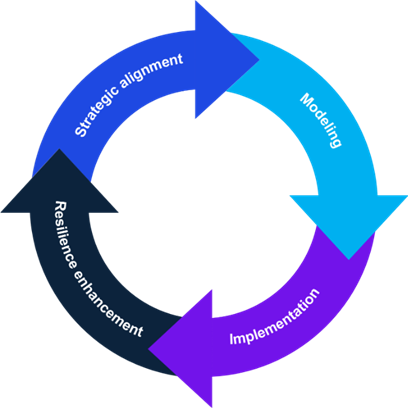
      4 key processes in enterprise resilience

      These processes provide a structured resilience approach, enabling organizations to move from reactive crisis management to a controlled, coordinated response.

          1. Strategic alignment
          Define clear strategic objectives and targeted enterprise outcomes, supported by the key drivers and methods required to measure progress effectively.

          2. Modeling
          Leverage data to define key performance metrics and apply quantitative methods for predictive analysis and simulations.

          3. Implementation
          Execute defined objectives and ensure alignment with the key metrics established during modeling.

          4. Resilience enhancement
          Identify strategic options to strengthen resilience and determine the optimal approach based on ROI and confidence levels.


              Operational resilience vs. business continuity management

              Operational resilience is often confused with business continuity management (BCM), but the focus is different.

              BCM focuses on recovery after a disruption. The goal is to restore operations within a defined timeframe, supported by disaster recovery planning.

              Operational resilience, by contrast, focuses on keeping critical services during disruption

              It combines:

              • BCM
              • IT resilience
              • Cyber resilience
              • Third-party risk management (TPRM)
              • Crisis management
              • Operational risk management

              In simple terms:

              • BCM asks: How do we recover?
              • Operational resilience asks: How do we continue operating during disruption?

              This shift changes how organizations manage risk, prioritize investments and make decisions.

              Why resilience must include financial stability

              Operational disruption quickly creates financial repercussions. Revenue loss, cost escalation, liquidity pressure, regulatory exposure and reputational damage can emerge within hours of a major incident.

              This is why resilience must extend beyond operational continuity alone and support effective risk management strategies to mitigate risks.

              Leading organizations connect:

              • operational resilience
              • financial resilience
              • governance
              • crisis management
              • strategic decision-making

              into a single, integrated enterprise capability.

              How KPMG can help

              Building enterprise resilience requires an integrated approach that connects operational continuity, financial stability, governance and transformation capabilities.

              KPMG helps organizations identify vulnerabilities through risk assessments, strengthen critical operations and improve decision-making under pressure.
               

              • Identify critical services and resilience gaps

                We support organizations in identifying critical business services, conducting due diligence on key dependencies and defining resilience objectives aligned with regulatory requirements such as DORA, NIS2 and FINMA.

                We also provide independent assurance over resilience frameworks and controls.


              • Strengthen continuity and crisis response

                We help organizations strengthen their ability to respond to operational disruption, cyber incidents and crises while maintaining continuity of critical services.

                We support leadership teams in improving decision-making and governance during disruption.


              FAQs

              Operational resilience is the ability to continue delivering critical products and services during disruption.

              It is a core component of enterprise resilience, focusing on maintaining continuity under stress while minimizing operational and financial impact.

              Financial resilience is the ability to absorb financial shocks through strong liquidity, diversified revenue streams, effective capital management and sound risk governance.

              Business continuity management focuses on recovery after disruption.

              Operational resilience, by contrast, focuses on maintaining critical services throughout disruption and takes a broader, enterprise-wide approach.

              DORA requires organizations to strengthen ICT risk management, ensure the continuity of critical services, manage third-party risks and conduct resilience testing under realistic scenarios.

              Impact tolerance defines the maximum level of disruption an organization can absorb before causing unacceptable harm to customers or the business.

              It helps prioritize resilience efforts and set clear thresholds for critical services.

              These are realistic disruption events, such as cyberattacks, system failures or supplier disruptions.

              Organizations use them to test whether their resilience capabilities perform effectively under real conditions.

              Building operational resilience requires identifying critical services, understanding dependencies, strengthening risk and crisis management capabilities, and testing these regularly.

              The goal is to remain in control and limit impact during disruption.

              Responsibility typically sits with executive management and the board, supported by risk, technology and operational functions.

              Clear governance and well-defined roles are critical for an effective response under pressure.

              A core platform such as an ERP, customer platform or production system becomes unavailable, causing operations to stop or become severely constrained.

              Key questions

              • What happens if a critical system fails tomorrow?

              • Which services would be affected first?

              • How long can we continue operating under degraded conditions?

              Where organizations struggle

              • Limited visibility into critical services

              • Misalignment between business priorities and IT recovery 

              • Over-reliance on single systems

              What resilient organizations do differently

              • Clearly prioritize critical services 

              • Align technology recovery with business impact

              • Establish structured incident response and escalation processes

              A supply chain disruption interrupts delivery, production or operational continuity.

              Key questions

              • How dependent are we on individual suppliers?

              • How quickly can we adapt or switch providers?

              • Which risks exist beyond Tier 1 suppliers?

              Where organizations struggle

              • Limited visibility across supply chain dependencies

              • Excessive focus on cost optimization over resilience

              • Weak ongoing monitoring of supplier concentration risks

              What resilient organizations do differently

              • Map critical supplier dependencies end-to-end 

              • Identify single points of failure early 

              • Integrate resilience into sourcing and procurement decisions

              A third-party provider underperforms or becomes unavailable, affecting critical operations.

              Key questions

              • Who is accountable when something goes wrong?

              • Do we have operational control or only contractual coverage?

              • What happens if the provider fails completely?

              Where organizations struggle

              • Weak third-party, outsourcing and vendor risk management

              • Limited operational visibility into vendors 

              • Missing fallback or exit strategies

              What resilient organizations do differently

              • Define clear ownership and accountability

              • Continuously monitor critical providers

              • Maintain tested fallback and exit options

              A major incident occurs, but response is slow, unclear or inconsistent.

              Key questions

              • Are decision-makers prepared to act under pressure? 

              • Are escalation paths clearly defined? 

              • Can leadership make decisions quickly with incomplete information?

              Where organizations struggle

              • Crisis plans exist only on paper 

              • Decision rights are unclear 

              • Teams lack realistic simulation training

              What resilient organizations do differently

              • Establish clear crisis governance structures 

              • Conduct regular simulation exercises 

              • Align leadership teams before disruption occurs


              Meet our experts

              Matthias Bossardt

              Partner, Head of Cyber & Digital Risk Consulting

              KPMG Switzerland

              René Koets

              Partner, Head of Management Consulting

              KPMG Switzerland

              Thomas Oschlisniok

              Partner, Head of Business Services Transformation

              KPMG Switzerland

              Mischa Sollberger

              Partner, Global Transfer Pricing Services, Value Chain Management

              KPMG Switzerland

              Related articles and more information

              AI assurance helps organizations build trusted and resilient AI across systems, data and business‑critical decision‑making processes.