error
Subscriptions are not available for this site while you are logged into your current account.
close
Skip to main content

Loading

The page is loading.

Please wait...


      Artificial intelligence is changing content creation at a pace none of us have seen before. AI now helps write, design, edit, and produce content in seconds – and it’s only getting faster.

      With so much now being generated automatically, it’s likely that most online content in the next few years won’t come directly from a human at all.

      So, the real question for the media industry isn’t whether AI becomes central to production. It’s this: In a world where content is infinite, what will people still value enough to pay a premium for?

      Increasingly, the answer points toward something simple but powerful: human‑curated work. Not because a person touched every frame or wrote every paragraph, but because audiences instinctively recognise authenticity, intention and accountability — qualities that remain deeply, and perhaps uniquely, human.


      Pukar Mehta

      Partner & Head of Media Strategy

      KPMG in the UK


      Pavitra Patel
      Pavitra Patel

      Manager, TMT Strategy

      KPMG in the UK


      Audiences have always valued two things at once: cheap, fast, minimally viable content for convenience, and rare, handcrafted work at a premium for mastery, specificity, and scarcity.

      Cody Updegrave,

      The Ambiguous Company


      From everywhere to rare: Why human content is becoming scarce

      Until recently, content required time, teams and budgets. Today, anyone with the right tools can create high-quality content in minutes – collapsing time, cost and barriers to entry.

      But here’s the twist: As output accelerates, audiences are beginning to feel the difference between ‘content’ and ‘something made with care’.

      People know when they’re consuming something that’s been auto generated. It might be convenient, but it rarely feels personal or emotionally grounded. And because AI is speeding up production and reducing the cost, time and human input required, truly human curated content becomes rarer – and potentially more valuable.

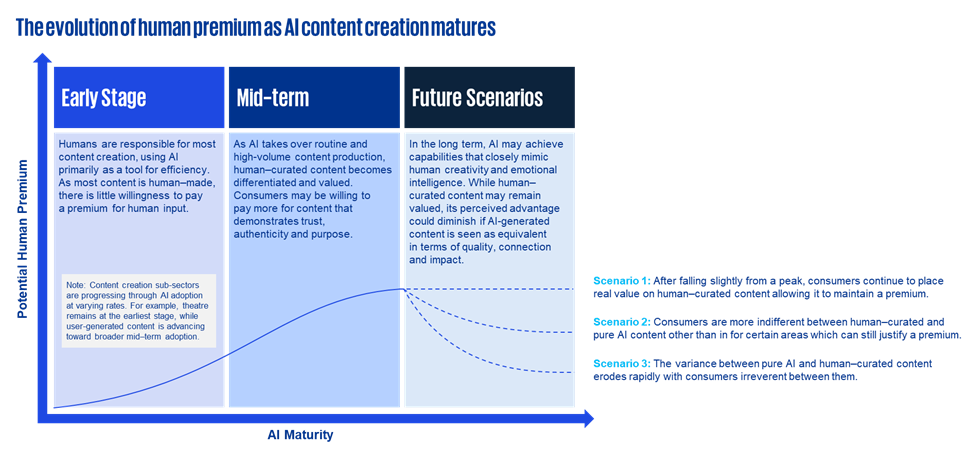
      This reveals a ‘human premium’: a willingness from audiences to pay for content, indirectly through advertising or directly, that carries the fingerprints of human creativity, judgement, and perspective.

      For media companies, this shifts the challenge from adoption to differentiation: deciding where human judgement creates long-term competitive advantage.


      What makes human content worth paying for

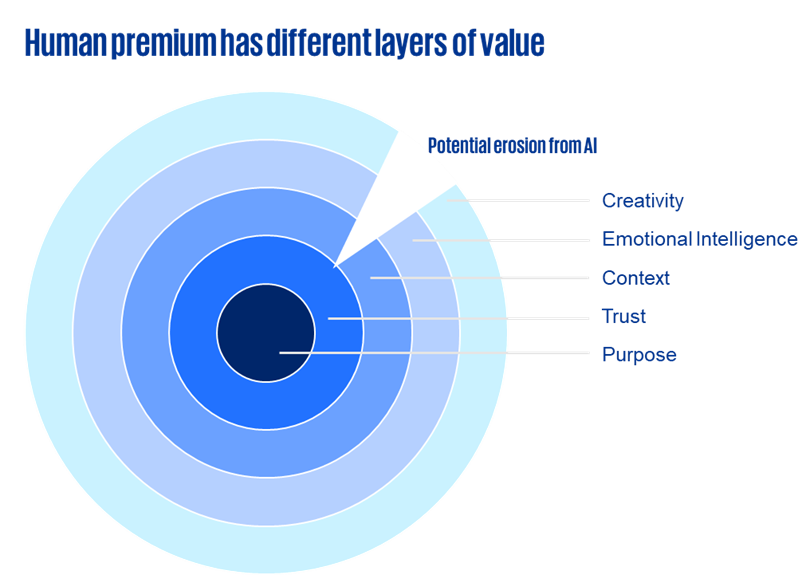
      These five layers of value make human‑curated content stand out.


      1. Creativity

      AI can remix what already exists. Humans imagine what doesn’t.

      Human creativity brings surprise, personality, and originality. It’s the ability to combine ideas in unexpected ways, draw from lived experience, or express a point of view that no model can replicate. Even if AI can mimic styles, it doesn’t invent intent or meaning.

      I do not see AI replacing the creative process – it will help in terms of costs and speed; and would be good for prototyping ideas. However, AI will copy but not inspire. Ultimately, quality will always triumph in the long term.

      Mike Beale

      ITV Studios

      2. Emotional intelligence

      AI can detect the emotional tone of text or voices, but it doesn’t actually feel anything. Humans write, speak, and create from real experiences and emotions. That’s why certain stories land harder when you know they came from a person.

      People trust creators who have something at stake — reputation, feelings, vulnerability — in a way that AI simply can’t.

      3. Context

      Humans live inside culture. We understand the little things — humour, timing, political nuance, social tension, mood shifts and trends. We interpret meaning within a specific moment. AI can reference culture, but it struggles to truly understand or predict it. It can’t reliably sense what will feel right, wrong, fresh, tired, or inappropriate in a cultural moment.

      Human-curated content can command a premium but not because a human touched every pixel. The premium comes from human accountability and cultural judgement in a world where AI makes content options infinite and attention is scarce. AI will commoditise execution, but it still struggles with what makes advertising and other forms of content memorable: landing in a shared cultural moment, activating nostalgia and belonging, and taking an accountable creative risk that signals a real point of view.

      Daniel Hulme

      WPP

      4. Trust

      Trust is built on accountability, transparency and judgement, and has become ever more important in a world of misinformation and disinformation. Audiences are more likely to trust something when they know a human is responsible for it, not just a model stitched together from millions of datasets.

      Human‑curated content signals responsibility. It has someone behind it — someone who can stand by the choices, the story, or the message.

      5. Purpose

      AI follows instructions. Humans decide what’s worth making.

      Purpose is the layer that ties creativity and strategy together. Humans understand mission, brand identity, ethical boundaries and the emotional impact content needs to have. It's not just “what” is being created, but why.

      Over time AI may chip away at these layers. It’s already learning to imitate creative styles, mimic emotional tones, and generate content that feels more sophisticated. Some in the industry even imagine a future where content is generated uniquely for each viewer on the fly, consumed once, and never stored.

      But three things remain stubbornly human and very hard for AI to fake convincingly: trust, authenticity and purpose. These are likely to keep human-created or human curated content valuable — especially in a world where AI-generated material becomes the default.


      Three ways the human premium could evolve

      Looking ahead, the premium on human‑curated content could play out in several ways.


      Scenario 1: The premium stabilises

      As synthetic content floods every platform, human craft maintains a sustained advantage. We already see this in categories like live entertainment, investigative journalism, podcasts, personality‑driven formats, and fan-supported creator content. People pay not just for the output, but for the perspective and connection behind it.

      Scenario 2: The premium declines modestly

      AI becomes increasingly sophisticated, but humans still guide meaning, culture, humour, and brand identity. In this world, most content is AI-produced, but the most memorable work — the big campaigns, the culturally defining moments remains human led.

      Scenario 3: The premium erodes but niches thrive

      If audiences fully normalise AI-generated media, human-curated content becomes a specialty category rather than the default. Think of it like ‘organic’, ‘craft’ or ‘handmade’. Smaller, but meaningful.

      In the end, it comes back to us

      AI will make content abundant, personalised and frictionless. But abundance doesn’t create value on its own.

      In the end, the most influential media brands in the future won’t be defined by how automated their content is — but by the unmistakably human perspective guiding it.

      That’s where the future premium will be, and it will be the defining factor in how tomorrow’s media is made.

      What this means for media companies

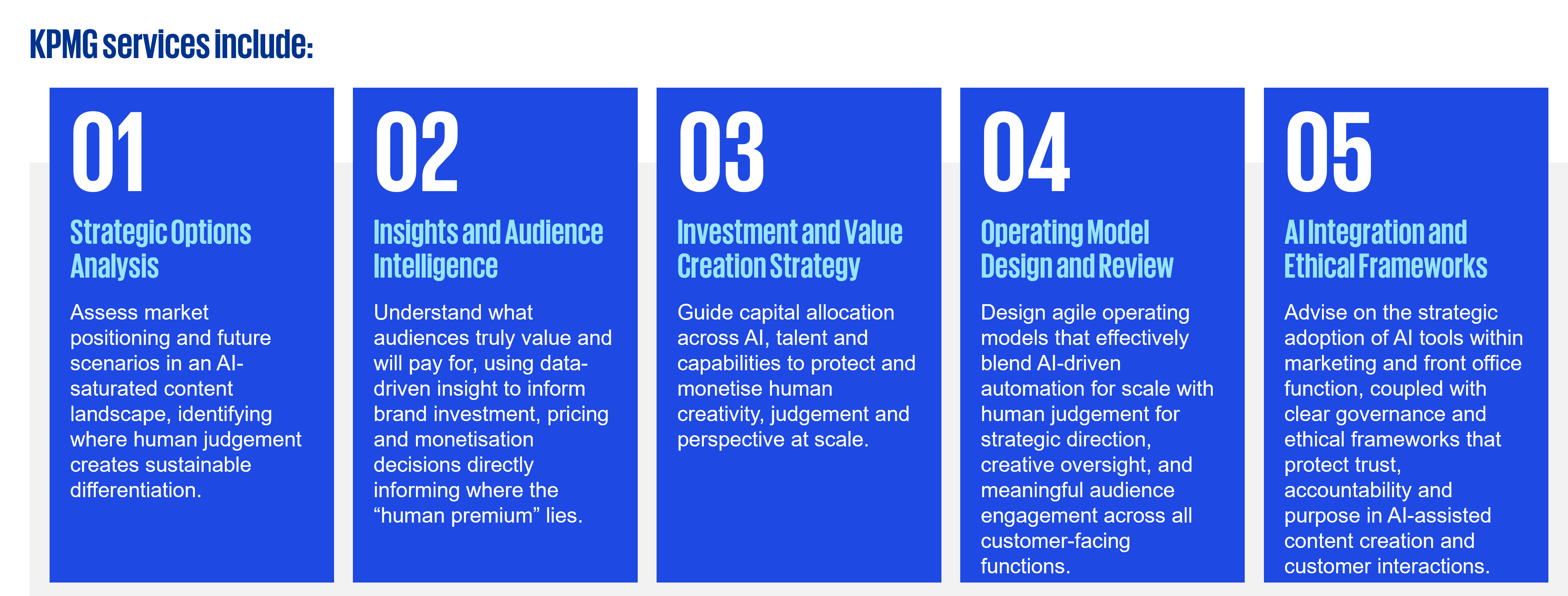
      This is a significant moment for the media sector. Winning won’t come from producing more content — AI gives everyone that capability. The real advantage will come from knowing where to use AI for scale and where to rely on human judgement for meaning.

      The most successful companies will design intentional, hybrid models that blend automation with human editorial judgement.

      Media leaders must consider the strategy and capabilities in their business required for this shift, including:

      • Brand positioning: How will your brand remain human, trusted and emotionally resonant?

      • Strategy and value proposition: Where does human creativity drive value?

      • Operating models: How should teams, workflows and governance adapt to AI‑native production?

      • Investment decisions: Which AI capabilities should you build, buy or partner for?

      • Pricing and monetisation: How should we price and monetise authentic content in an AI-saturated market? Which parts of your portfolio can command a human premium?

      As AI rapidly reshapes content, our focus must be to intrinsically link audience understanding and trust with ethical AI, efficient operations, and effective monetisation. AI is a powerful means to enhance our craft, not an end in itself; its integration must always align with our core values and the distinctive content we aim to create.

      Nat Gross

      EMA Head of KPMG Media Practice

      How we can help

      If you're rethinking your content strategy, exploring new operating models, or deciding how to integrate AI sustainably without losing your human advantage, contact us today to help you shape what’s next.


      The em dashes (—) used in this article are entirely intentional and a small, grammatical sign of the human premium in action.

      Further insights

      KPMG Strategy will work with you to create value, drive productivity, and transform your business, at speed and at scale. Learn more today.

      Explore how AI is transforming content, operations, and audience engagement

      Helping TMT businesses stay ahead, scale fast and shape what’s next

      Our people

      Pukar Mehta

      Partner & Head of Media Strategy

      KPMG in the UK

      Pavitra Patel
      Pavitra Patel

      Manager, TMT Strategy

      KPMG in the UK


      MTD TEST

      Get in touch


      Discover why organisations across the UK trust KPMG to make the difference and how we can help you to do the same.