error
Subscriptions are not available for this site while you are logged into your current account.
close
Skip to main content

Loading

The page is loading.

Please wait...


      KPMG’s latest research reveals that most tax functions are just scratching the surface when it comes to adopting AI.

      Astonishingly, 72% of tax leaders say their teams aren’t using generative AI solutions at all. A further 33% are only doing so at a basic level. And two thirds (67%) admit to only having a basic understanding of the technology.

      AI is reshaping tax, yet clearly there’s a maturity challenge. Few departments have embedded AI solutions to unlock meaningful transformation.

      Stuart Tait

      Tax Technology & Innovation Partner

      KPMG in the UK


      Horizontal vs vertical AI

      In our experience, the tax functions that are pulling ahead have moved beyond ‘horizontal’, enterprise-wide applications like CoPilot and ChatGPT. They’re using dedicated, ‘vertical’ solutions to automate, accelerate and augment defined tax tasks and processes, and reinvent their operations.

      Horizontal AI tools deliver only incremental, individual productivity gains, while leaving the underlying tax operating model unchanged. They don’t integrate with tax data, workflows, controls, or systems of record. And so they can’t improve process throughput, consistency or risk management.

      Over time, that leads to greater operational risk, and less influence on the firm’s wider transformation agenda.

      But in a world where complexity and cost pressures are increasing faster than headcount and budgets, vertical AI tools redesign end-to-end processes, enhancing throughput, quality, and the scalability of the tax function.

      What’s more, they drive a shift from effort-based delivery to system-driven execution. This delivers structurally lower costs, more consistent outcomes, faster processing, and the ability to redeploy tax teams to judgment, advisory, and strategic work.

      The AI maturity curve

      The table below sets out four distinct stages of AI maturity, and what they might typically look like in tax functions (see figure 1). Its sets out a structured progression from no AI usage, through to full integration within the tax function.

      What differentiates the steps isn’t the sophistication of the technology being used It’s the degree of integration into your tax processes and systems; and whether your team can access AI in a secure environment.


      Stage 0

      No AI use in the tax function

      At this stage, AI is not used within the tax function.

      Stage 1

      Personal productivity

      • AI is used at an individual level to speed up everyday work using generalist tools.
      • Typical use cases include summarising meetings and drafting or refining emails.
      Stage 3

      Process productivity

      • AI supports broader tax processes that are still initiated and reviewed by humans.
      • Use cases include extracting data from receipts and classifying employee expenses as deductible or non‑deductible for tax purposes, mapping ERP data into the required format for tax return software, and reviewing accounts payable and accounts receivable data to support correct tax determination.
      Stage 4

      Systems integration

      • AI is fully embedded into tax operations and workflows.
      • Examples include automatically triggering tax analysis when transactions are posted in core systems, running expense, AP and AR tax assessments continuously in the background, and executing end‑to‑end tax processes using agentic solutions.

      Stage 0

      No AI use in the tax function

      At this stage, AI is not used within the tax function.

      Stage 1

      Personal productivity

      • AI is used at an individual level to speed up everyday work using generalist tools.
      • Typical use cases include summarising meetings and drafting or refining emails.

      Stage 3

      Process productivity

      • AI supports broader tax processes that are still initiated and reviewed by humans.
      • Use cases include extracting data from receipts and classifying employee expenses as deductible or non‑deductible for tax purposes, mapping ERP data into the required format for tax return software, and reviewing accounts payable and accounts receivable data to support correct tax determination.

      Stage 4

      Systems integration

      • AI is fully embedded into tax operations and workflows.
      • Examples include automatically triggering tax analysis when transactions are posted in core systems, running expense, AP and AR tax assessments continuously in the background, and executing end‑to‑end tax processes using agentic solutions.

      Most tax departments currently sit in the early stages. At a recent KPMG event for tax leaders, less than one in three (29%) said that they’d reached stage four. That’s more than seven in ten tax departments struggling to move along the maturity curve.

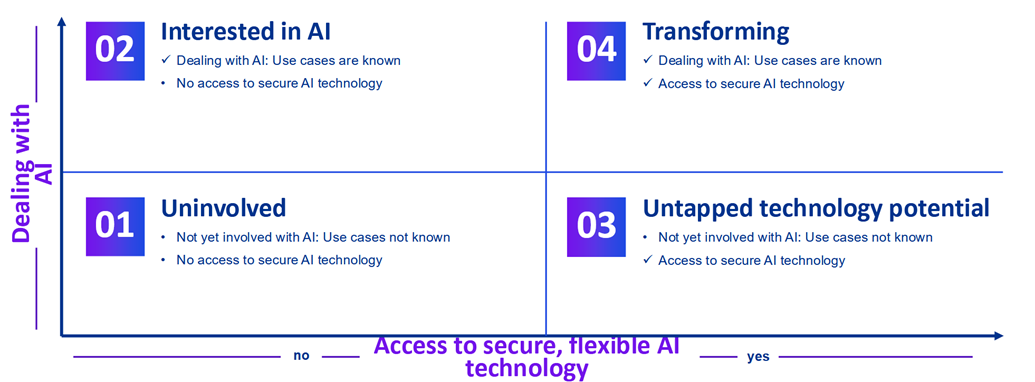
      The model acts as a diagnostic and roadmap, helping you assess where they are today and what capabilities, data and operating model changes are needed to reach the next stage (see figure 2).

      Fig 2. Assessing AI maturity 


      assessing-ai-maturity

      Building AI maturity

      Though the end goal should be vertical AI integration, your first step on the maturity journey – from zero AI use to stage one – will involve a ‘horizontal’ solution, often in line with the whole business.

      That lets your team start experimenting with generalist AI tools, to understand its capabilities and gain confidence.

      Solutions like CoPilot and ChatGPT don’t offer specialist tax capabilities. But this early experimentation is essential. Without it, developing tax use cases further down the line will be a challenge. So create a secure environment, with clear guardrails, where your staff can become familiar with AI.

      Once they’re comfortable with it, you can adopt more tax-specific uses. Start with routine tasks AI tools can carry out faster and more efficiently, and identify the data required.

      From there, your AI sophistication will grow as your team feels confident handing more tax work over to the technology.

      Supporting that progression will involve the various aspects of AI adoption we’ve covered in previous blogs. These include evaluating tax AI solutions; identifying your killer use cases; developing personas; and ultimately, allowing agentic AI to run your tax processes end to end.

      The endgame

      The tax function of the future will create value by embedding AI vertically into core workflows, data, processes, controls and platforms.

      AI will automate and orchestrate many aspects of compliance, reporting, and analytics, enabling consistent execution across jurisdictions and cycles.

      Your team will increasingly focus on judgment, interpretation, risk management, and business partnering – supported by AI systems that run routine activities, reliably and at scale.

      Prioritising that shift will allow you to redesign processes, reduce structural costs, improve quality and control, and build a scalable operating model. 


      Tailored support at every stage

      Whatever stage of maturity your tax function is at, we can help you get the most from your AI investments. Our tax and technology experts will work with you and your team to optimise and scale your AI initiatives by:


      • developing a comprehensive AI strategy
      • designing and delivering bespoke training
      • identifying the use cases that will benefit your function
      • establishing a secure infrastructure on which to deploy AI solutions
      • building applications that improve business processes and drive innovation

      Get in touch to find out where you are on the maturity curve, and how to harness the full power of AI in tax.


      Our tax insights

      Something went wrong

      Oops!! Something went wrong, please try again

      Our people

      Stuart Tait

      Tax Technology & Innovation Partner

      KPMG in the UK

      Christoph Steiner

      Chief Technology Officer, Tax & Legal

      KPMG Switzerland


      MTD

      Get in touch


      Discover why organisations across the UK trust KPMG to make the difference and how we can help you to do the same.