error
Subscriptions are not available for this site while you are logged into your current account.
close
Skip to main content

Loading

The page is loading.

Please wait...


      UK Fintech funding drops to a decade low, with AI bucking the trend


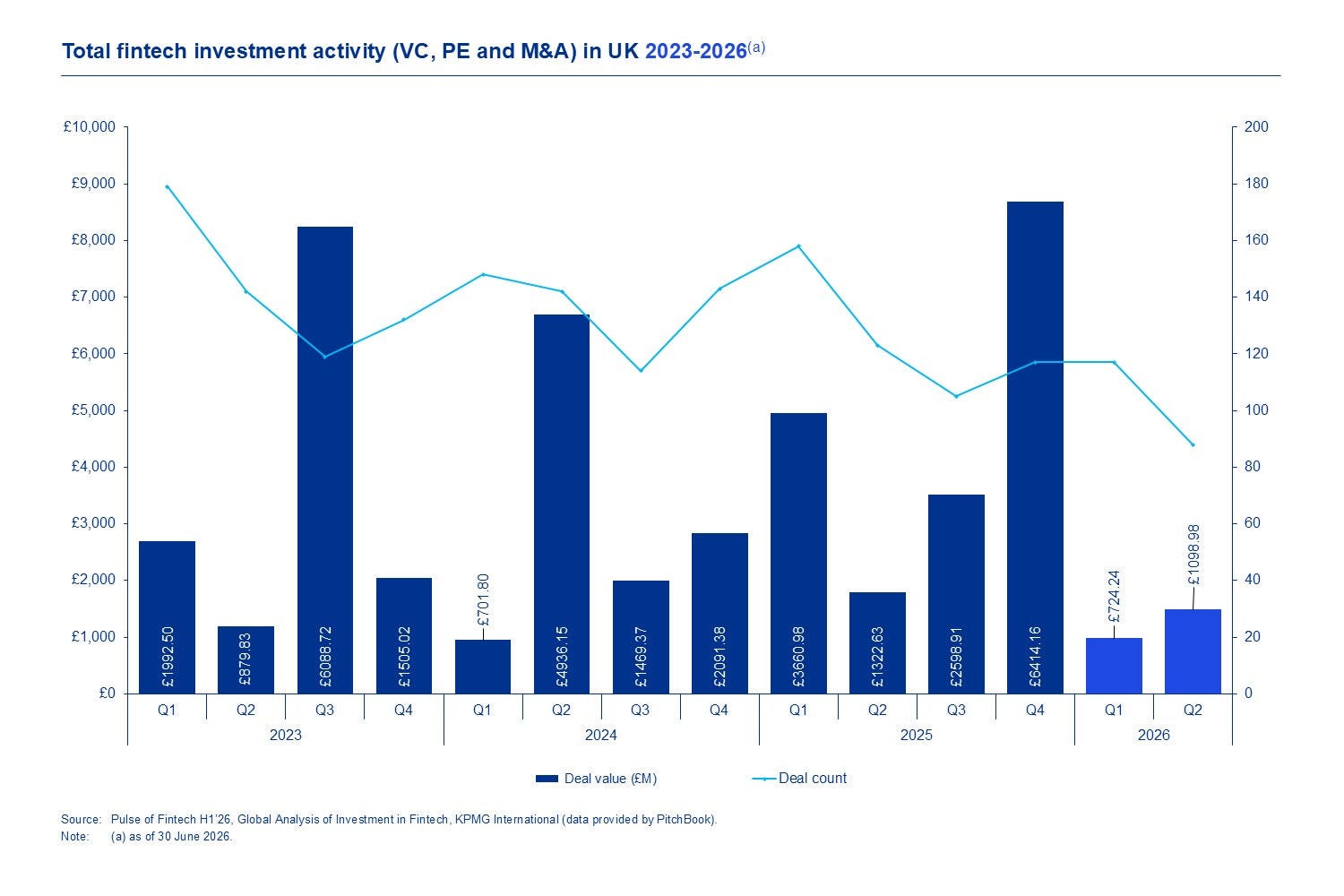
      Total UK fintech investment hit £1.8bn in the first half of 2026, down two-thirds from £5.0bn in the same period in 2025 according to KPMG’s latest Pulse of Fintech report.

      This marks the lowest level of UK fintech investment since 2016 (£735m), when the report began and puts this year on a par with 2020 when Covid took hold.

      While the UK retains the top spot for fintech investment in Europe, and indeed EMEA, its dominance has waned. The UK accounted for 22% of all EMEA investment in H1'26 versus 68% at the end of 2025.

      Deal count also fell to its lowest in a decade, with 205 UK M&A, PE and VC fintech deals completed in H1’26, down from 281 year-on-year. Yet, when it comes to deal activity, the UK still sits second only to the US globally and exceeds all other European countries combined*.

      Hannah Dobson

      UK Fintech Lead and Partner, Indirect Tax

      KPMG in the UK


      Investment continues to slow as caution rises

      • Remaining the European continent’s deepest fintech ecosystem thanks to strong incumbency advantages, including talent pools, etc., the UK is still seeing some slow subsiding in deal flow, most likely due to overall caution on the part of investors.
      • Major deals still occur, primarily among growth-equity and later-stage venture rounds, e.g., 9fin’s AI-enabled platform play with strong niche pushes into select asset classes, Ebury’s £543million PE growth round that is mainly predicated on potential for geographic expansion. That also reflects a shift toward revenue-proven, later-stage businesses that are safer bets.
      • Regulations around fraud for push payments, crypto-assets, stablecoins plus related custody continue to establish guardrails for startups within the space, as the FCA continues to try to establish clearer parameters for investors and entrepreneurs. Granted, that also favours players with sufficient scale to align with such degrees of compliance.
      Total fintech investment activity graph deal value v/s deal count.


      Hannah Dobson, Head of Fintech, Partner, KPMG in the UK, said:

      "It has been a challenging start to 2026, with levels of investment on a par with those seen during the first wave of the pandemic. That said, there are pockets of significant demand, particularly in AI, where investment is gaining prominence even as the wider market has softened.

      “Investors are continuing to back areas where they see long-term structural growth, even as capital deployment becomes more selective. Cybersecurity investment also increased year-on-year, with a clear overlap with AI as the whole sector navigates the age of frontier AI models and the opportunities and threats these create for businesses.

      “While there are bright spots, the geopolitical and economic headwinds facing firms only stand to intensify as the year continues and the second half of the year is likely to remain challenging for fundraising.”


      AI-related fintech funding gains ground despite wider slowdown

      AI-related UK fintech investment** reached £445m across 79 deals in H1'26 making up 25% of total UK fintech investment. By comparison, the first six months of 2025 saw £382m invested across 67 deals, comprising 16% of all fintech investment. The UK continues to lead Europe for AI-related fintech investment, ahead of France at £244m and Germany at £134m.


      Karim Haji, UK and Global Head of Financial Services, KPMG, adds:

      “While much of today's investment is focused on the largest and highest-quality deals, the broader fintech market is gaining momentum. AI is driving new opportunities, corporates are becoming more active, and private equity is looking at consolidation plays. Even smaller startups are attracting attention when they bring something truly differentiated to the table. Together, these trends point to a positive long-term outlook for the fintech sector.”


      2026 key global highlights:

      • Global fintech investment has grown considerably over the past three six-month periods, rising from £37.1bn in H1’25 to £53.1bn in H2’25 to £75.8bn in H1’26.
      • Global deal volume fell from 2,501 deals in H2’25 to 2,100 in H1’26; this remains below historic norms, reflecting continued investor selectivity despite higher capital deployment.
      • The Americas attracted over 80 percent of global fintech investment in H1’26 (£63.8bn across 1,120 deals), of which the US accounted for £59.4bn cross 933 deals.
      • Coming off a strong 2025 that saw £29.0bn invested across 1,715 deals, the EMEA region saw £8.3bn invested across 626 deals in H1’26 – on pace for a decade-low for both deal volume and value.
      • Fintech investment in the ASPAC region remained muted, declining from £5.2bn across 426 deals during H2’25 to £3.4bn across 350 deals in H1’26.
      • Global fintech M&A activity strengthened, with deal value increasing from £27.3bn across 514 deals in H2´25 to £49.9bn across 394 deals in H1´26.
      • Venture capital investment remained strong across the global fintech sector, led by the US which saw £12.3bn in VC investment.
      • At the sector level, payments led the way, attracting £32.5bn in H1’26: well over 2025’s annual total, as a result of several large megadeals.
      • AI-focused fintechs attract £15.7bn across VC, PE, and M&A

      Conversion rate accurate as of August 2026 from USD to GBP


      *Germany 36, Belgium 10, Nordics 44, Ireland 13, France 45, Netherlands 26

      **Verticals are tag-based and non-exclusive, meaning a single deal can be counted across multiple areas - for example AI, SaaS and Cybersecurity - so the vertical totals should be compared directionally rather than summed.

      Our fintech insights


      Something went wrong

      Oops!! Something went wrong, please try again


      MTD

      Get in touch


      Discover why organisations across the UK trust KPMG to make the difference and how we can help you to do the same.