


Climate will be the immediate focus for many companies, but UK SRS S1 also extends to other relevant sustainability-related matters, potentially including nature, water, human capital and supply chains.
In Policy Statement 26/19, the Financial Conduct Authority has finalised rules requiring in-scope listed companies to report against the UK Sustainability Reporting Standards (UK SRS). UK SRS are based on standards issued by the International Sustainability Standards Board, with targeted changes for the UK context. Our article, How do the UK SRS differ from the ISSB standards? explains those differences.
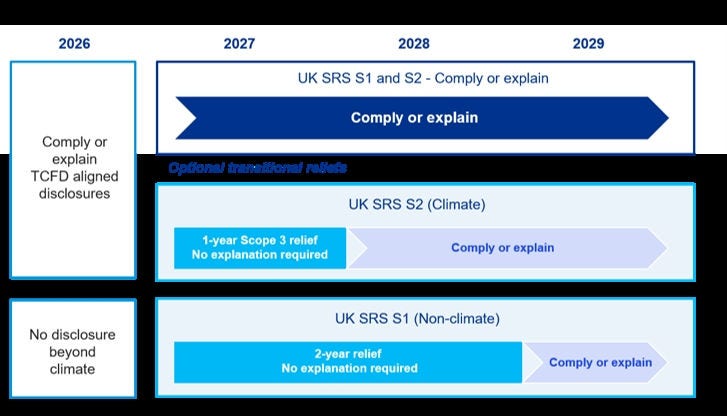
The comply-or-explain approach adopted by the FCA gives companies more flexibility than originally proposed, but it should not disguise the scale of the change from current TCFD-aligned reporting.
The new requirements will replace the FCA’s existing TCFD-aligned listing rules. However, in-scope companies will still need to consider the separate climate-related financial disclosure requirements under the Companies Act.
The FCA requirements at a glance
Implementation timeline and transitional reliefs
Identifying what matters to investors
The UK SRS require companies to identify sustainability-related risks and opportunities that could reasonably be expected to affect their prospects and then determine the material information investors need about them.
The reporting logic can be summarised in three stages:
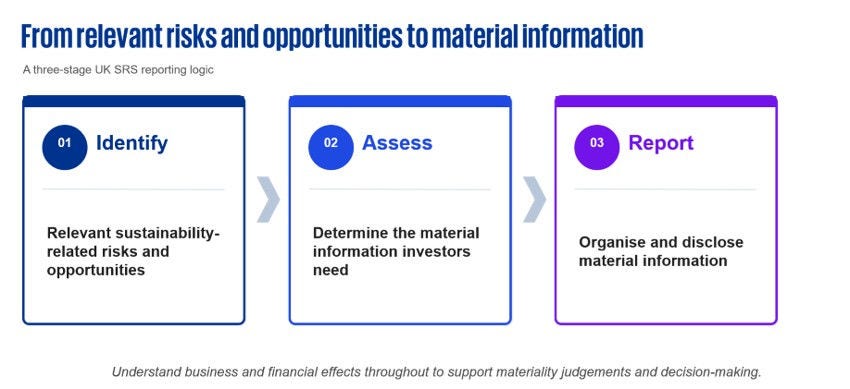
KPMG’s IFRS Sustainability handbook provides further guidance on how to identify sustainability-related risks and opportunities and assess which information is material.
Building on existing reporting foundations
The FCA rules will also sit alongside existing Companies Act climate-related financial disclosure requirements. The Government’s Modernising Corporate Reporting consultation considers a more focused corporate reporting framework, but climate-related disclosures are outside its current scope. Greater alignment will be important to avoid duplication and support coherent reporting.
A step up from TCFD-aligned reporting
Many listed companies have established TCFD-aligned climate reporting processes. In practice, however, disclosures have often remained largely qualitative when explaining financial implications.
UK SRS represents a broader change. Companies will need to consider sustainability-related risks and opportunities beyond climate where these could reasonably be expected to affect their prospects. For climate, they will need to explain current and anticipated financial effects, assess the resilience of their business model and strategy over the short, medium and long term, and show how the analysis informs decision-making.
Other changes include a more structured assessment of material information, disclosures across the value chain and, where relevant, industry-based metrics. Companies will need to determine which existing TCFD-aligned processes can be retained and where broader capabilities, data and controls are required.
Comply or explain still requires substance
The PS26/19 rules for listed companies are now final, but the FCA is consulting further until 28 October 2026 on proposed guidance for using the explain option. Under the rules, companies will need to identify what has not been disclosed, explain why and describe any steps towards future disclosure. Explanations should be clear, proportionate and company-specific, and should not omit material information.
A decision to explain rather than disclose does not remove the need to identify relevant risks and opportunities. Companies will still need to undertake that assessment, even where they ultimately choose not to make the relevant disclosures.
Bridging sustainability and finance
Many companies already have processes for identifying sustainability-related risks and opportunities. The greater challenge is translating that view into a clear assessment of resilience and financial effect, then using it in business decisions.
A recent World Business Council for Sustainable Development discussion paper calls this the physical risk to finance “translation gap”. A company may understand its exposure to physical climate risks but still struggle to trace the effect through to revenue, costs, capital expenditure, asset values, insurance or cash flow. The paper focuses on physical risk, but the same practical challenge runs through UK SRS more broadly.
UK SRS should not be treated as a year-end drafting exercise. It will require clear ownership and collaboration across sustainability, finance, risk and strategy, supported by reliable processes and controls over data, methodologies, assumptions and significant judgements. The analysis will also need to connect with strategy, risk management, planning, capital allocation and financial reporting.
That does not always mean producing a single monetary estimate. Depending on the circumstances, useful information might be an estimate, a range, a sensitivity, a scenario, a stress case or a structured qualitative assessment.
Building on EU sustainability reporting requirements
Companies that already report under the Corporate Sustainability Reporting Directive (CSRD) in line with the European Sustainability Reporting Standards (ESRS), or are preparing to do so, will not be starting from scratch. Existing governance, risk identification, value chain information, data, systems and controls may all provide a useful base.
There are important differences between ESRS and UK SRS. ESRS apply double materiality, while UK SRS focus on sustainability-related risks and opportunities that could reasonably be expected to affect the company’s prospects, and the material information investors need about them. Companies should map their ESRS work against UK SRS to identify what can be reused and where further work is needed.
What should companies do now?
Companies should use the implementation period to:
- establish a repeatable process for identifying relevant sustainability-related risks and opportunities and determining material information;
- assess where existing TCFD-aligned reporting and processes fall short;
- where applicable, map ESRS information, processes and controls against UK SRS to distinguish what can be reused from what requires further work;
- identify where the translation from sustainability-related risk to operational and financial effect breaks down;
- assess business-model and strategic resilience, and connect the analysis with budgets, forecasts, capital allocation and accounting; and
- strengthen the ownership, data, controls, evidence and governance supporting disclosures and explanations.
From reporting risk to understanding value
Applying UK SRS is not about asking companies to report more on every sustainability issue. It has a narrower focus: which risks and opportunities could affect the company’s prospects, and what material information do investors need about them?
The priority for companies is not simply to redraft existing TCFD-aligned disclosures, but to build the capability to identify the issues that matter, understand their operational and financial effects, and use that analysis in decision-making and reporting. Done well, this should give companies a clearer view of the resilience of their business model and strategy, not simply a better sustainability report.
Our insights


Something went wrong
Oops!! Something went wrong, please try again

Get in touch
Discover why organisations across the UK trust KPMG to make the difference and how we can help you to do the same.