error
Subscriptions are not available for this site while you are logged into your current account.
close
Skip to main content

Loading

The page is loading.

Please wait...


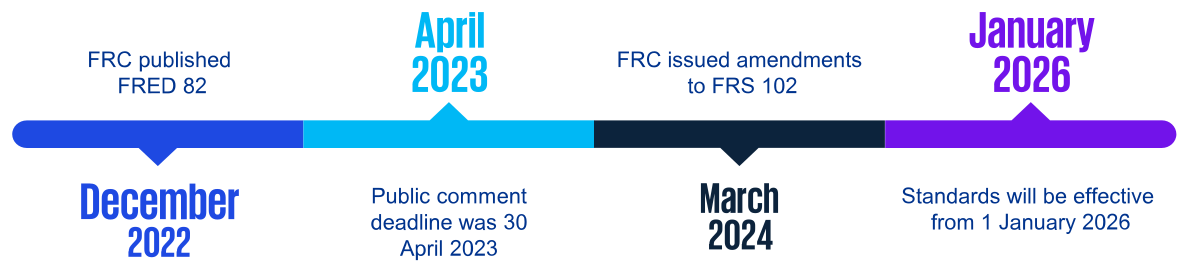
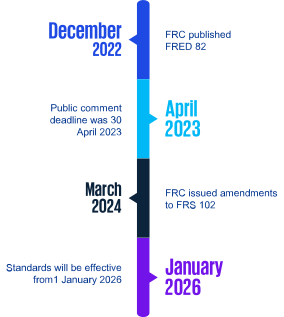
      On 27 March 2024, the FRC issued amendments to FRS 102 The Financial Reporting Standard applicable in the UK and Republic of Ireland and other FRSs – Periodic Review 2024. The effective date for most amendments is periods beginning on or after 1 January 2026*, with early adoption permitted provided all of the changes are adopted at the same time. These amendments seek to provide greater consistency and alignment to international accounting standards including:

      • A new model for revenue recognition, aligned to IFRS 15: Revenue from Contracts with Customers, but with some simplifications;
      • On balance sheet lease accounting for lessees, aligned to IFRS 16: Leases, but with certain practical exemptions; and
      • Various other modifications, including but not limited to fair value measurement, uncertain tax positions, business combinations, and a revised Section 2 aligned with IASB’s Conceptual Framework.


      * The amendments for supplier finance arrangements are effective from 1 January 2025.

      Simon Cooper

      Partner, Accounting Advisory Services

      KPMG in the UK


      We summarise on this page an overview of the key changes to FRS 102 and its impacts. To understand the amendments to FRS 102 in more detail, please you can listen to our podcast or watch an on-demand recording of our latest FRS 102 webinar (below), or you can read our other blogs on specific topics:

      FRS 102 amendments webinar: Are you ready?


      Man on phone


      The FRS 102 changes are effective on or after 1 January 2026

      The FRC’s latest financial reporting infographic The FRC’s latest financial reporting infographic

      What are the key changes to revenue and lease accounting?

      How could the FRS 102 changes impact my business?

      The commercial impacts of the new requirements may be wide reaching, and include considering:

      • How will the amendments affect key metrics, such as EBITDA, profit and net debt?
      • Will any debt/pension covenants need to be reset if EBITDA/net debt is impacted?
      • How will you amend current remuneration, bonus and share option schemes where reward is directly linked to financial performance?
      • Will dividend payments be restricted if distributable reserves are impacted?
      • How will I update internal controls and processes to ensure accounting complexities are reported to finance on a timely basis, such as commercial/contract decisions impacting revenue recognition, or legal decisions impacting leases?
      • How will I account for my leases on an ongoing basis – do I need a tool or software or will internal calculations suffice?


      What should I do next?

      The standards are effective for accounting periods beginning on or after 1 January 2026, and we would encourage companies to start their implementation projects as soon as possible if they haven’t already, as the effective date as already passed and new transactions after the initial application date should be accounted for under the new requirements.

      Performing an initial impact assessment is advised to understand the likely areas of impact for your financial statements, whether that be profit or loss or balance sheet. From that, calculations can be performed over the key areas impacted to understand the quantitative impact of initial application.

      These amendments may require changes to systems and processes to be in place ahead of implementation of the accounting changes. This may involve updating charts of accounts, assessing system capabilities, and designing revised processes to ensure compliance.

      Also, don’t forget the disclosure impact: the revenue recognition and lease changes will require increased disclosures in your financial statements from previous years; this will provide more information to the readers of your accounts, some of which may be sensitive around future revenue.

      The amendments also introduce disclosure requirements for supplier finance arrangements, where a third-party finance provider pays an entity's supplier, and the entity repays the finance provider. Preparers will now need to disclose information, in aggregate, about supplier finance arrangements which will include key terms and conditions, carrying amounts of liabilities subject to the arrangements (and any effects of non-cash changes), and ranges of payment dates. Amendments relating to supplier finance arrangements are effective from accounting periods beginning on or after 1 January 2025 with early application being permitted. Comparative information is not required in the year of adoption.


      How can we help?

      KPMG’s Accounting Advisory Services team are on hand to support you with the initial application. Our team of technical accountants has significant experience in accounting standard changes including the adoption of IFRS 15 and IFRS 16 for international standard adopters. Do please reach out if you require support or require further information.


      Workshops

      • In-person or virtual workshops tailored for finance teams to explain the new requirements and start assessing the impact.​​
      • Identify the next steps for implementation of the new accounting requirements.​​

      Impact assessment

      • Review your existing accounting policies and proposed changes under the amendments.
      • Identify customer contracts and lease portfolios.
      • Identify impacted metrics (e.g. KPIs, covenants).
      • Determine a initial application approach appropriate for your business.

      Accounting policies

      • Prepare accounting policy papers setting out application of the standards to your arrangements.​
      • Set out key judgements under the new standards.

      Quantification

      • Review revenue and lease contracts and extract data.​
      • Make contract level judgements, such as:​
        • Leases – discount rate, lease term, lease payments, practical expedients.
        • Revenue – unbundle promises, measure variable consideration, standalone selling price.​
        • Model lease and revenue contracts.

      Systems and processes

      • Advise on updated processes and controls.
      • Assess lease software and model requirements.​
      • Charts of account mapping.
      • Identifying any financial statement and consolidation impact going forward.​
      • Training across the business.​

      Tax

      • Tax impact assessment - initial application and beyond.
      • Tax planning.

      Financial reporting

      • Prepare financial statement disclosures under the amendments​
      • Explain changes to key metrics to stakeholders.

      PDF

      Upcoming changes to FRS 102

      Summary of key FRS 102 amendments from FRED 82, outlining changes to lease and revenue accounting, effective 2026, and KPMG’s advisory support services.

      Our accounting and finance insights

      Thoughts on the likely tax impacts of prospective changes to FRS 102 lessee accounting

      Thoughts on the likely tax impacts of prospective changes to FRS 102 lessee accounting

      What are the changes and what counts as verifiable hours?

      How KPMG can help assist you throughout the implementation journey

      Its not too late to start thinking about the changes to UK GAAP

      What are the changes and when will they take effect?

      The future of FRS 103 and its potential alignment with IFRS 17

      Bespoke training helps finance teams stay compliant, improve reporting, and boost performance.

      We discuss transition options available, whether comparatives are restated, and some of the expedients available when applying the amendments to save you time and effort.

      A closer look at right-of-use assets, transitional options, and potential HMRC focus areas.

      Our people

      If you want to discuss this in more detail please contact your usual KPMG account lead or one of our experts below.


      Simon Cooper

      Partner, Accounting Advisory Services

      KPMG in the UK

      Ian Greenwood

      Partner, Accounting Advisory Services

      KPMG in the UK

      Liang Zhang

      Director, Financial Modelling

      KPMG in the UK