error
Subscriptions are not available for this site while you are logged into your current account.
close
Skip to main content

Loading

The page is loading.

Please wait...


      • Household consumption to continue as the primary engine of Eurozone GDP growth in 2026, despite subdued consumer confidence and high savings intentions.
      • The outlook for the manufacturing sector remains weak, with PMI surveys signalling no meaningful recovery on the horizon. Competitive challenges add structural headwinds.
      • Major European central banks have ended their rate-cutting cycles. Interest rates are expected to stay stable through 2026 as inflation returns to target levels.
      • The fiscal stance across the Eurozone is expected to be broadly neutral in 2026, with consolidation plans in many countries offsetting expansion elsewhere. Thereafter we expect more expansionary fiscal policies as some countries leave the excessive deficit procedure and spending on defence increases to meet NATO targets.
      • Europe’s reliance on China for critical raw materials, including rare earths, poses strategic risks. Demand for rare earths is projected to rise fivefold by 2030, requiring diversification and investment in refining and recycling.
      • High electricity prices following the pivot from Russian gas continue to erode competitiveness in energy-intensive sectors, driving structural adjustments and increasing reliance on imports.


      In our European Economic Outlook – December 2025, we look at the ways that Europe could meet its growing demand for rare earths, the ongoing impacts of high energy costs on European competitiveness and how more spending on defence and infrastructure could shape the economic outlook for the continent. 

      Download the report for our full analysis. Or read on for a summary.

      Download

      European Economic Outlook - December 2025

      In our latest European Economic Outlook we look at the prospects for the European economy for 2025 and 2026, including our analysis of growth prospects, trade outlook, consumer spending, inflation, interest rates and fiscal outlook.

      Summary of KPMG’s latest forecasts for the Eurozone

      December 2025

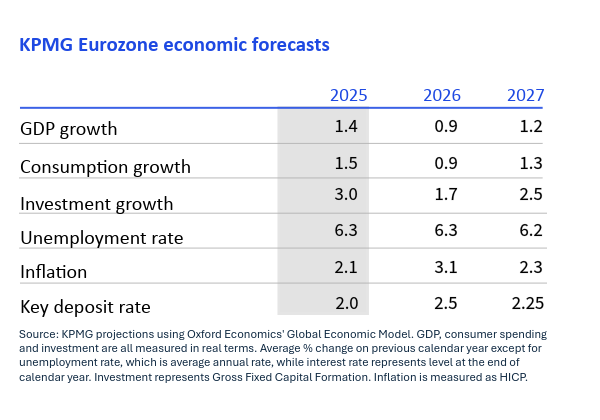
      Eurozone GDP to grow at a modest pace, with consumer spending remaining the key driver. Overall investment is set to accelerate in 2027, helped by a growing contribution of public sector investment on defence and infrastructure.

      Meanwhile, the ECB is unlikely to change rates, while inflation stays near its 2% target.

      KPMG projections for the Eurozone economy


      Household spending the key to growth in 2026

      The largest contribution to economic growth is expected to come from higher consumer spending. The labour market remains strong, with robust job creation across parts of southern Europe offsetting a weakening labour market in Northern and Eastern economies. Overall, we expect to see relatively strong real wage growth, supporting sustained increases in households spending power over the next two years.

      Nevertheless, elevated uncertainty, particularly in countries such as France, is supressing consumer confidence across the region, with savings intentions remain high and a consistent majority of consumers indicating an intention to increase savings dampening the prospects for an acceleration in consumer spending growth in 2026. 

      Manufacturing faces growing competition and potentially limited uplift from higher defence spending

      Despite a greater focus on defence, European industrial production is expected to remain weak, with EU manufacturing PMI pointing at neutral levels following some recovery in 2025. European Commission surveys of firms’ perceptions show order books stabilising but remaining broadly negative, supporting the view that EU manufacturing has reached a trough in output, but that recovery is not yet forthcoming.

      Despite weakness in industrial production, overall business activity has maintained solid growth, with composite EU PMI having increased in recent months, driven by a resilient services sector. 

      Muted inflation signals the end to rate cutting cycle for the major European central banks

      Inflation across Europe is returning to target, easing concerns for policymakers and pointing at the end to the current rate-cutting cycle. In the Eurozone, inflation is expected to fall to 1.6% in 2026, below the central bank’s 2% target, due to energy base effects. The ECB is unlikely to respond, viewing this fall in inflation as temporary and maintaining a high threshold for further cuts.

      A broadly neutral fiscal stance in 2026?

      With capacity constraints limiting the absorption of public funds, fiscal stance could be broadly neutral across Europe in 2026. Fiscal consolidation in countries such as Italy and France is expected to offset expansionary policy elsewhere, especially in Germany.

      We anticipate a more expansionary fiscal stance in 2027, as German defence and infrastructure spending gains momentum, while Italy is expected to exit its excessive deficit procedure, allowing for less restrictive fiscal policy, with a potential uplift in defence spending to meet NATO targets.

      Household spending the key to growth in 2026

      The largest contribution to economic growth is expected to come from higher consumer spending. The labour market remains strong, with robust job creation across parts of southern Europe offsetting a weakening labour market in Northern and Eastern economies. Overall, we expect to see relatively strong real wage growth, supporting sustained increases in households spending power over the next two years.

      Nevertheless, elevated uncertainty, particularly in countries such as France, is supressing consumer confidence across the region, with savings intentions remain high and a consistent majority of consumers indicating an intention to increase savings dampening the prospects for an acceleration in consumer spending growth in 2026. 

      Manufacturing faces growing competition and potentially limited uplift from higher defence spending

      Despite a greater focus on defence, European industrial production is expected to remain weak, with EU manufacturing PMI pointing at neutral levels following some recovery in 2025. European Commission surveys of firms’ perceptions show order books stabilising but remaining broadly negative, supporting the view that EU manufacturing has reached a trough in output, but that recovery is not yet forthcoming.

      Despite weakness in industrial production, overall business activity has maintained solid growth, with composite EU PMI having increased in recent months, driven by a resilient services sector. 

      Muted inflation signals the end to rate cutting cycle for the major European central banks

      Inflation across Europe is returning to target, easing concerns for policymakers and pointing at the end to the current rate-cutting cycle. In the Eurozone, inflation is expected to fall to 1.6% in 2026, below the central bank’s 2% target, due to energy base effects. The ECB is unlikely to respond, viewing this fall in inflation as temporary and maintaining a high threshold for further cuts.

      A broadly neutral fiscal stance in 2026?

      With capacity constraints limiting the absorption of public funds, fiscal stance could be broadly neutral across Europe in 2026. Fiscal consolidation in countries such as Italy and France is expected to offset expansionary policy elsewhere, especially in Germany.

      We anticipate a more expansionary fiscal stance in 2027, as German defence and infrastructure spending gains momentum, while Italy is expected to exit its excessive deficit procedure, allowing for less restrictive fiscal policy, with a potential uplift in defence spending to meet NATO targets.


      Global Economic and Geopolitical Outlook webcast


      Hear from our global economists on the 17th December on central bank rate changes, fiscal policies, and how evolving geopolitical dynamics could affect your operations, trade strategies, and supply chains.


      A 3D globe with a web graphic overlay

      KPMG Economics

      Click here to access our additional research and contact detail as well as to subscribe to our mailing list.

      Two professionals walking in a modern office hallway