error
Subscriptions are not available for this site while you are logged into your current account.
close
Skip to main content

Loading

The page is loading.

Please wait...


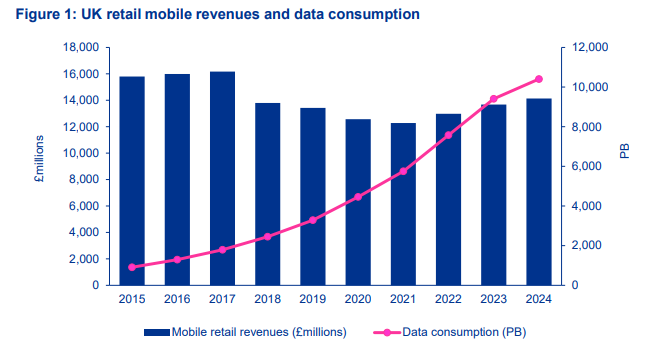
      UK MNOs (Mobile Network Operators) have had a tough decade. Retail mobile revenues across the industry are 11% lower in 2024 compared to 2015, but data consumption – which requires expensive network investment to meet demand – has increased by 1041% in the same period (see Figure 1).

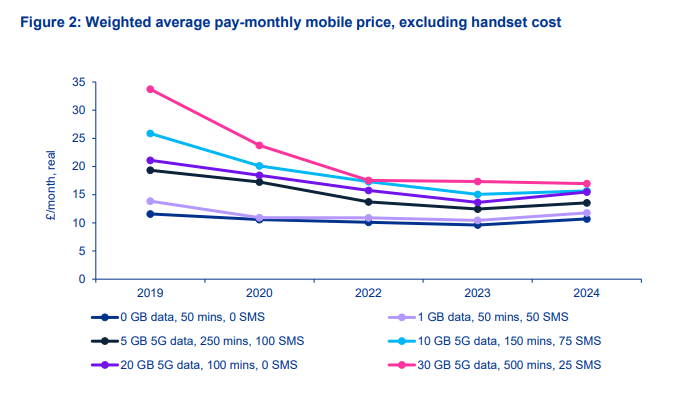
      Whilst consumers have demanded more data, they aren’t willing to pay much more for it. Prices for pay-monthly plans have broadly declined between 2019 and 2024 (see Figure 2). There is also a minimal difference between the average price paid for a package with a moderate data allowance versus one with a large allowance (£14 versus £17 respectively for 5 GB and 30 GB packages in 2024). These trends pose a significant ROI (return on investment) challenge for operators.

      Intense competition from MVNOs (Mobile Virtual Network Operators) is one of the drivers of the challenges faced by MNOs; as per recent reports,1 MVNOs have gained 1.5 million customers in the UK whilst MNOs have lost 54,000 in 2024. There are potentially more headwinds to come for MNOs.

      eSIMs, whilst still somewhat nascent, represent a potential challenge. eSIMs are virtual sim cards and allow for more effortless switching compared to traditional physical sim cards as they remove the need to visit a physical shop or wait for a new sim to arrive in the post.

      Whilst dual-sim phones exist, eSIMs could allow for even easier and wider multi-homing (i.e.use multiple sims) with some phones supporting the use of eight eSIMs.

      Umayr Loan

      Director, Economics

      KPMG in the UK


      Source: KPMG analysis of Ofcom data, Ofcom (2025), Q1 Telecommunications market data update.

      Source: KPMG analysis of Ofcom data. 2021 data not published by Ofcom. Ofcom (2024), Pricing Trends 2024.


      The opportunities that could come with eSIMs may invite entry from Big Tech in the supply of mobile network services if they choose to act as MVNOs themselves. Alternatively, they could play a role in the choice of mobile network provider. If the need for a physical sim card is eliminated, consumers could choose their network provider instantaneously when they set up their phone. Much like how goods are strategically positioned on a shelf in a supermarket, the way in which the choice of network provider is presented to consumers (e.g.whether a provider is at the top of list, or if they appear only after a consumer has swiped through several options) could impact consumer choice.

      Potential entry from players beyond the world of telecoms and Big Tech has also been reported. Challenger banks, utility companies and even influencers have recently announced plans or are rumouredto be planning on entering the market.

      In short, existing business can become digital MVNOs – enabled via eSIMs – and can cross sell connectivity to their customer base thus increasing their stickiness.

      Alternatively, new digital connectivity only providers are likely to emerge and potentially capture lucrative connectivity revenues, e.g. roaming by offering simpler eSIM journeys. MVNEs (Mobile Virtual Network Enabling) players can offer eSIM provisioning facilitating new digital retail players. The MVNEs, in turn, can purchase connectivity directly from MNOs acting as MVNAs (Mobile Virtual Network Aggregators). By weakening long-standing industry moats, eSIMs could pave the way for disruptive players and accelerate the disintermediation of Mobile Network Operators.

      However, eSIMs may also offer new ways for MNOs to attract new customers and offer differentiated propositions. The ability to multi-home easily could present opportunities. For example, if a customer has good service at home but has poor service at their area of work, they could potentially have two eSIMs on the go. MNOs could offer temporary event passes for large events such as festivals and gigs or “try before you buy” packages to tempt new customers. Indeed, both of thesehave been trialledin the UK by Vodafone. Operators such as Vodafone can also look to use the strength of their global brand and scale to proactively target the roaming market using eSIM-based propositions. Such efforts could focus on enabling simpler digital customer journeys to sign up to travel eSIMs and can proactively target customers who may not necessarily subscribe to the network at home.

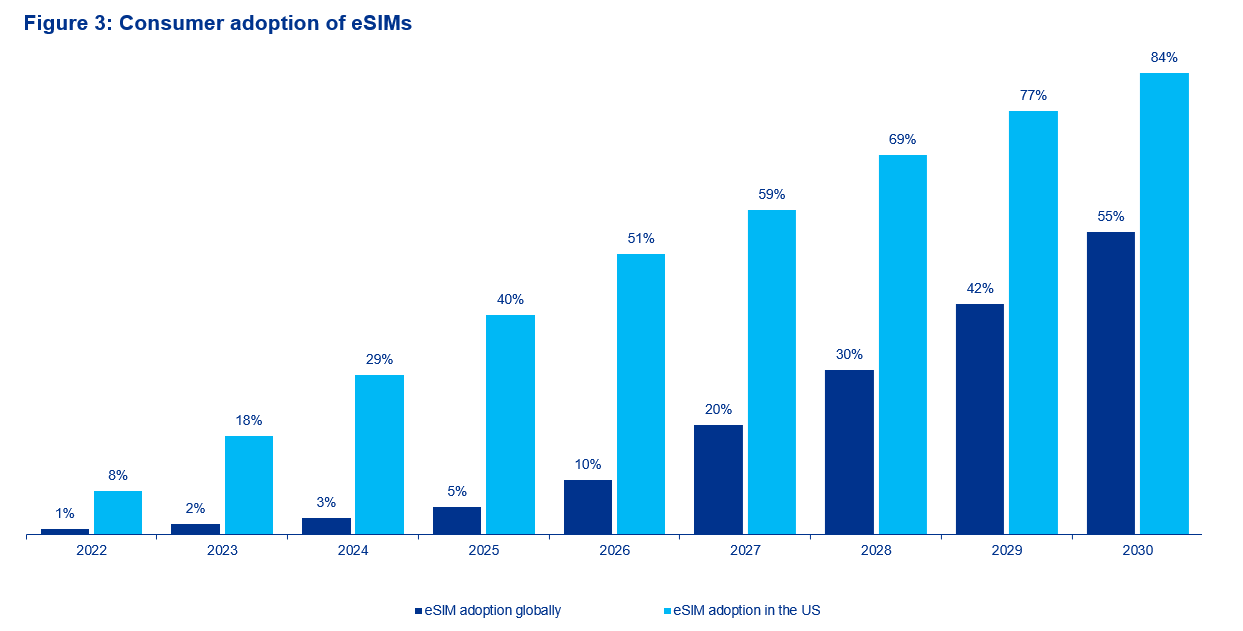
      That said, the popularity of eSIMs still remains uncertain (see Figure 3). GSMA notes that “contrary to initial ambitions and forecasts, adoption of eSIM in the smartphone market has been slow and mostly driven by the US (where the launch of eSIM-only iPhones in 2022 has boosted adoption to 40%) and travel eSIM (users have grown by 45% in the last 12 months).”2

      Whilst the newest iPhone model will only support eSIMs,3 it is not known whether other mobile handset manufacturers will follow suit. Even if that is the case, it may take some time for customers to replace their existing handsets with eSIM-only ones.

      Nevertheless, the provision of mobile network services has seen several big shifts, driven by technological advancements over the past decade and this trend may continue. Whilst eSIMs may or may not bring widespread disruption in the near-term, there remain other challenges on the horizon (or coming from space,4 in the form of satellite services) that could further shake up the mobile market.


      Source: GSMA Intelligence (2026), The telecoms industry in 2026: trends to watch


      Download

      eSIMs: Threat or opportunity for mobile network operators?

      KPMG. Make the Difference


      (1) Financial Times (2025), Everyone suddenly wants to be a telecoms group, 21 August 2025

      (2) GSMA Intelligence (2026), The telecoms industry in 2026: trends to watch, January 2026

      (3) BBC (2025), Will the latest iPhone kill off the Sim card?, 12 September 2025

      (4) Light Reading (2025), Turning Starlink into a global mobile carrier 'one of the options,' Musk says, 11 September 2025

      Our economics insights

      Something went wrong

      Oops!! Something went wrong, please try again


      MTD TEST

      Get in touch


      Discover why organisations across the UK trust KPMG to make the difference and how we can help you to do the same.