

      The impacts from regulatory changes are not always obvious when first reading the provisions. However, the implications become clearer when those provisions are traced through the customer, compliance and operational processes they may affect.

      That is particularly true of the Omnibus Bill. Our review identified 421 proposed amendments and related legislative effects across its 96 clauses, with approximately 304 assessed by KPMG as effect-bearing. Around 35 percent of those effect-bearing proposals sit within the part of the Bill addressing customer due diligence, reporting groups, specified sanctions, programmes and transaction restrictions. The second third relate to liability, offences, penalties and infringement enforcement. The remaining third largely relate to search, intelligence, production and freezing orders and delegated powers.

      This is the third article in our series asking: Is your organisation ready for the future the Bill proposes? The Bill suggests that process change would not be confined to customer onboarding or programme documentation. It could extend across day-to-day compliance, investigation, information production and operational intervention.

      Malcolm Bruce

      Partner - Risk Consulting and Partner in charge of Alumni Programme

      KPMG in New Zealand


      This is the third article in our series asking: Is your organisation ready for the future the Bill proposes? We recommend you read articles 1 and 2 first:

      looks_one

      The Bill by numbers: a different way to understand the proposed AML/CFT reforms.
      looks_two

      The people implications of the proposed AML/CFT reforms


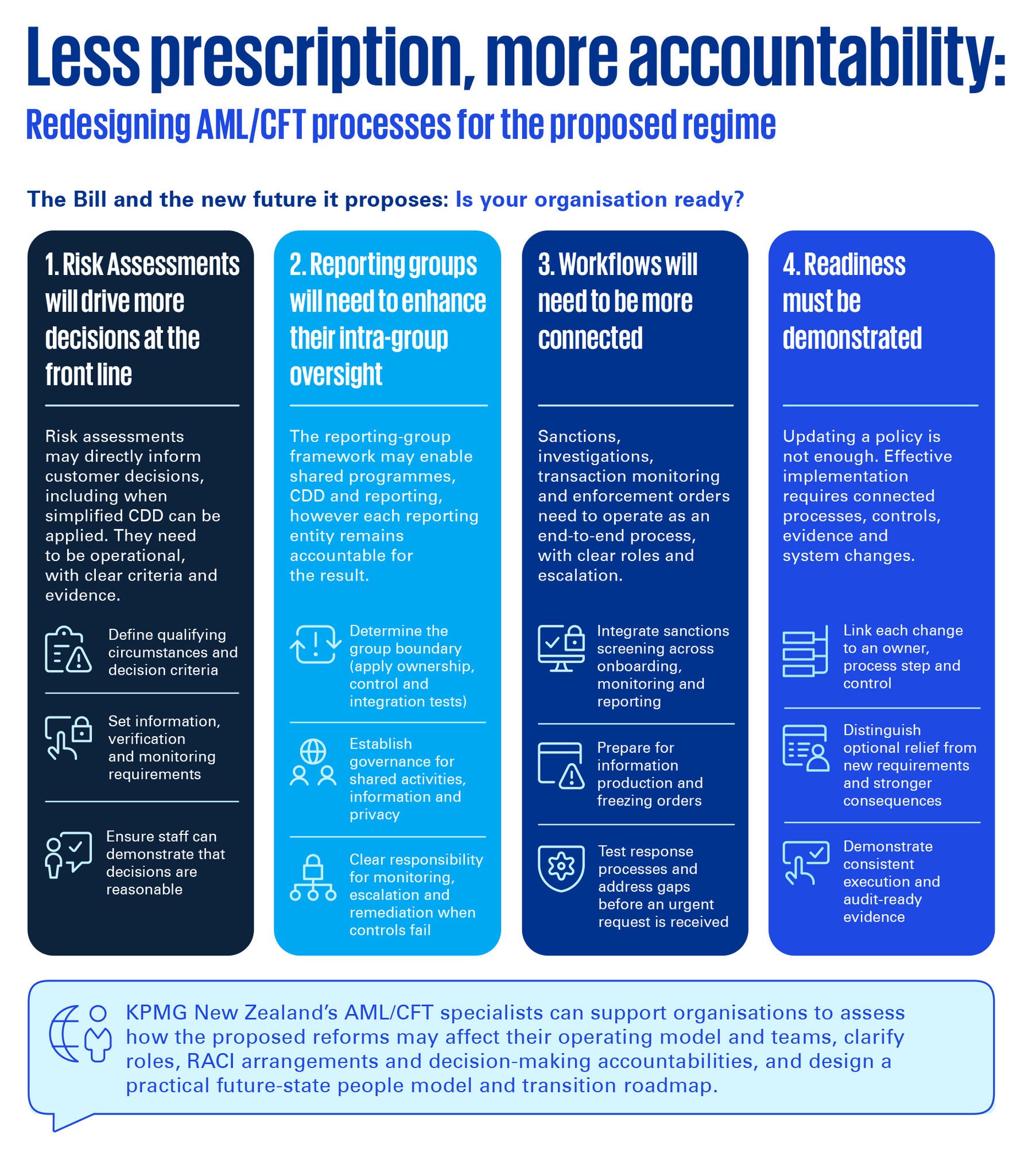
      Risk assessments will drive more decisions at the front line

      The Bill could create a much closer link between a reporting entity’s section 58 risk assessment and the decisions made for individual customers. Under the proposed low-risk pathway, the assessment could identify circumstances considered to present a low risk. Those circumstances could then inform whether a customer qualifies for simplified customer due diligence.

      For that to work, the risk assessment may need to do more than describe a reporting entity’s exposure for boards or supervisors. It could need to define the qualifying circumstances, the information and verification required, the applicable monitoring and the events that return a customer to standard due diligence. Staff would also need to know what evidence demonstrates that the decision was reasonable.

      Some existing risk assessments may be too high level for this purpose. A supporting methodology or decision tool therefore may be needed, however it should remain connected to the approved assessment rather than evolving into a separate and inconsistent framework.

      The wider customer due diligence proposals also need to be implemented as a connected process. For example, changes to low-risk simplified due diligence, delayed verification, trust requirements, geographic triggers and enhanced customer due diligence should not be treated as isolated policy edits.

      Importantly, the decision to apply simplified CDD would not necessarily end at onboarding. Clause 21 would require monitoring sufficient to establish that the customer's risk remains low, while clause 8 would require standard CDD if the circumstances supporting simplified CDD no longer apply. The challenge will therefore be making sure the risk assessment can be applied consistently from the initial customer decision through to ongoing monitoring.

      Info-sheet Click the image to enlarge for easier reading.

      Reporting groups will need to enhance their intra-group oversight

      Clause 22, which introduces the new mandatory and voluntary reporting-group arrangements, contains 24 proposals we have assessed as effect-bearing, making it one of the most substantial sources of potential operational change. It addresses mandatory-group eligibility, ownership and control tests, lead entities, oversight, notifications and voluntary arrangements.

      The first process challenge may be determining the reporting-group boundary. It may not align with the organisation’s existing corporate, tax, financial-reporting or operational structures. Ownership, voting rights, control, business integration and overseas regulated entities may all be relevant.

      Once membership is established, governance processes will be needed for shared assessments, programme elements, reporting, customer information and privacy. The group must also be able to identify where a shared control has failed and which entity is responsible for responding.

      A group procedure will not be enough if activities, decisions and accountability cannot be traced. Shared delivery may require service expectations/SLAs, issue escalation and assurance arrangements that reflect the continuing responsibility of individual reporting entities.


      Workflows will need to be more connected

      Specified sanctions would become more closely integrated across the AML/CFT framework. Reporting entities may therefore need to connect sanctions screening with customer onboarding, periodic reviews, transaction monitoring, investigations, account restrictions, suspicious activity reporting and record keeping. These activities should form a coordinated workflow rather than operate as separate compliance processes.

      The checking process may later be prescribed through rules, so flexibility will be important. Reporting entities should design processes that can adapt as further requirements emerge. They should avoid relying on assumptions or detailed screening methods.

      The proposed infringement regime presents a different process challenge. It could attach additional consequences to existing programme, reporting and record-production duties, increasing the importance of effective controls and reliable evidence. The Bill would also introduce ongoing production and temporary freezing-order mechanisms, each requiring distinct operational responses.

      A generic legal-request procedure may not be sufficient to manage these instruments. Each could require defined validation steps, ownership, deadlines, scope, evidence, system actions and closure criteria. Freezing orders may be particularly demanding because selected facilities might need to be restricted while permitted expenses continue, confidentiality is maintained and extensions or cessation notices are tracked.

      These arrangements must operate effectively under pressure. Roles, escalation paths and system actions should be clear before an urgent request or order is received. Reporting entities should therefore test the end-to-end response process in advance and address any gaps identified.


      Readiness must be demonstrated

      Updating a policy is not the same as implementing a change. A procedure can be approved while decision criteria, workflows, forms, systems and records remain untouched.

      A useful readiness assessment connects each applicable effect-bearing proposal to an owner, process step, control, evidence requirement, system dependency, escalation route and testing plan. It should distinguish optional relief from new requirements and from existing duties that may acquire stronger consequences.

      The Bill may be less prescriptive in selected areas, but process quality will remain critical. Potential relief will be most valuable to reporting entities that can exercise discretion consistently and explain how their operating decisions reflect assessed risk.

      Is your organisation ready? KPMG New Zealand can support process-impact assessments, customer due diligence redesign, group-control mapping, sanctions-process integration, enforcement-response design and readiness assessment.


      How KPMG can help

      The proposed reforms may require reporting entities to reconsider how AML/CFT requirements are translated into processes, controls and operational workflows, particularly where greater discretion, shared delivery and new enforcement mechanisms are introduced.

      Our AML/CFT specialists can help you assess the impact on your end-to-end processes, including customer due diligence, reporting-group arrangements, sanctions workflows, information and order responses, control points, evidence requirements and system dependencies. We can then support the design of practical future-state processes and an implementation roadmap that enables consistent execution, clear accountability and effective control while retaining flexibility as the Bill progresses.


      Malcolm Bruce

      Partner - Risk Consulting and Partner in charge of Alumni Programme

      KPMG in New Zealand

      Luke Daly

      Director - Consulting

      KPMG in New Zealand


      This series provides a thematic and quantitative perspective on the Anti-Money Laundering and Countering Financing of Terrorism (Omnibus) Amendment Bill for general information. The Bill may change before enactment.

      The information contained herein is of a general nature and is not intended to address the circumstances of any particular individual or entity. Although we endeavour to provide accurate and timely information, there can be no guarantee that such information is accurate as of the date it is received or that it will continue to be accurate in the future. No one should act upon such information without appropriate professional advice after a thorough examination of the particular situation.

      These materials may incorporate AI-assisted content which has been subject to human review in accordance with KPMG's Trusted AI Framework.


      You may also be interested in

      KPMG's FRM team advise NZ business facing exposure to financial and regulatory risk.

      Supporting organisations with the identification, assessment, monitoring and management of operational risks.

      New Zealand banks face rising AML risk and regulatory scrutiny. This short KPMG report explores key transaction monitoring challenges and practical recommendations.