

      As you plan for the year ahead, your attention will naturally be divided between immediate delivery pressures and the changes taking shape across New Zealand’s anti-money laundering (AML) and counter financing of terrorism (CFT) system. The transition to a single supervisor, continuing regulatory reform and preparations for future implementation will all compete for attention from yourself and other management.

      The Anti-Money Laundering and Countering Financing of Terrorism (Omnibus) Amendment Bill (the Bill) was introduced on 1 September 2026 and is yet to complete its first reading. While the Bill may change as it progresses through Parliament, we believe reporting entities should start preparing for the extensive proposed changes. At first glance, it is a 96-clause Bill spanning customer due diligence, specified sanctions, reporting groups, information sharing, offences, penalties and law-enforcement tools. Look beneath that structure, and a much broader programme of potential change emerges.

      Malcolm Bruce

      Partner - Risk Consulting and Partner in charge of Alumni Programme

      KPMG in New Zealand


      Scale of changes

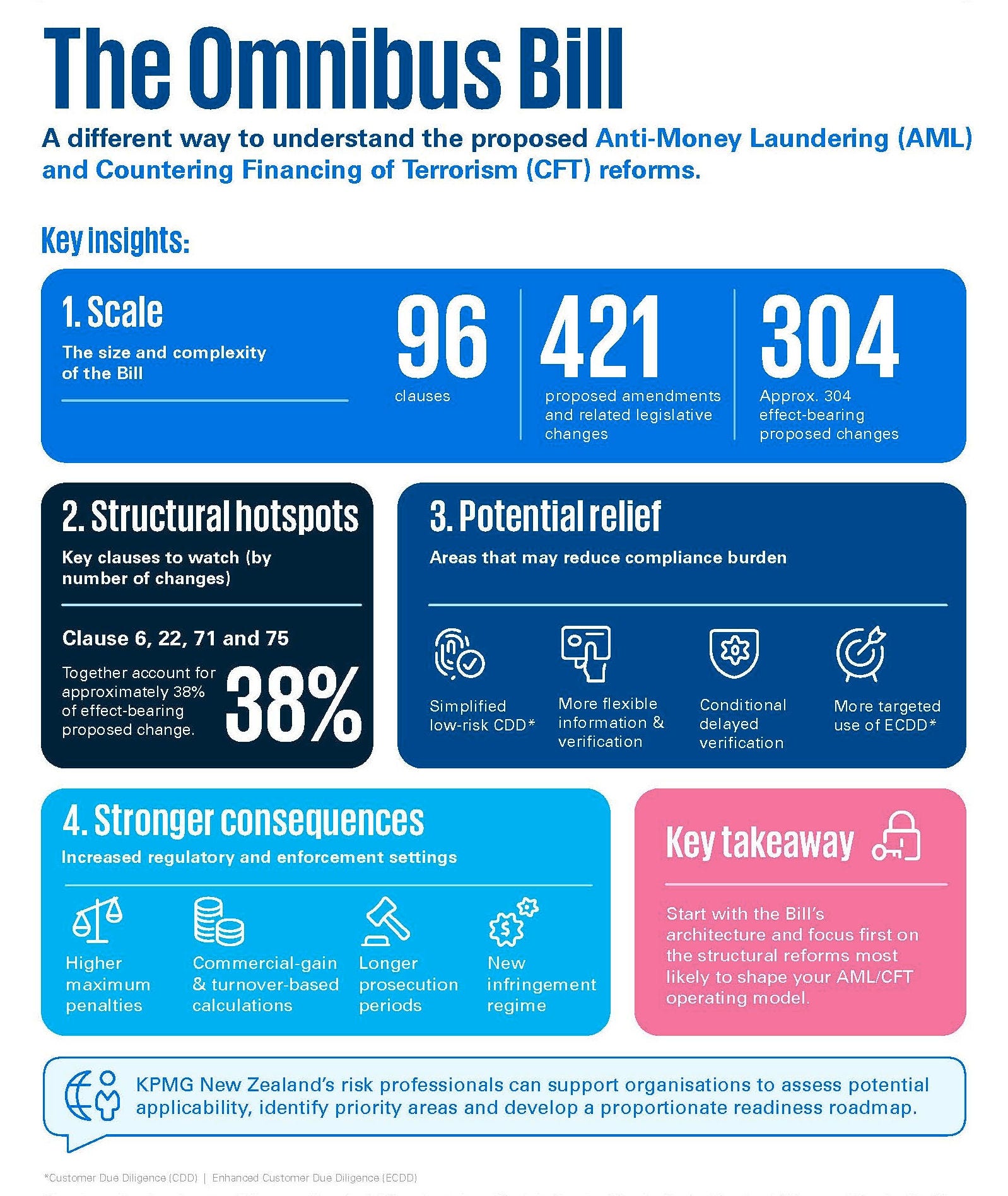
      To understand its scale, the KPMG team examined the Bill at a granular level. Our analysis identified 421 proposed amendments and related legislative effects. These are not 421 standalone obligations. They include substantive amendments, supporting changes, safeguards, procedural provisions and individual penalty components.

      After separating supporting, duplicated and non-effect-bearing items, we identified approximately 304 ‘proposed changes that we classified as ‘effect-bearing’.

      These are proposals that may alter legal meaning, application, obligations, rights, powers, timing or procedures, or have an identifiable practical implication for your people, processes, technology, data or controls.

      This is the first article in our five-part series asking a central question:

      Does your organisation understand the scale of change the Bill proposes?


      A Bill with three substantial areas of change

      The approximately 304 effect-bearing proposals are spread across three broad parts of the Bill. Around 35 percent arise in clauses 4–42, which contain the main proposals concerning customer due diligence, reporting groups, specified sanctions, programmes, risk assessments, information sharing and transaction restrictions.

      A slightly larger share, around 36 percent arises in clauses 43–71. These clauses principally address civil liability, offences, penalties and the proposed infringement regime. The remaining 29 percent arises in clauses 72–93, which deal with search and information powers, ongoing production orders, temporary freezing orders, intelligence functions and delegated powers.

      These figures do not estimate implementation cost or regulatory burden. Nor does every effect-bearing proposal apply directly to every reporting  entity. They show, however, that potential change is distributed across how reporting entities comply, the consequences of non-compliance and the mechanisms through which information or facilities may be accessed and restricted.

      The Bill is therefore wider than a customer due diligence reform programme. Its proposals reach into governance, operational response, enforcement exposure, information management and technology. 


      Four clauses account for almost two-fifths of the changes

      A significant number of the proposed changes are concentrated into four clauses in the Bill.


      • Clause 75 covering ongoing production and temporary freezing orders, contains 49 effect-bearing proposals;
      • Clause 71 covers infringement regime accounts (for 29 proposals);
      • Clause 22 covers the reporting-group framework (for 24 proposals); and
      • Clause 6 has definition changes (for 13 proposals).

      Together, these four clauses represent approximately 38 percent of all material changes, making them important implementation priorities. Clause 6 could reshape the regime’s scope and terminology by updating existing defined terms and creating new ones. Clause 22 relates to changes to reporting groups that could affect group boundaries, lead-entity responsibilities, shared programmes and accountability. Clause 71 could create a more immediate enforcement route for specified failures with the introduction of infringement offence. While Clause 75 could require new or strengthened capabilities for information production under increased production order powers, targeted restrictions, confidentiality, extensions and release.

      Implementation effort should therefore reflect the significance of each clause rather than be spread evenly across all 96.


      Potential relief sits alongside stronger consequences

      Much of the Bill’s potential regulatory relief is concentrated in customer due diligence. The proposals include a new low-risk simplified customer due diligence pathway, more flexible information and verification requirements, conditional delayed verification and removal of certain automatic enhanced customer due diligence triggers.

      Used well, and supported by a clearly documented, risk-based approach, these measures could support more proportionate customer treatment and allow resources to be directed towards higher-risk relationships. They would also place greater weight on a reporting entity’s methodology, professional judgement and evidence.

      At the same time, the Bill proposes materially stronger enforcement consequences. These include increased maximum penalties, commercial-gain and turnover-based calculations, longer prosecution periods and a new infringement regime. Some existing programme, reporting and record-production requirements could acquire additional consequences even where the underlying duty remains broadly familiar.

      The opportunity and the risk are therefore connected. Reporting entities may receive more discretion over how they comply, but in turn, they will need to demonstrate more clearly why the decisions made under that discretion were reasonable.


      Five priorities emerge

      The effect-bearing analysis points towards five practical areas of focus. The first is customer due diligence, where much of the potential regulatory relief sits. The second is reporting-group governance, including eligibility, lead-entity responsibilities, shared activities and entity-level accountability. The third is specified sanctions, which would become more closely integrated into the AML/CFT framework. The fourth is enforcement readiness, covering both new offences and stronger consequences attached to existing or revised duties. The fifth is information and order response, including continuing record production, targeted restrictions, confidentiality, variation and release.

      These are not isolated workstreams. For example; customer due diligence decisions depend on people, data and methodology; shared group controls depend on governance, information quality and assurance; and freezing orders depend on legal interpretation, operational processes and technology that can apply and remove restrictions precisely.


      Start with the Bill’s architecture

      The most useful quantitative insights are not simply that the Bill contains 96 clauses, 421 proposed amendments and related legislative effects, or approximately 304 effect-bearing proposals. It is that much of the potential change is concentrated in a small number of structural reforms.

      A proportionate impact assessment should begin with those reforms rather than treating the Bill as 96 separate implementation tasks. Organisations should first understand the revised scope, reporting-group model, sanctions framework, infringement regime and production and freezing-order powers. Other proposals can then be considered in relation to those foundations. The upcoming KPMG articles in this series will examine what the proposals may mean for your people, processes, technology and data and the wider AML/CFT operating model. 

      Is your organisation ready? This article aims to show how the changes are substantial, numerous and wide-ranging.  Each organisation will have different impacts, but our message is clear: start working through a process to assess applicability, quantify impacts, identify priority areas and develop an implementation roadmap to be ready from day one.


      How KPMG can help

      Our AML/CFT specialists can support you to assess applicability, quantify impacts and prioritise change across your governance, people, processes, technology and data. This can include assessing customer due diligence changes, reporting-group arrangements, specified sanctions, enforcement readiness and information and order response requirements. We can then help you translate that assessment into a proportionate implementation roadmap, identifying key dependencies and areas where early preparation may be valuable while retaining flexibility as the Bill progresses.


      Malcolm Bruce

      Partner - Risk Consulting and Partner in charge of Alumni Programme

      KPMG in New Zealand

      Luke Daly

      Director - Consulting

      KPMG in New Zealand


      This series provides a thematic and quantitative perspective on the Anti-Money Laundering and Countering Financing of Terrorism (Omnibus) Amendment Bill for general information. The Bill may change before enactment.

      The information contained herein is of a general nature and is not intended to address the circumstances of any particular individual or entity. Although we endeavour to provide accurate and timely information, there can be no guarantee that such information is accurate as of the date it is received or that it will continue to be accurate in the future. No one should act upon such information without appropriate professional advice after a thorough examination of the particular situation.

      These materials may incorporate AI-assisted content which has been subject to human review in accordance with KPMG's Trusted AI Framework.


      You may also be interested in

      KPMG's FRM team advise NZ business facing exposure to financial and regulatory risk.

      Supporting organisations with the identification, assessment, monitoring and management of operational risks.

      New Zealand banks face rising AML risk and regulatory scrutiny. This short KPMG report explores key transaction monitoring challenges and practical recommendations.