

      When regulatory reform arrives, attention often turns first to legislation, policies and implementation plans. Yet some of the most important effects of the Omnibus Bill may ultimately be felt by the people expected to interpret risk, make decisions and explain why those decisions were reasonable.

      Our analysis of the Bill’s 96 clauses identified 421 proposed amendments and related legislative effects, of which approximately 304 were assessed by KPMG as effect-bearing proposed changes. Some will change obligations or responsibilities directly. Others introduce new powers, permissions, safeguards or procedures that could alter the way employees perform their roles.

      This is the second article in our series asking: Is your organisation ready for the future the Bill proposes?

      Here, the focus is not simply on training. It is on whether your organisation has the capability, authority structures and accountability needed to use greater discretion while managing stronger consequences.

      Another requirement is for cultural change – reporting entities can no longer rely on a box-ticking approach to compliance. Instead, they will need to demonstrate how judgement has been applied to decision-making. 
      This is the second article in our series asking: Is your organisation ready for the future the Bill proposes? We recommend you read article 1 first:

      looks_one

      The Bill by numbers: a different way to understand the proposed AML/CFT reforms.


      Greater discretion will place more weight on judgement

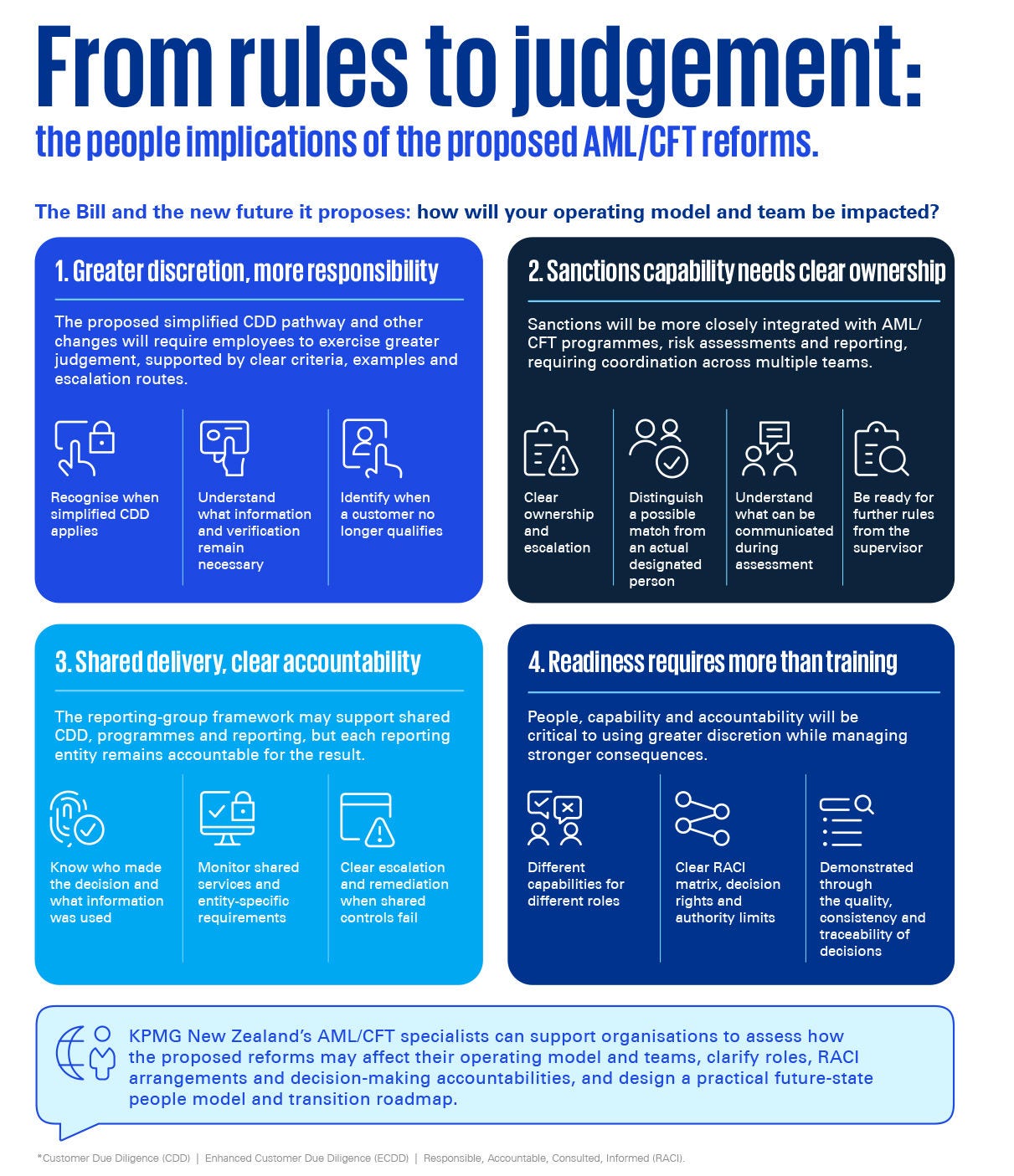
      The proposed low-risk simplified customer due diligence pathway is a key example of the shift. A reporting entity could apply simplified due diligence where particular circumstances have been assessed, on reasonable grounds, as low risk in, or based on, its risk assessment.

      This could reduce unnecessary customer friction and allow resources to be directed towards higher-risk relationships. It may also place more responsibility on the employees applying the methodology. Frontline personnel would need to recognise when approved circumstances apply, in a much broader range of circumstances than they do currently, and understand what information and verification remain necessary as well as identifying when a customer no longer qualifies.

      Compliance teams may face a different challenge. They may need to translate the risk assessment into practical decision criteria, define the evidence expected, approve exceptions and test whether similar customers are treated consistently.

      The primary risk is not discretion itself. It is unmanaged variation. Two employees should not reach materially different conclusions merely because one is more experienced, more cautious or under greater commercial pressure. Clear authority limits, practical examples and accessible escalation routes may be as important as the policy wording.

      The proposed trust changes reinforce this point. Removing the automatic enhanced customer due diligence trigger for certain trusts may provide relief, but other enhanced due diligence triggers could still apply. Employees would need to understand the revised decision path, not simply be told that trusts no longer trigger enhanced due diligence automatically.

      Info-sheet Click the image to enlarge for easier reading.

      Sanctions capability will need clear ownership

      Specified sanctions would become more closely integrated with AML/CFT programmes, risk assessments, suspicious activity provisions and supervisory arrangements. Again, this could require far more than a new policy section or an additional training module.

      A possible sanctions match may involve customer and beneficial ownership information, the nature and scope of applicable sanctions, transaction activity and suspicious activity reporting. Several teams may each hold part of the answer. Without clear ownership, a matter could stall between AML/CFT compliance, sanctions specialists, legal advisers, fraud teams and operations.

      Reporting entities, more than ever, need people who can distinguish a possible match from a true match, identify the relevant sanctions and the financial instrument to which they apply, and determine what action may follow. Customer-facing employees also need to understand what they may communicate while an assessment is underway.

      In our view, it is likely that the supervisor will prescribe aspects of the checking process through rules. The operational requirements for sanctions checking may therefore evolve as those rules are developed. Durable ownership and escalation arrangements will be more useful than a model designed around assumptions about the final screening methodology.


      Shared delivery requires clear accountability

      The proposed reporting-group framework could support shared customer due diligence, programmes, risk assessments and reports. Lead-entity responsibilities may improve coordination and reduce duplicated activity.

      Shared delivery, however, creates an important people question: who remains accountable for the result?

      An individual reporting entity would continue to carry responsibility when relying on another group member. It may therefore need to know who made the decision, what information was used, who monitors the shared service and how entity-specific requirements are addressed. Responsibility for escalation and remediation should already be clear when a shared control fails.

      Centralisation can improve consistency, but it does not remove accountability. It changes where work is performed and makes ownership more important.

      Reporting entities may end up becoming part of a reporting group by default. For example, a reporting entity may become part of a mandatory reporting group without the ability to opt in or out and therefore be required to comply with a group programme. This is a significant departure from the current system where Designated Business Group membership is voluntary and by opt-in only.

      The same principle applies to ongoing production and temporary freezing orders. These instruments could require rapid coordination between legal, compliance, operations, technology, data and customer teams. Reporting entities may need authorised personnel who can validate an instrument, identify affected records or facilities, manage confidentiality, release permitted expenses and confirm when restrictions should end.

      Those responsibilities should not depend on one experienced employee being available at the right time. Clear accountability establishing decision rights, delegates and escalation arrangements will be required.


      Readiness requires more than training

      The proposed Bill may give people more discretion in some areas while attaching stronger consequences to failures elsewhere, based on a refined risk-based approach. Organisations that treat judgement, escalation and ownership as formal parts of the control framework will be better placed than those relying mainly on updated policies and general awareness training.

      Different employees will need different capabilities. Frontline teams must recognise the limits of their authority. Compliance personnel need to design and interpret the methodology. Specialists should be able to resolve unusual or high-risk matters. Senior management needs visibility over where judgement is being exercised and whether it is appropriately controlled.

      Training remains important, but completion rates will say little about whether the new framework works in practice. Readiness will be demonstrated through the quality and consistency of decisions, and whether there is a clear record of what was decided, why and by whom.

      Is your organisation ready and how will your operating model and team be impacted? We believe many organisations will need to clarify their RACI matrix (Responsible, Accountable, Consulted, Informed) and ensure that your teams are ready for the changes. For many organisations, this is likely to require changes to the design and implementation of their future-state operating model.


      How KPMG can help

      The proposed reforms warrant careful consideration and may require you to reconsider roles and responsibilities, who and what skills you need in the future, and how important AML/CFT decisions are governed.

      Our AML/CFT specialists can help you assess the impact on your operating model and workforce, including roles and responsibilities, decision rights, escalation pathways and capability requirements. We can then support the design of a practical target-state operating model and transition roadmap, helping you prepare for a less prescriptive, risk-based approach, with clearer accountability while retaining flexibility (for potential future changes) as the Bill progresses.


      Malcolm Bruce

      Partner - Risk Consulting and Partner in charge of Alumni Programme

      KPMG in New Zealand

      Luke Daly

      Director - Consulting

      KPMG in New Zealand


      This series provides a thematic and quantitative perspective on the Anti-Money Laundering and Countering Financing of Terrorism (Omnibus) Amendment Bill for general information. The Bill may change before enactment. We recommend you read Article 1before reading this article.

      The information contained herein is of a general nature and is not intended to address the circumstances of any particular individual or entity. Although we endeavour to provide accurate and timely information, there can be no guarantee that such information is accurate as of the date it is received or that it will continue to be accurate in the future. No one should act upon such information without appropriate professional advice after a thorough examination of the particular situation.

      These materials may incorporate AI-assisted content which has been subject to human review in accordance with KPMG's Trusted AI Framework.


      You may also be interested in

      KPMG's FRM team advise NZ business facing exposure to financial and regulatory risk.

      Supporting organisations with the identification, assessment, monitoring and management of operational risks.

      New Zealand banks face rising AML risk and regulatory scrutiny. This short KPMG report explores key transaction monitoring challenges and practical recommendations.