




- In the first half of 2026, global PE deal value sat at $1 trillion across 9,294 deals.
- On a rolling twelve-month basis, both global PE investment and deal volumes dropped by small amounts, from $2.4 trillion to $2.3 trillion and from 21,060 to 20,105 deals.
- Global PE exit flow remained subdued, with 1,315 exits in the first half of the year – a pace not seen in over a decade.
Explore the Q2’26 regional insights
In Q2’26, Global PE-announced four-quarter sums amounted to $2.3 T across 20,105 transactions
Global highlights of Q2’26
Global PE market sees $1 trillion in investment at mid-year as investors focus on large deals
Global PE investment was at $1 trillion at the end of Q2’26; while somewhat shy of the investment pace seen in 2025, when annual PE investment was $2.3 trillion, the total remained very solid compared to historical norms. Deal volume, however, remained somewhat suppressed, with 9,294 deals at mid-year compared to 21,646 in all of 2025. The rolling twelve-month total for global PE investment fell slightly quarter-over-quarter, from $2.3 trillion to $2.2 trillion, while the rolling twelve-month total for deal volume fell to 20,105 — a more than five-year low. These trends highlight an ongoing flight to quality as PE investors globally continue to prioritize a smaller number of high-value, high-conviction deals, particularly in areas like AI and energy infrastructure.
Americas leads PE investment globally, but EMA region sees largest deals in Q2’26
The Americas continued to attract the largest share of global PE funding, attracting $579.1 billion across 4,219 deals in the first six months of 2026h. The US accounted for a large share of this total ($545 billion across 3,926 deals). EMA came in second with $343.2 billion across 4,067 deals, while the ASPAC region drew $67.9 billion across 639 deals. While these results appear a little softer relative to 2025’s full-year PE investment totals, the rolling twelve-month figures show more positivity, with both EMA and ASPAC seeing slight increases to their rolling twelve-month investment totals, from $775.6 billion to $782.4 billion, and from $153.7 billion to $154.1 billion, respectively.
The $10 billion launch of Helix Digital Infrastructure by KKR in the US accounted for the largest PE deal in the Americas, while the acquisition of Australia-based I-Med Radiology Network by Jardines, which was backed by Permira, accounted for the largest deal in the ASPAC region.(although Jardines is an investment conglomerate, the deal was structured as essentially a secondary buyout and was tracked as such by PitchBook).
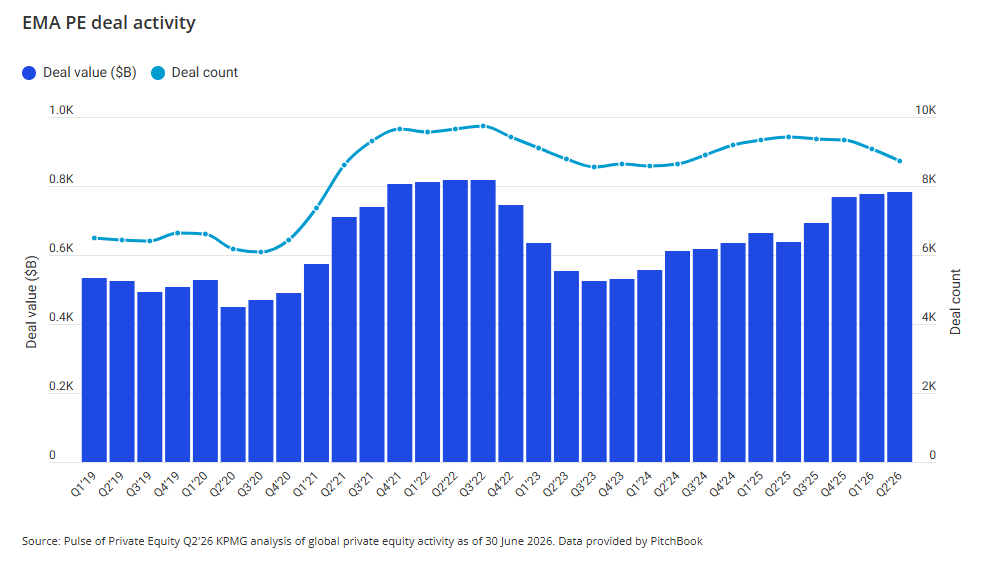
Large deals in EMA region keep PE investment resilient
The EMA region stood out in Q2’26, attracting three of the four largest PE deals globally of the quarter, including the take private of UK-based Intertek Group by EQT for $14.6 billion, the buyout of Germany-based Everllence by Bain for $12.5 billion,1 and the take private of Italy-based Recordati by CVC Capital Partners and Groupe Bruxelles Lambert.
The rolling twelve-month PE investment total remained on a positive trajectory, rising slightly from $775.7 billion in Q1’26 to $782.4 billion in Q2’26, despite a continued decline in deal volume; between Q1’26 and Q2’26, rolling twelve-month deal volume fell from 9,084 deals to 8,732.
Large, high-quality deals across the region helped keep PE investment very resilient despite ongoing geopolitical and economic uncertainties.
PE investment in the UK and India holding steady at mid-year, while other jurisdictions see pullback
Both PE investment and deal volume in the UK remained strong and remarkably steady, with $105.3 billion invested across 991 deals at mid-year compared to $210.6 billion across 2,040 deals during 2025. India also saw steady investment, with $15.8 billion invested by the end of Q2’26 compared to $31.8 billion in 2025, despite softer deal volume. After reaching three- and four-year highs respectively in 2025, both Germany and France saw PE investment slip. Germany attracted $34.9 billion across 401 deals in the first half of 2026 compared to $87.7 billion across 951 deals in 2025, while France attracted $31.1 billion across 508 deals compared to $91.8 billion across 1,170 deals.
Infrastructure and transportation the only sector tracking ahead of last year in EMA
The TMT sector attracted the largest share of PE investment in the EMA region during the first half of 2026 ($93 billion in investment across 1,442 deals), followed by the consumer and retail sector ($41.3 billion across 555 deals) and the energy and natural resources sector ($40.9 billion across 359 deals), although all three sectors were tracking below their 2025 results. Of the sectors tracked, only infrastructure and transportation was on pace to exceed its 2025 total, with $27.1 billion across 338 deals at mid-year compared to $35.4 billion across 660 deals in 2025.
Geopolitical uncertainties continued through Q2’26, causing divergent action across regions
Geopolitical tensions remained high during Q2’26, driving continued uncertainties around the full reopening of the Strait of Hormuz. Regions and individual jurisdictions took different approaches to the resulting inflation and macro-economic impacts. In the EMA region, the European Central Bank chose to raise interest rates for the first time in three years during Q2’26,4 while the Bank of England held them steady.5 In the Americas, both the US and Canada chose to maintain their interest rates.
In the ASPAC region, Japan raised its key interest rate to its highest level in over 30 years in Q2’26;6 Australia, Indonesia, Singapore and the Philippines also raised their rates. This divergence between jurisdictions is not expected to improve the overall stability of the macro-environment.
Global trends to watch for in Q3’26
Looking ahead, PE investment globally is expected to remain relatively resilient as PE investors continue to focus on large, high-quality deals and opportunities in high-priority sectors like energy, AI infrastructure, and hardware related to industrial manufacturing. Sport investments are also expected to keep growing. Deal volume will likely remain subdued, however, given no major clearing of the backlog of companies waiting to exit is expected in Q3’26 and the ongoing uncertainty in the market, particularly around tensions in the Middle East and the unstable macroeconomic environment.
The US IPO market opening up could help drive more interest in IPO and dual-track exits in the second half of the year, although any uptick in IPO activity will likely not be seen outside of the US until at least 2027. Strategic exits will likely remain the most prominent exit route in the second half of 2026.
EMA Trends to watch for in Q3’26
There is cautious optimism for private equity investment in the EMA region heading into Q3 2026. While ongoing political and geopolitical tensions are expected to persist, investors anticipate that the market will continue to demonstrate resilience. A strengthening deal pipeline should support increased investment, particularly in AI and energy infrastructure, hardware, and industrial manufacturing. At the same time, deal activity is expected to remain focused and selective, with corporate carve-outs, take-private transactions, and other transformative opportunities continuing to drive activity through the second half of 2026.Exit activity is also expected to accelerate in the second half of the year, supported by the large volume of assets that have been prepared for sale.


Explore the regional reports
1 Everllence, “Volkswagen Group enters into exclusive arrangement with Bain Capital for sale of majority stake in Everllence“25 June 2026.
2 Yahoo Finance, “KKR Launches Helix Digital Infrastructure, a New Company to Finance and Deliver the Next Generation of AI Infrastructure.” 11 June 2026.
3 Pulse of private equity Q2’’26 KPMG analysis of global private equity activity as of 30 June 2026. Data provided by PitchBook.
4 Yahoo Finance, “ECB raises interest rates for the first time in three years as Iran war fuels inflation.” 11 June 2026.
5 BBC, “What's happening to UK interest rates and what does it mean?.” 18 June 2026.
6 BBC, “Japan raises interest rate to highest for 31 years.” 16 June 2026.
Our people


