error
Subscriptions are not available for this site while you are logged into your current account.
close
Skip to main content

Loading

The page is loading.

Please wait...


      Internal controls transformation spans the entire controls lifecycle – from scoping and design to monitoring, testing, and ongoing maintenance.

      Organisations are rethinking how controls operate as regulatory expectations increase and operating models become more complex. Traditional approaches – manual, fragmented, and retrospective – limit visibility, increase cost, and expose organisations to risk.

      Advances in AI, automation, and data analytics enable a different model. Controls can now be automated, continuously monitored, and embedded directly into business processes and systems – improving efficiency, strengthening assurance, and reducing operational risk.

      The opportunity is to move from static control environments to dynamic, intelligence-led control frameworks that evolve with the organisation.
      Integrating regulation, risk, and internal controls

      Understanding regulatory obligations for internal controls

      Most organisations do. The challenge is not just identifying them – it’s understanding how they translate into risks and controls, and how those controls remain effective as regulation and the business change.

      Without clear regulatory traceability, organisations struggle to:


      • Keep pace with regulatory change
      • Demonstrate how obligations are met through controls
      • Maintain confidence in their control environment
      • Evidence compliance to regulators and Boards

      Why regulatory traceability strengthens control design

      Regulatory traceability provides a clear, auditable line of sight from laws and regulations, through risks and policies, to the controls that demonstrate compliance.

      It enables organisations to:


      • Identify and assess regulatory obligations systematically
      • Map obligations to risks, policies and controls
      • Monitor regulatory change and trigger control updates
      • Reduce duplication, gaps and manual interpretation

      From static mapping to AI-enabled control scoping

      Leading organisations are moving beyond static inventories and spreadsheets. Using AI and automation, scoping can become:


      • Continuous rather than periodic
      • Risk focused rather than exhaustive
      • Integrated directly into control design and monitoring

      This creates a stronger foundation for the rest of the controls lifecycle.


      How internal controls transformation works

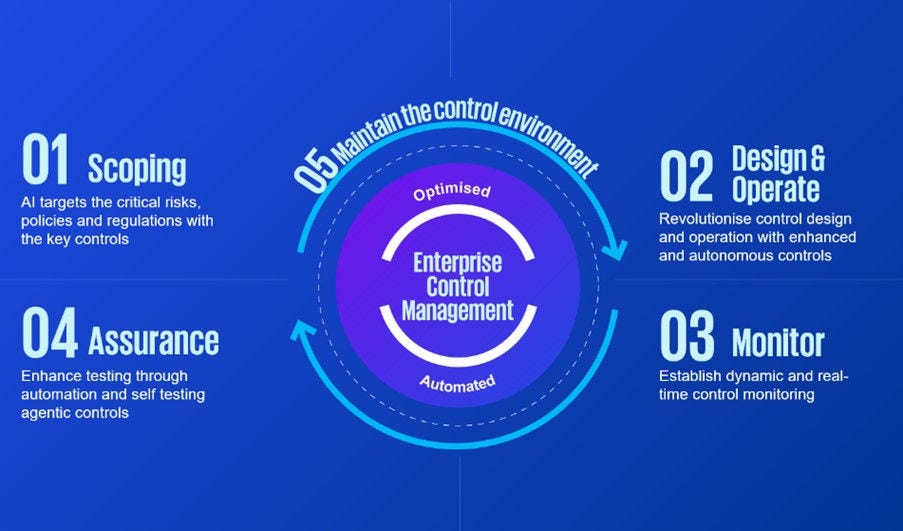
      We work with clients to redesign and transform their entire controls lifecycle, helping them move from static, manual controls to an optimised, automated and AI‑enabled control environment.

      Our approach spans:


      • Scoping controls from regulations, risks and policies
      • Designing and operating enhanced and autonomous controls
      • Monitoring controls dynamically and in real time
      • Delivering automated, evidence based assurance
      • Maintaining a sustainable, enterprise wide control environment

      The future of controls

      Controls are evolving at a rapid pace, and every stage of the traditional lifecycle will be impacted.


      From monitoring to assurance: Modernising the internal control environment

      Once controls are designed and operating, organisations face three ongoing challenges:

      • How to monitor controls effectively as the business changes
      • How to deliver assurance without excessive manual testing
      • How to maintain a sustainable, enterprise‑wide control environment

      Across the market, many organisations are responding by establishing controls utility functions – centralised capabilities that support consistent operation, monitoring, testing and reporting.

      These models help organisations:

      • Standardise controls testing and assurance
      • Improve efficiency and scalability
      • Create a single source of truth for control effectiveness
      • Build confidence with Boards, regulators and stakeholders

      Controls utilities can take different forms — from fully in‑house models, to co‑sourced and outsourced approaches — depending on maturity, scale and risk profile.

      The right model enables organisations to shift focus away from manual activity and towards insight, judgement and continuous improvement.


      Meet Nehal.

      Find out how he made the difference by introducing a financial controls framework.


      Begin your internal controls transformation

      We help organisations move from fragmented, manual controls to intelligent, enterprise‑wide control environments – aligned to risks, regulation and industry frameworks, enabled by technology and built for the future.

      Talk to us about transforming and managing your controls lifecycle.


      Our consulting insights

      Something went wrong

      Oops!! Something went wrong, please try again

      Our people

      Sarah Ward

      Partner - Risk & Regulatory

      KPMG in the UK

      Nehal Jilka

      Partner - Controls & Technology Risk Leader

      KPMG in the UK

      Lucas Ocelewicz

      Partner, Banking Risk

      KPMG in the UK

      Marina Krumbholz

      Partner, Technology Risk

      KPMG in the UK


      MTD

      Get in touch


      Discover why organisations across the UK trust KPMG to make the difference and how we can help you to do the same.