
Key findings
- Permanent placements and temp billings both increase marginally
- Vacancies fall at weakest rate in over two years
- Pay growth moderates
Data collected 10-24 September
Key findings
Data collected 10-24 September
Summary
Data from the latest KPMG and REC, UK Report on Jobs survey, compiled by S&P Global, indicated that UK hiring activity improved slightly in September. Permanent placements rose at a pace that, though marginal, was the strongest in four years, while temporary billings increased more modestly. At the same time, demand for workers declined at the weakest rate in just over two years.
Pay pressures eased, with permanent salary growth slowing for the first time in four months and temp wage inflation slipping to the lowest since May. Staff availability continued to rise sharply amid reports of redundancies and fewer job opportunities, although overall growth was the slowest in three years.
The report is compiled by S&P Global from responses to questionnaires sent to a panel of around 400 UK recruitment and employment consultancies.
Permanent placements rise for second month in a row
The KPMG/REC UK Report on Jobs survey signalled a back-to-back rise in permanent placements during September. The rate of growth picked up slightly from August and, though marginal, marked the strongest rise in four years. The upturn was supported by rising activity levels at employers and efforts to expand capacity amid improved business confidence. Temp billings also expanded in September, though growth was the least pronounced in five months.
Permanent Placements Index
Temporary Billings Index
50.0 = no-change
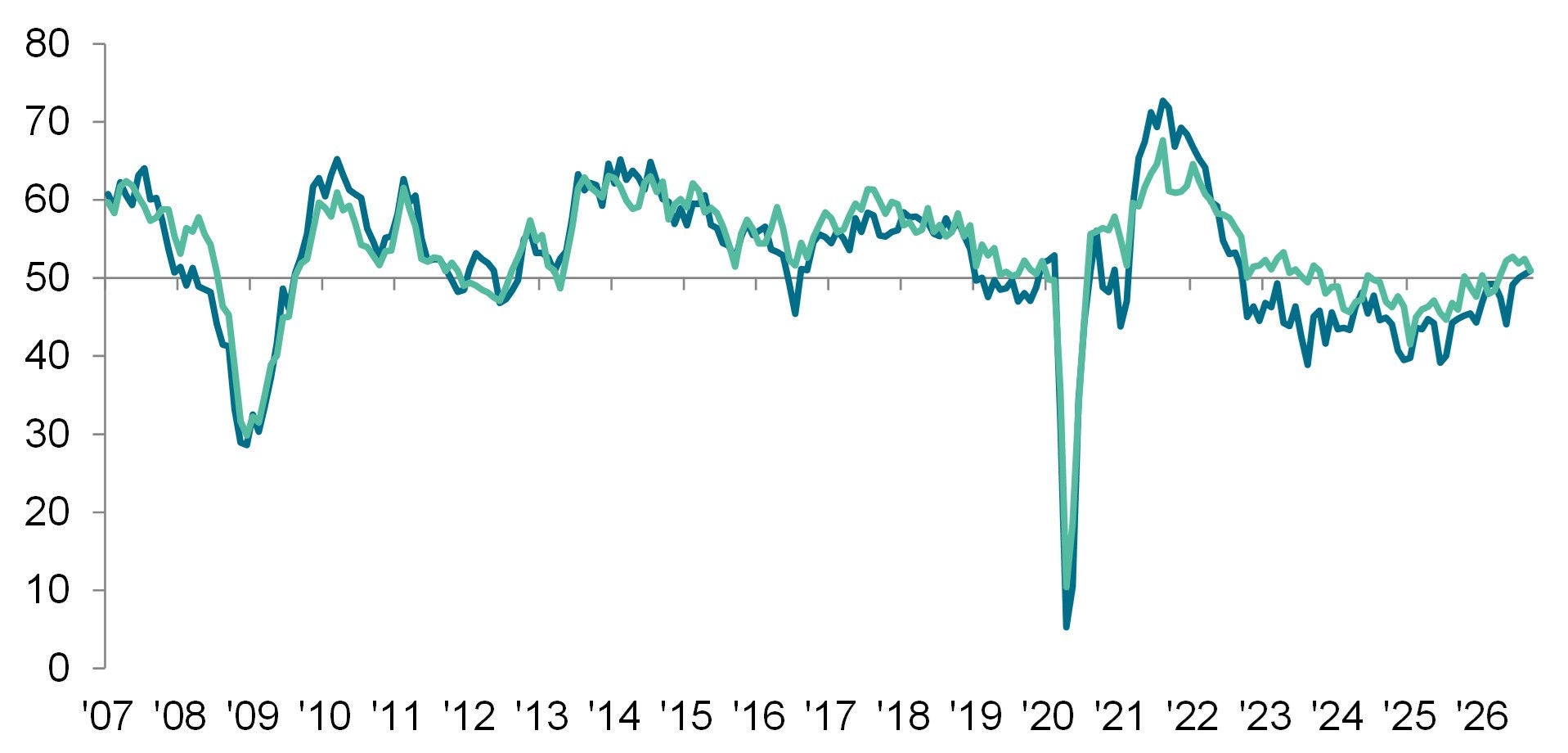 Sources: KPMG, REC, S&P Global PMI.
Permanent pay inflation softens in September
While competition for highly skilled workers continued to add upward pressure on rates of starting pay, permanent salary growth slowed for the first time in four months in September, and remained below the historical average. There were reports that cost considerations and increases in staff availability had tempered inflation. Temp pay rates likewise rose at a softer pace, with the rate of growth easing to a four-month low.
Vacancy numbers fall at softest rate since August 2024
Latest survey data indicated a further decline in overall demand for workers. However, the rate of contraction moderated to the weakest in just over two years and was only mild. Underlying data showed that both permanent and temporary vacancies declined at similarly modest rates in September. Data broken down by the private and public sectors - which are not seasonally adjusted - indicated the first improvement in demand for permanent private sector staff for over two years.
Staff availability rises at weakest pace in three years
The availability of candidates to fill roles continued to increase in September amid reports of redundancies and fewer job opportunities. Whilst sharp, the rate of expansion was the slowest in three years, driven by a softer rise in permanent candidate supply. Notably, the latter increased at the weakest rate since September 2023, while growth in temporary candidate numbers was the fastest in three months.
Regional and Sector Variations
Three of the four monitored English regions recorded higher permanent placements, led by the North of England. The South of England was the only area to see a decline.
Marked increases in temp billings were seen in the North of England and the Midlands, while a modest rise was recorded in the South of England. Meanwhile, a sharp reduction was registered in London, which ended a four-month period of growth.
Higher demand for permanent workers was recorded in half of the ten monitored job sectors during September, led by IT & Computing and Engineering. At the other end of the table, the sharpest falls in vacancies were signalled across Retail and Hotel & Catering categories.
Only the Blue Collar, IT & Computing and Nursing/Medical/Care sectors recorded growth in temp vacancies during September. Rates of decline varied across the seven other monitored job categories, with a modest fall in Engineering roles contrasting with a sharp drop in Retail jobs.
Comments
Commenting on the latest survey results, Jon Holt, Group Chief Executive and UK Senior Partner KPMG, said:
“For the second month in a row we are seeing the jobs market starting to flicker back to life, with businesses increasing their hiring across both permanent and temporary roles, and for the first time in over two years vacancies grew in the private sector.
“But this remains a fragile recovery; and in some sectors it could be seen as an employer’s market as the number of people looking for roles increases. The growing uncertainty around energy prices and higher borrowing costs also means there are still headwinds in the wider economy. Businesses will be looking to the Budget later this month for greater certainty in tax policy and a sense that the Government is willing to create the right conditions to turn this emerging confidence into investment and ultimately jobs.”
Maxine Bligh, Interim Chief Executive at the Recruitment and Employment Confederation (REC), said:
“The permanent jobs market is revving its engine, with a second successive month of growth. The last time we saw a sustained run of growth in permanent placements was between March 2021 and September 2022. If this trend continues, we could see genuine momentum building across the labour market, with both permanent and temporary hiring moving in the same direction, which is encouraging for jobseekers and the economy. The signal from the private sector is that it is ready to invest, with permanent vacancies rising for the first time in more than two years across the sector. A Budget that gets business confidence moving again is key to keeping that momentum going. The geopolitical backdrop remains challenging for government and business alike. But the Chancellor cannot seize this moment with talk of stability alone. Employers want to hear not just how we deliver stability, but how we go for growth.”
Group Chief Executive, KPMG in the UK and Switzerland and Senior Partner
KPMG in the UK
-ENDS-
Contact:
KPMG
Claire Barratt
Deputy Head of Media Relations
T: +44 (0)7923 439264
claire.barratt@kpmg.co.uk
REC
Hamant Verma
Communications Manager
T: +44 (0)20 7009 2129
hamant.verma@rec.uk.com
S&P Global
Annabel Fiddes
Economics Associate Director
S&P Global Market Intelligence
T: +44 (0)1491 461 010
annabel.fiddes@spglobal.com
Hannah Brook
EMEA Communications Manager
S&P Global Market Intelligence
T: +44-7483-439-812
hannah.brook@spglobal.com
press.mi@spglobal.com
Methodology
The KPMG and REC, UK Report on Jobs is compiled by S&P Global from responses to questionnaires sent to a panel of around 400 UK recruitment and employment consultancies.
Survey responses are collected in the second half of each month and indicate the direction of change compared to the previous month. A diffusion index is calculated for each survey variable. The index is the sum of the percentage of ‘higher’ responses and half the percentage of ‘unchanged’ responses. The indices vary between 0 and 100, with a reading above 50 indicating an overall increase compared to the previous month, and below 50 an overall decrease. The indices are then seasonally adjusted.
Underlying survey data are not revised after publication, but seasonal adjustment factors may be revised from time to time as appropriate which will affect the seasonally adjusted data series.
For further information on the survey methodology, please contact economics@spglobal.com.
Full reports and historical data from the KPMG and REC, UK Report on Jobs are available by subscription. Please contact economics@spglobal.com.
About KPMG in the UK:
KPMG is trusted to make the difference for our clients, people and the communities we work in. With our people’s deep sector expertise and cutting-edge technology, we help organisations overcome their biggest challenges and unlock new opportunities to transform and grow.
On 1 October 2024, KPMG UK and KPMG Switzerland merged to form KPMG UK/Swiss Group, scaling our strengths and amplifying the difference we make.
KPMG International Limited is a global organisation of independent professional services firms providing Audit, Tax and Advisory services in 138 countries and territories. Each KPMG firm is a legally distinct and separate entity and describes itself as such.
About REC
The REC is the voice of the recruitment industry, speaking up for great recruiters. We drive standards and empower recruitment businesses to build better futures for their candidates and themselves. We are champions of an industry which is fundamental to the strength of the UK economy. Find out more about the Recruitment & Employment Confederation at www.rec.uk.com.
About S&P Global
S&P Global (NYSE: SPGI) S&P Global provides essential intelligence. We enable governments, businesses and individuals with the right data, expertise and connected technology so that they can make decisions with conviction. From helping our customers assess new investments to guiding them through ESG and energy transition across supply chains, we unlock new opportunities, solve challenges and accelerate progress for the world.
We are widely sought after by many of the world’s leading organizations to provide credit ratings, benchmarks, analytics and workflow solutions in the global capital, commodity and automotive markets. With every one of our offerings, we help the world’s leading organizations plan for tomorrow, today. www.spglobal.com.
Disclaimer
The intellectual property rights to the data provided herein are owned by or licensed to S&P Global and/or its affiliates. Any unauthorised use, including but not limited to copying, distributing, transmitting or otherwise of any data appearing is not permitted without S&P Global’s prior consent. S&P Global shall not have any liability, duty or obligation for or relating to the content or information (“Data”) contained herein, any errors, inaccuracies, omissions or delays in the data, or for any actions taken in reliance thereon. In no event shall S&P Global be liable for any special, incidental, or consequential damages, arising out of the use of the Data.
This Content was published by S&P Global Market Intelligence and not by S&P Global Ratings, which is a separately managed division of S&P Global. Reproduction of any information, data or material, including ratings (“Content”) in any form is prohibited except with the prior written permission of the relevant party. Such party, its affiliates and suppliers (“Content Providers”) do not guarantee the accuracy, adequacy, completeness, timeliness or availability of any Content and are not responsible for any errors or omissions (negligent or otherwise), regardless of the cause, or for the results obtained from the use of such Content. In no event shall Content Providers be liable for any damages, costs, expenses, legal fees, or losses (including lost income or lost profit and opportunity costs) in connection with any use of the Content.
