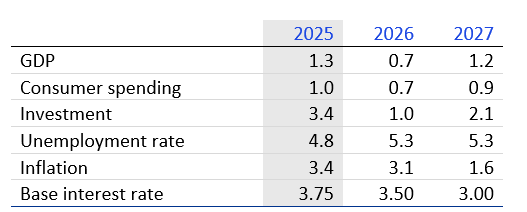
Yael Selfin, Chief Economist at KPMG UK, said: “The outlook for growth in 2026 has taken a hit from the impact of higher energy prices, a cooling labour market and weak household spending.
“The weaker growth outlook coupled with growing cost pressures will likely see firms scale back any investment plans over the coming year. Consumers could also cut back on discretionary spending to offset the squeeze from higher prices.
“With inflation likely to re-accelerate from this summer, the Bank of England will be reluctant to move quickly on rates, meaning households and businesses will face higher borrowing costs for longer, even as the economy slows.”
Inflation to peak at 3.6% in 2026
Headline inflation is now expected to rise in the second half of the year, potentially peaking at 3.6% in September 2026, due to higher wholesale energy prices, keeping inflation above the Bank of England’s 2% target over the coming year.
Businesses are likely to face more immediate cost pressures, increasing the risk of second-round effects as higher energy costs are passed on to consumers.
Interest rates to remain higher for longer
The Bank of England is expected to take a cautious approach to monetary policy. KPMG UK forecasts that interest rates will be cut only once this year, as policymakers remain concerned about persistent inflationary pressures.
Further rate cuts are now likely to be delayed until 2027, as the Bank balances the risks of rising prices against a weakening labour market and sluggish economic growth.
Government faces growing fiscal pressures
The Government faces increasing fiscal challenges despite a stable Spring Forecast. Weaker growth and higher interest rates are expected to erode fiscal headroom later this year.
If the Government intervenes to shield households from rising energy prices, the cost could reach up to £5 billion in 2026. At the same time, commitments to increase defence spending to 3% of GDP by the end of the decade may require difficult trade-offs, including potential cuts to investment budgets in other departments.
UK consumer spending is expected to remain weak
Consumer spending in 2026 is expected to remain relatively weak, with expected growth of just 0.7%, a slowdown from the 1% recorded in 2025. The succession of shocks that have dented economic growth in recent years have impacted households’ ability and willingness to spend. Household spending in the UK has grown just 1.4% since the pandemic, in stark contrast to a nearly 20% growth in the US over the same period, and 5% growth in the Eurozone.