error
Subscriptions are not available for this site while you are logged into your current account.
close
Skip to main content

Loading

The page is loading.

Please wait...


      Geopolitical disruption, the climate crisis, and evolving regulation are exposing structural weaknesses in how organisations manage supplier risk.

      Supplier risk management, the systematic process of identifying, assessing, monitoring and mitigating risk from suppliers, has long been fundamental to protecting companies from financial, operational and regulatory risks, as well as reputational harm. It allows companies to ensure they can meet regulatory due diligence expectations, protect value, and improve resilience and performance in the supply chain.

      While businesses have largely adapted well to new and emerging risks such as cybersecurity and technology, risk domains have typically been managed within their specific functions, siloed and in isolation from the other risk owners across the business. This results in fragmented ways of working, often leading to duplication, misalignment across teams, and certain risks ‘slipping through the cracks’ where they do not fit neatly into existing risk domains.

      This is frequently the case with sustainability risk, which is often poorly integrated into supplier risk management or, at worst, omitted from it altogether.

      In this article, we explore why sustainability needs to be embedded into supplier risk management and what businesses stand to gain through effective integration.

      Brian Connell

      Director

      KPMG in the UK


      Annabel Reoch

      Global Head of Ethics and Compliance

      KPMG in the UK


      Supply chain sustainability issues heavily impact enterprise value

      Many of the most material sustainability issues impacting businesses take place in the upstream supply chain. They can present considerable operational, legal and financial challenges for businesses, including the following:


      precision_manufacturing

      Supply chain disruption

      Sustainability issues can wreak havoc on supply chains. For example, the physical impacts of climate change are likely to restrict access to key natural resources as a result of changing weather patterns and biodiversity loss, and transportation routes will be badly affected – more than $122 billion of economic activity ($81 billion in international trade) is at risk from the impact of extreme climate events (Systemic risks from climate-related disruptions at ports | Nature Climate Change).
      Additionally, imports that are not compliant with sustainability regulations, such as the EU Deforestation-free Regulation (EUDR), are at risk of being confiscated at borders. Meanwhile, as recent geopolitical activity has shown, sourcing from third parties based in conflict-affected regions can significantly hinder supply.

      eco

      Reputational damage

      Human rights violations and harmful environmental practices taking place across companies’ value chains often lead to intense scrutiny from external stakeholders including the media, NGOs and investors. Managing supplier sustainability risk helps maintain your license to operate and preserves the trust of the public, regulators and business partners. It has been shown that high severity sustainability incidents can drive an average stock value loss of 5% after six months.

      account_balance

      Financial impacts

      Suppliers’ sustainability performance can also have a direct hit to companies’ bottom line. For example, companies deemed non-compliant with the Corporate Sustainability Due Diligence Directive (CSDDD) are subject to financial penalties of 3% of net worldwide turnover (note that the minimum ceiling was set at 5% before the final text of the Omnibus I Directive was adopted in February 2026). This may result from companies failing to manage the most significant adverse human rights and environmental impacts across the value chain.


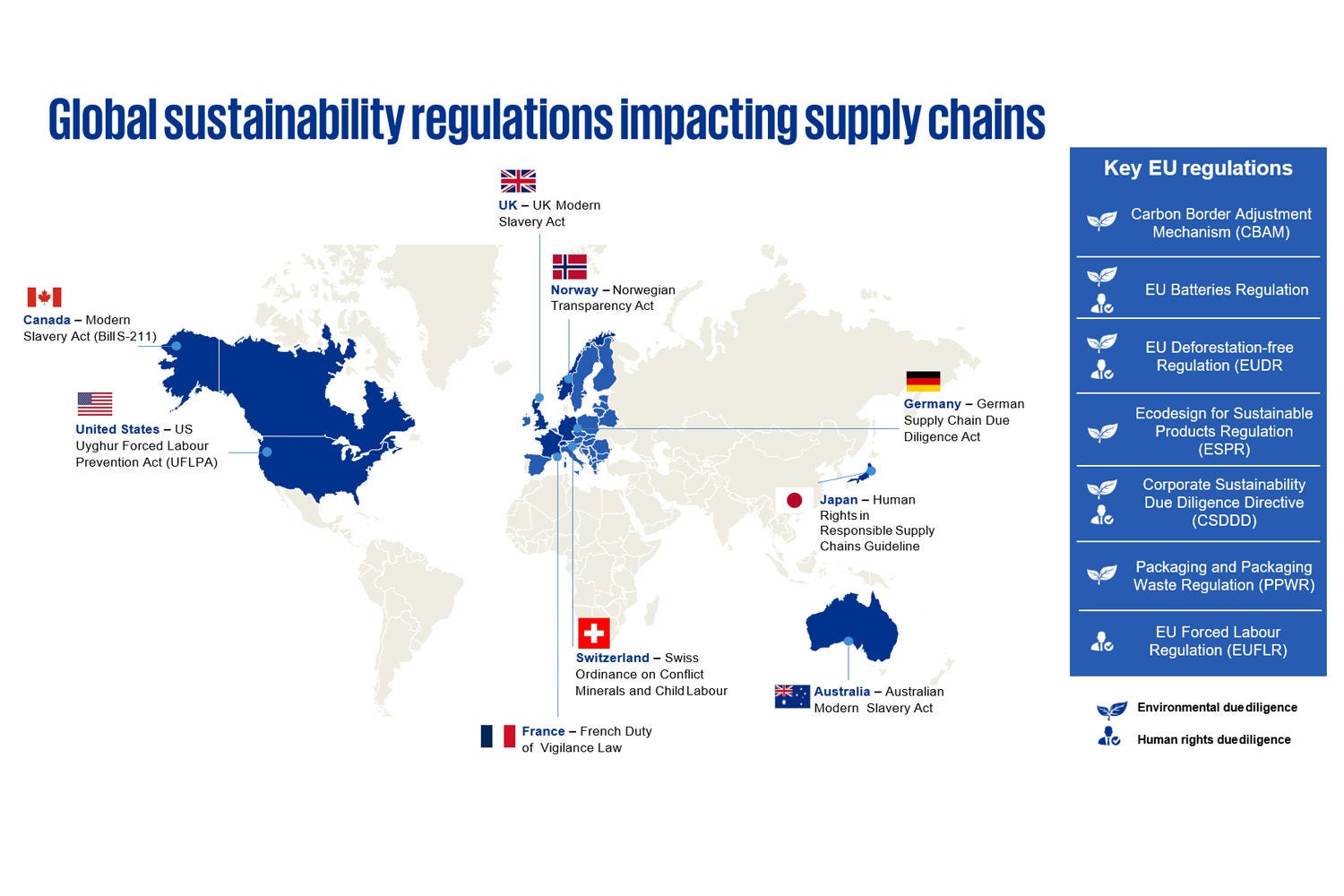
      The need for businesses to assess, manage and report their impact on sustainability issues has grown significantly in recent years. There is increased regulatory pressure for clear reporting and due diligence requirements upstream and downstream in the value chain, such as the CSDDD, EUDR, EU Packaging and Packaging Waste Regulation (EU PPWR) and EU Forced Labour Regulation (EUFLR). However, many are failing to turn the reporting ‘burden’ into a value driving exercise which reduces risk and increases resilience.

      Global sustainability regulations


      The case for managing sustainability as a key third party risk domain

      Given that sustainability issues are presenting such significant risks to business, it is crucial sustainability is effectively integrated into supplier risk management processes. Failure to do so means companies have limited visibility of potential upstream roadblocks and are vulnerable to shocks.

      In turn, supplier risk management is a key mechanism to managing sustainability issues across the supply chain in a proactive, coordinated and strategic way.

      Managing sustainability issues through supplier risk management can generate the following benefits for businesses:


      • Business continuity and supply chain resilience

        Improved visibility of the upstream supply chain, including beyond Tier 1, allows companies to anticipate risks such as single source dependencies and high-risk geographies early, and conduct scenario planning, proactive risk mitigation and monitoring. 

      • Operational efficiencies

        Regulatory and voluntary frameworks increasingly require companies to demonstrate effective human rights and environmental due diligence across their supply chains or risk fines or import/export delays. Supplier risk management translates these expectations into practice by embedding requirements and accountabilities into supplier onboarding, sourcing and contract management – rather than treating sustainability as a standalone initiative.

      • Streamlined ways of working

        Holistic management of sustainability supplier risks streamlines due diligence and monitoring as well as reducing duplication across functions, for example by standardising policies and processes, reusing evidence across teams, and jointly prioritising risks.

      • Value preservation and creation

        Strong supplier risk management protects companies’ license to operate, maintains access to markets, improves access to customers and markets with sustainability requirements, and strengthens supplier performance.


      The case for action is urgent: supply chains are being reshaped by more frequent disruption, rising stakeholder expectations and fast-evolving sustainability due diligence requirements, meaning organisations that delay action risk being forced into reactive, higher-cost remediation, lost access to products or markets, and avoidable reputational harm. Acting now allows businesses to prioritise what matters most, build credible data and governance over time, and embed supplier sustainability risk management as a ‘business as usual’ capability that protects value today while enabling future resilience and growth.

      If you’d like to learn more about how to successfully manage suppliers’ sustainability risk, look out for our next article. Alternatively, please get in touch if you’d like to discuss further.


      Our advisory insights

      Something went wrong

      Oops!! Something went wrong, please try again

      MTD

      Get in touch


      Discover why organisations across the UK trust KPMG to make the difference and how we can help you to do the same.