

The UK faces a decade of declining gas supply security driven by technical and market fundamentals, according to the government’s energy advisor, NESO¹. This emerging risk challenges the historical precedents of policy and market design, where market signals alone seem insufficient to bring forward new gas supply capacity and achieve the UK’s regulatory requirement for energy security.

How have we historically achieved energy security?
The natural gas supply chain is the provider of resilience to the UK energy markets and wider economy – providing heat to homes and businesses and providing backup power to support intermittent renewable generation. Unlike the electricity wholesale market, the UK government takes a broadly ‘hands off’ approach to the wholesale gas market. Since the discovery of North Sea reserves and then accelerated through privatisation, the UK has benefited from a diversified portfolio of gas supply options to bring natural gas into the UK energy markets.
This market-led approach has relied on private companies reacting to market signals and developing infrastructure to capitalise on the premium UK gas market, resulting in a portfolio of gas supply points, including: pipeline supply from both the UK Continental Shelf (UKCS) and Norwegian Continental Shelf (NCS), three LNG import terminals (Dragon, South Hook and GrainLNG), gas storage facilities, and interconnection with Europe. The current balance of supply capacity across this portfolio is shown in Figure A².
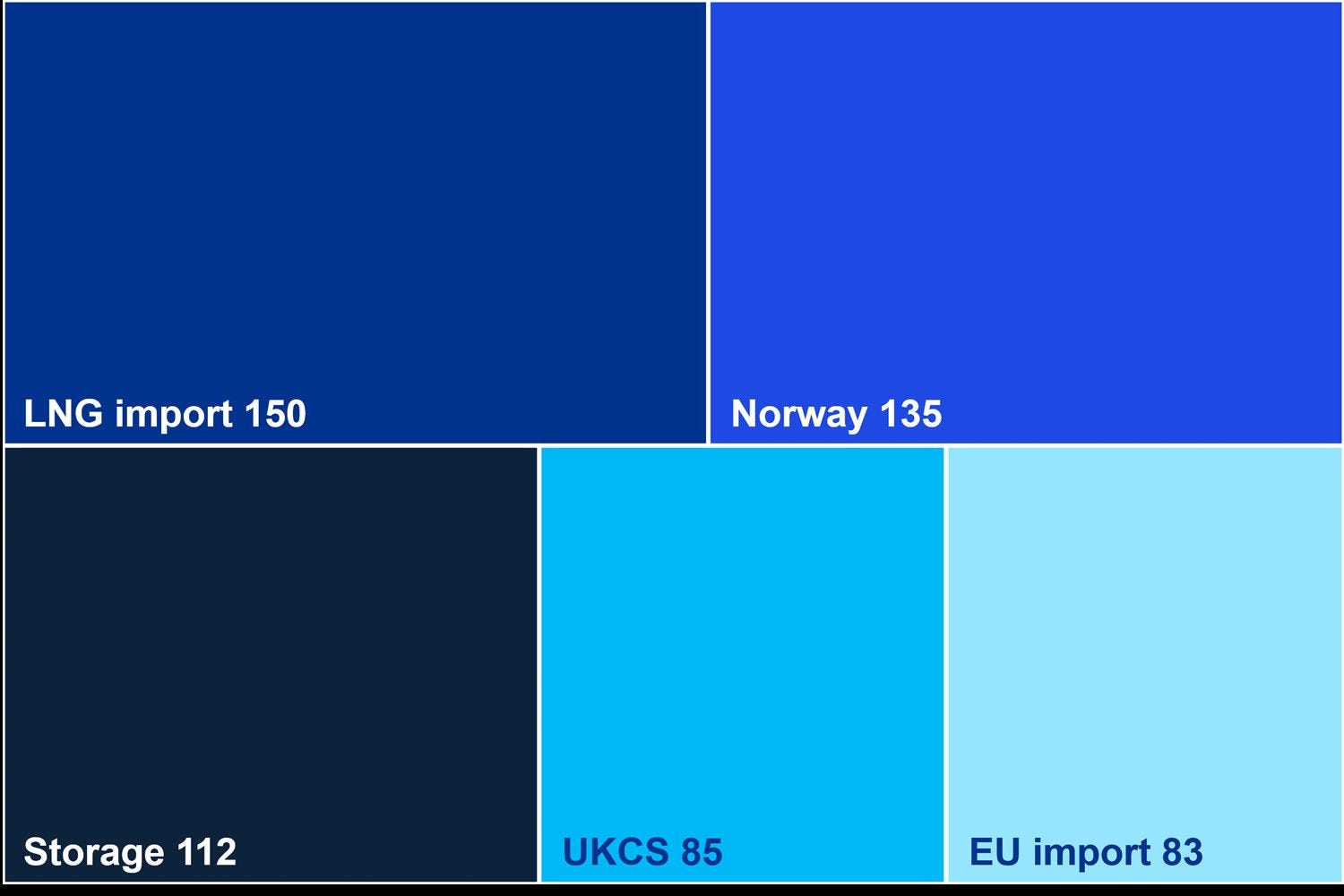 Figure A: 2026 supply capacities (bcm)
Given the importance of maintaining gas supplies to the energy security of the economy, in 2011 the UK adopted the EU standard for gas supply resilience3, known as the N-1 test. These regulations place an obligation on the UK Secretary of State to ensure the necessary measures are taken to ensure a positive margin of supply assuming:
- Demand = peak 1-in-20 day
- Supply = maximum technical capability of all supply infrastructure minus the single largest piece of supply infrastructure
Since adopting this regulatory standard, the UK has always maintained a positive N-1 margin, as reported through the Gas Winter Outlooks published by National Gas Transmission (NGT)².
What’s the problem now?
In November 2025 the National Energy System Operator (NESO) published its Gas Security of Supply Assessment1 (GSSA), which was carried out at the request of DESNZ. The GSSA took a forwarding looking perspective, assessing expected gas security margins in the winters of 2030 and 2035. The N-1 margin was calculated using NESO’s 10-Year Forecast scenario – which represents NESOs “best view of supply and demand”, alongside the four Future Energy Scenarios (FES). The analysis identified a common failure across all scenarios of the N-1 standard in 2030 and the majority of scenarios continuing to fail the standard in 2035. A comparison of the historical margins assessed through NGT’s Gas Winter Outlooks and NESOs expected margins of the 10-Year Forecast, are shown in Figure B.
The problem highlighted by NESO is one of reducing gas supply capacity against a backdrop of stubbornly high peak demand. In 2000 pipeline supplies contributed 98% of UK supply, in 2025 they contributed 40%⁴. Looking forwards¹, pipeline supplies will continue to reduce given the super-mature status of the UKCS basin (reducing at circa. 10% per year) and expected declines in Norwegian supplies of 7% per year. This reduction in pipeline capacity is being insufficiently compensated by arbitrage values for the remaining supply options (LNG import terminals, interconnectors and storage) which is required to bring forward replacement supply capacity.
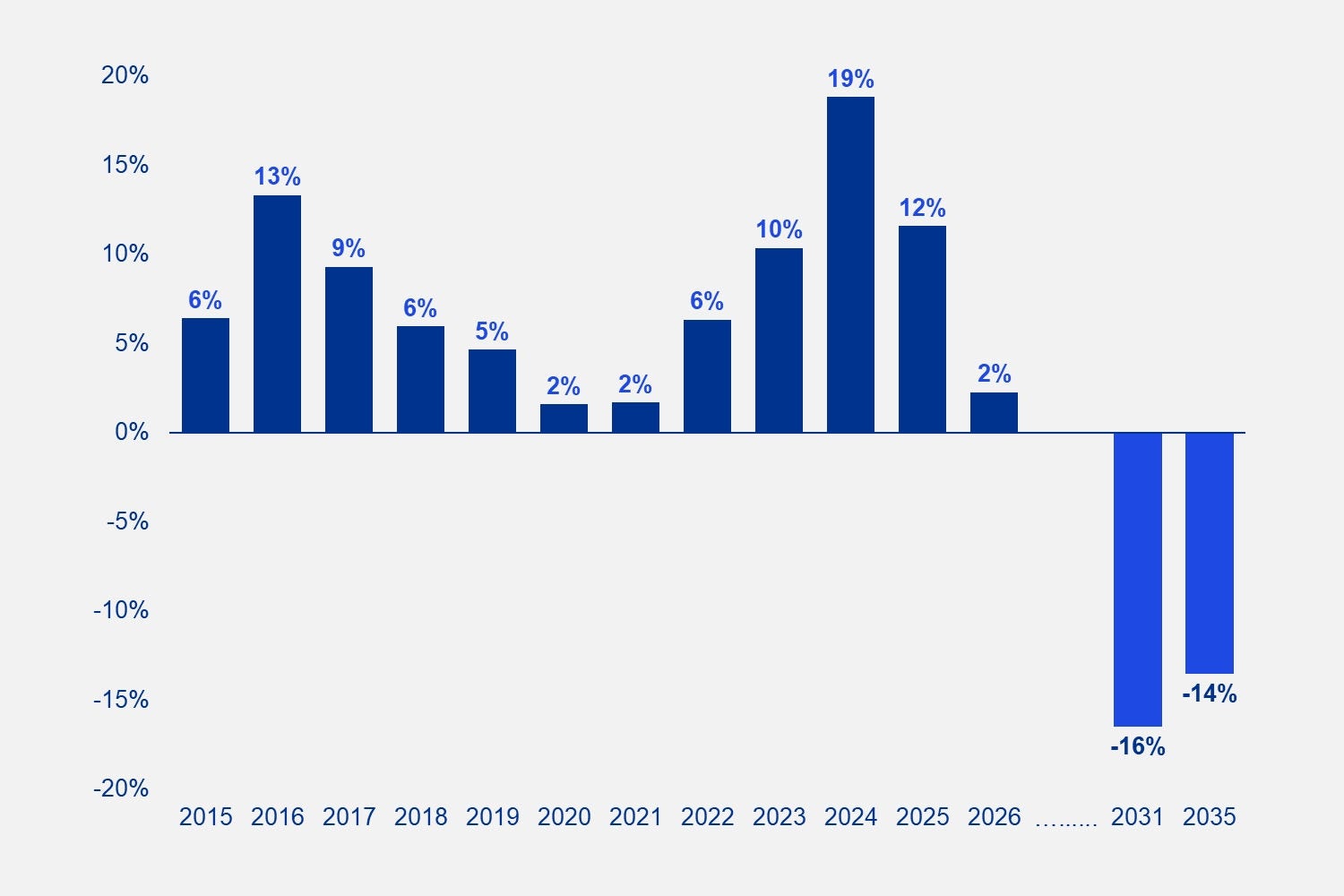 Figure B: System stress test supply margins1,2 (N-1 test)
This issue sits at the complex interface of net zero and energy security. Overall, UK gas demand has been reducing over the 21st Century through building renewable generation capacity and deindustrialisation – both reducing UK territorial emissions. However, gas still plays an important role in maintaining security of supply, resulting in peak demand remaining largely unchanged over the same time-period. As the function of the gas market incrementally shifts from day-to-day energy provider to energy insurance provider, this transformation leads to a natural decline in the commercial value of incremental supply infrastructure. Therefore, today’s market looks very different to the market of the 90’s and early 2000’s, given that a legal security of supply standard must be maintained whilst being caught between structurally declining pipeline supplies and insufficient commercial value to stimulate investment in non-UKCS supply capacity.
Why does it matter?
Were there to be insufficient supply capacity to meet demand, NGT would invoke the gas supply emergency plan⁵. All available supply-side measures would be actioned first to balance the system, followed by demand-side measures – which would involve ceasing supplies to gas users to maintain minimum pressures in the gas network – a process called ‘load shedding’. If load-shedding was required, the priority would be protecting domestic and vulnerable customers, which means large single points of demand such as industrial sites and power generators would be the first to be cut off. Therefore, declining gas supply security matters for several reasons:
The fact that NESO is forecasting a structural decline in gas security implies the long-held position of the UK government that gas supply will be adequately maintained through a passive ‘market-based’ approach is under threat. Given the broad based societal and economic impacts that would result from a gas supply emergency, and the lack of market signals bringing forward new infrastructure to meet the UK’s regulatory resilience requirements over the remainder of this decade, the UK government may be forced to intervene in the wholesale gas market and support infrastructure developers to build new supply capacity.
What technical solutions are available?
There are broadly two potential approaches that could be deployed to maintain the UK’s security of supply:
- Demand-led (e.g., reducing peak demand)
- Supply-led (e.g., increasing supply capacity)
On the face of it, the first approach would seem to fit more neatly with the current direction of UK energy policy where gas demand (both average and peak) is intended to reduce through the roll out of electrification technologies, supported via the Warm Homes Plan and capital grants. However, NESO’s assessment of the three net-zero compliant FES scenarios (Hydrogen Evolution, Electric Engagement and Holistic Transition) all fail the N-1 test in 2030. Given that the more electrification-focused scenarios already include hitherto unseen adoption rates of electrified technologies, it seems unjustifiable to assume even greater adoption rates will occur to allow supply and demand to naturally rebalance.
This leaves us to consider the second approach of stimulating new supply capacity, which was the focus of DESNZ’s gas security of supply consultation⁶ in early 2026. Options exist in this space, which include:
- Issuing new North Sea exploration and production licenses for UKCS gas production
- Developing more interconnection with Europe
- Developing more LNG import and regasification capacity
- Developing more gas storage
UKCS production has been in structural decline from its peak in 2000 at 117 bcm to recent production levels of 31 bcm in 2025⁷. Given the super-mature nature of the UKCS, further exploration is unlikely to significantly shift the balance of supply. A recent assessment by S&P Global⁷ estimates a positive policy environment could unlock production of 2 bcm pa, which is equal to less than one year of overall basin decline. This sentiment is shared by NESO in the GSSA who conclude “exploration of new [UKCS] fields is unlikely to deliver material new capacity within the required period”. Therefore, further supply capacity would likely need to be via the other routes, a summary of the three remaining options is given in Table A.
Is support needed to stimulate investment?
All three non-UKCS supply options have the same fundamental business model, where a developer builds infrastructure and recovers their costs via capacity auctions to third party traders. Traders ascribe value to infrastructure capacity based on the access rights being offered by the infrastructure provider and the expected earnings from trading activity resulting from capturing arbitrage opportunities. There are currently limited market signals to bring forward new supply capacity, due to reduced arbitrage values limiting the commercial value of infrastructure access:
Across asset classes there seems to be a common challenge of insufficient commercial value from arbitrage opportunities to recover the lifetime costs of infrastructure provision. Given the broader market context of declining pipeline supply and stubbornly high peak demand, what seems to emerge is a trade-off between maintaining security of supply requirements and the precedent ‘market-based’ approach by the UK government to wholesale gas supply. This trade off is recognised in the recent gas security of supply consultation, where the UK government is considering potential market intervention options to maintain security of supply. Such market intervention could take many forms but would likely be in the form of a revenue support model to bridge the gap between lifetime costs and the commercial value of new infrastructure.
Overall, NESO’s assessment of UK gas supply security is a cannery in the coalmine signalling the structural challenges the market faces in bringing forward the necessary infrastructure to maintain supply resilience. It is now over to the UK government to consider its position and determine if an adjustment in policy is needed to support additional infrastructure. Given the critically of this issue, and the timescale highlighted by NESO regarding insufficient supply margins, the UK government will need to act with some haste if it is to facilitate new supply capacity this decade.
¹Gas Security of Supply Assessment, National Energy System Operator, 2025
²Gas Winter Outlooks, National Gas Transmission
³The Gas (Security of Supply and Network Code) Regulations
⁴Gas production and consumption, DUKES 4.1.1
⁵Network Gas Supply Emergency Procedure, National Gas Transmission, 2025
⁶Gas System in Transition: Security of Supply Consultation, DESNZ, 2026
⁷UK Gas Market Profile, S&P Global Energy, 2026
⁸Global LNG and Gas Prices, S&P Global Energy, 2026
Notes:
A – Strategic control has been assessed by the number of third-party dependencies required to supply gas at the point of demand
Our advisory insights
Something went wrong
Oops!! Something went wrong, please try again

Get in touch
Discover why organisations across the UK trust KPMG to make the difference and how we can help you to do the same.