

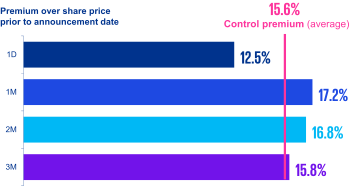
Two years after its previous publication, KPMG in Poland returns with another analysis of tender offers for shares of companies listed on the Warsaw Stock Exchange, this time covering the period from 1 January 2016 to 31 December 2025. The findings confirm the continued decline in takeover bid activity. In 2024-2025, only one new takeover bid was announced involving an investor who did not previously hold effective control over the target company. Based on its examination of the tender offers market in Poland during the 2016-2025 period, KPMG in Poland estimated the control premium at 15.6%.
Key report highlights
What is a control premium and how is it calculated?
Premia za kontrolę stanowi dodatkową premię ponad proporcjonalną wartość godziwą udziału we A control premium is the excess over the pro-rata fair value of the equity interest in a business that a bidder is willing to pay to own a controlling stake in the acquired company. In other words, the control premium quantifies the additional benefits that an investor obtains by becoming a majority shareholder.
Owning a controlling interest in a company makes it possible to take decisions regarding the sale of the business, nominate and revoke members of the management board and set the rules for their remuneration, manage the company’s assets, declare dividends and influence the strategic direction of the organisation.
KPMG in Poland estimates the control premium associated with acquiring control of a company based on an examination of the tender offers market in Poland over a 10-year period. The analysis covers successful tender offers for shares of companies listed on the WSE in which the investor’s objective was to obtain control of the target company.
For each transaction, the control premium is calculated as the median of the percentage differences between the price paid for the tendered shares and the market share prices observed prior to the announcement of the tender offer. To mitigate the impact of short-term share price volatility, four distinct reference share prices preceding the announcement date are used. The final control premium is then derived as the arithmetic mean of the four median premiums calculated relative to the respective reference share prices of the target companies.
„The findings of the latest analysis confirm the continued decline in the number of takeover bids involving companies listed on the WSE. In 2024-2025, only one new takeover bid was announced involving an investor who did not previously hold effective control over the target company. This trend reflects broader developments in the Polish capital market. In 2025, a total of 15 companies were delisted from the WSE, while only three initial public offerings were completed. Interestingly, 2026 has already begun to paint a very different picture. By the date of this report, several takeover bids have already been announced, although we leave a detailed discussion of these developments for the next edition of the report.”

Tomasz Wiśniewski
Partner, Chief Operating Officer, Head of Valuations Team in Poland & CEE
KPMG in Poland
Key findings of the analysis
Between 2016 and 2025, KPMG in Poland identified 222 successful tender offers, excluding buybacks, for shares of WSE-listed companies. In 75 cases, the investor’s intention was to acquire control of the company, while 52 tender offers were included in the control premium analysis.
On this basis, KPMG in Poland estimated the control premium at 15.6%. The calculation took into account the differences between the price paid for the tendered shares and the market share prices observed at four points in time prior to the tender offer announcement date. Detailed findings, the methodology applied and a comparison of premiums across the respective periods are presented in the report.
KPMG study on tender offers for shares of WSE-listed companies
„A comparison of control premiums across selected global capital markets indicates clear differences between developed and emerging markets. The highest premiums are observed in the United States and in developed markets in Asia and Oceania, where they exceed 30%. The control premium for Poland, calculated at 20.6% for the purposes of the international comparison, is slightly higher than that recorded in emerging markets, but significantly lower than in all developed markets included in the analysis. The results indicate a clear pattern: the more developed a financial market, the higher the control premium typically observed.”

Control premiums in Poland historically
Download the report
Contact us
Learn more about how KPMG's knowledge and technology can help you and your business.
See also


Our experts
Tomasz Wiśniewski
Partner, Chief Operating Officer, Head of Valuations Team in Poland & CEE
KPMG in Poland

Newsletter
Want to receive the latest business updates? Subscribe to our newsletter.