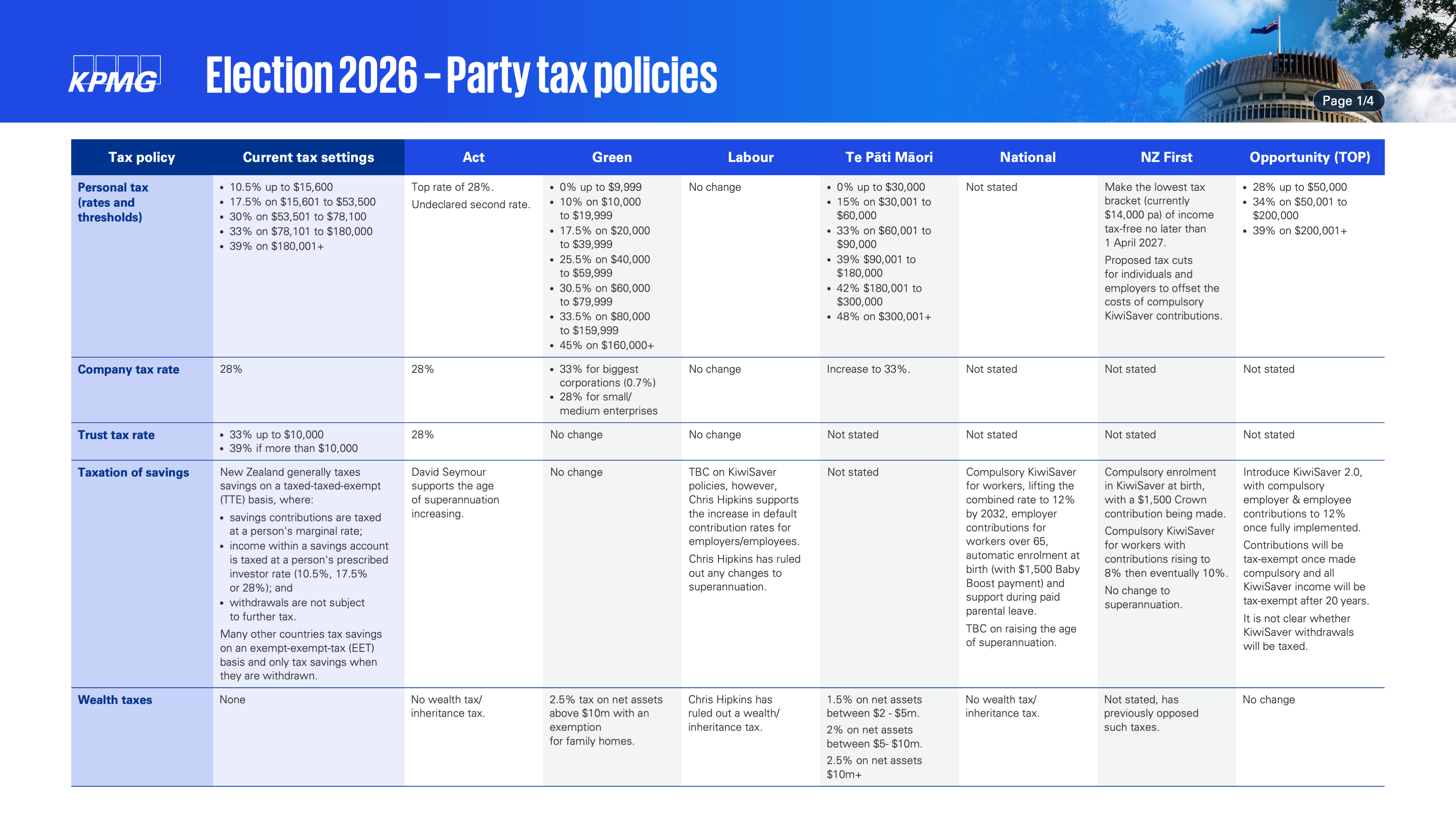
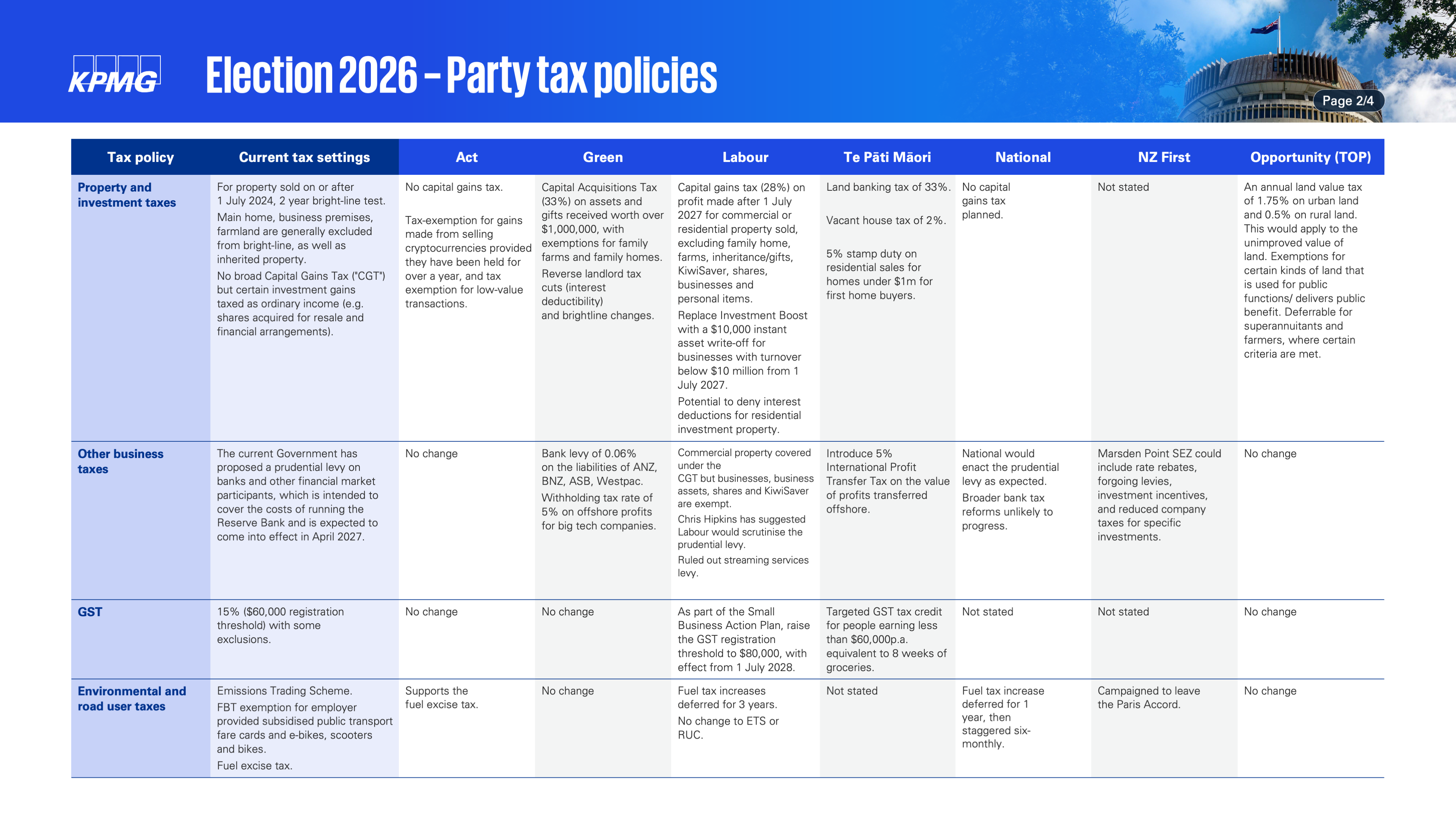
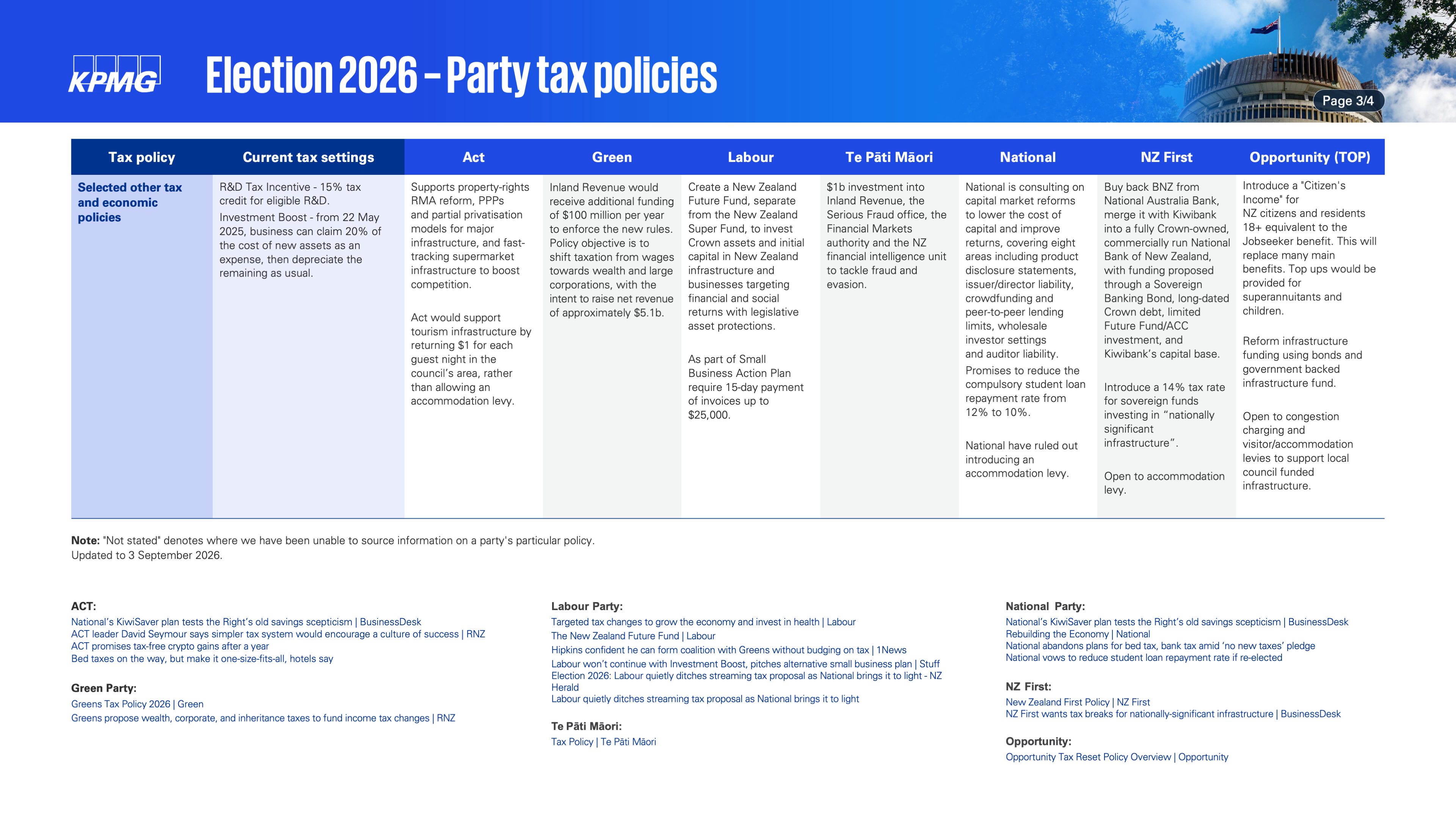
With fewer than 100 days to go to the general election on November 7th, tax policy is shaping up to be a key differentiator between the parties. See our tax tracker which summarises the key announcements to date.

      Labour, the Greens and Opportunity (formerly TOP) are all proposing broader structural changes, including a mix of capital gains tax, land tax, wealth and inheritance taxes to support either increased government investment or in the case of Opportunity a chance to reset the benefit system with a move towards a universal basic income.

      By contrast National and ACT are placing more emphasis on lower-tax settings and targeted reforms to boost investment. New Zealand First appears open to some reform, particularly for lower-income households, but is unsurprisingly holding firm on retirement settings. 

      This election the policy debate is not just about the pros and cons of individual measures, but about whether New Zealand’s settings are in need of a more fundamental reset to address current and future fiscal challenges as highlighted in Inland Revenue’s Long-term Insights Briefing


      What is changing?

      While invariably some measures may not survive coalition negotiations (particularly those calling for more radical reform) the direction of travel is clear: further tax change appears inevitable whatever the shape of the next Government.

      Areas to watch include:


      window

      KiwiSaver and retirement savings

      Increased contribution rates appear certain given broad support across a number of parties.

      window

      Personal income tax rate changes

      Whether through cuts for lower-incomes, cost of living relief, tax-free thresholds or changes at higher income levels, depending on the make-up of the next government.


      window

      Taxation of capital gains

      If Labour leads the next government, a capital gains tax appears to be a common denominator in a coalition with any of the Greens, Opportunity or Te Pāti Māori all of whom are calling for more structural tax reforms.

      window

      Taxes applicable to banks

      Unless the ACT party holds the deciding vote in future coalition arrangements, additional taxes applicable to banks appear likely with most of the parties calling for some reforms.


      Will we see a repeal of recent reforms?

      A change in government could of course also see some of the more recent tax policy reforms reversed. Labour has for instance already announced it would replace Investment Boost with a package of small business measures. Other reforms, such as interest deductibility, property bright-line, and thin capitalisation for infrastructure could also be reviewed, depending on the make up of the next Government.  

      Much has been written about the cost of the electoral cycle policy churn which sees policies come in and go with every change in political leadership. Undeniably businesses thrive best within stable settings, with predictable rules that foster investment over a longer-term horizon. Recent experience on the flip-flop over commercial building depreciation, and now the shifting sands under Investment Boost, both serve to erode confidence in the stability of government policy.

      As a result, future attempts to use tax as an investment incentive may face an even tougher task to capture the attention of taxpayers too fatigued by the policy churn to notice.


      Election policies at a glance

      Get in touch

      Our election tax policy tracker summarises the key proposals announced to date and will be updated as further policies are released.

      If you would like to discuss how the proposals could affect your business, investment and workforce planning, reach out to us on the contacts below. 

      Sladja Lines

      Director - New Zealand Tax Policy Lead

      KPMG in New Zealand

      Rachel Piper

      Partner - Tax

      KPMG in New Zealand

      Robert Grignon

      Director - Tax

      KPMG in New Zealand


      Taxmail

      Our views on current tax issues

      earth