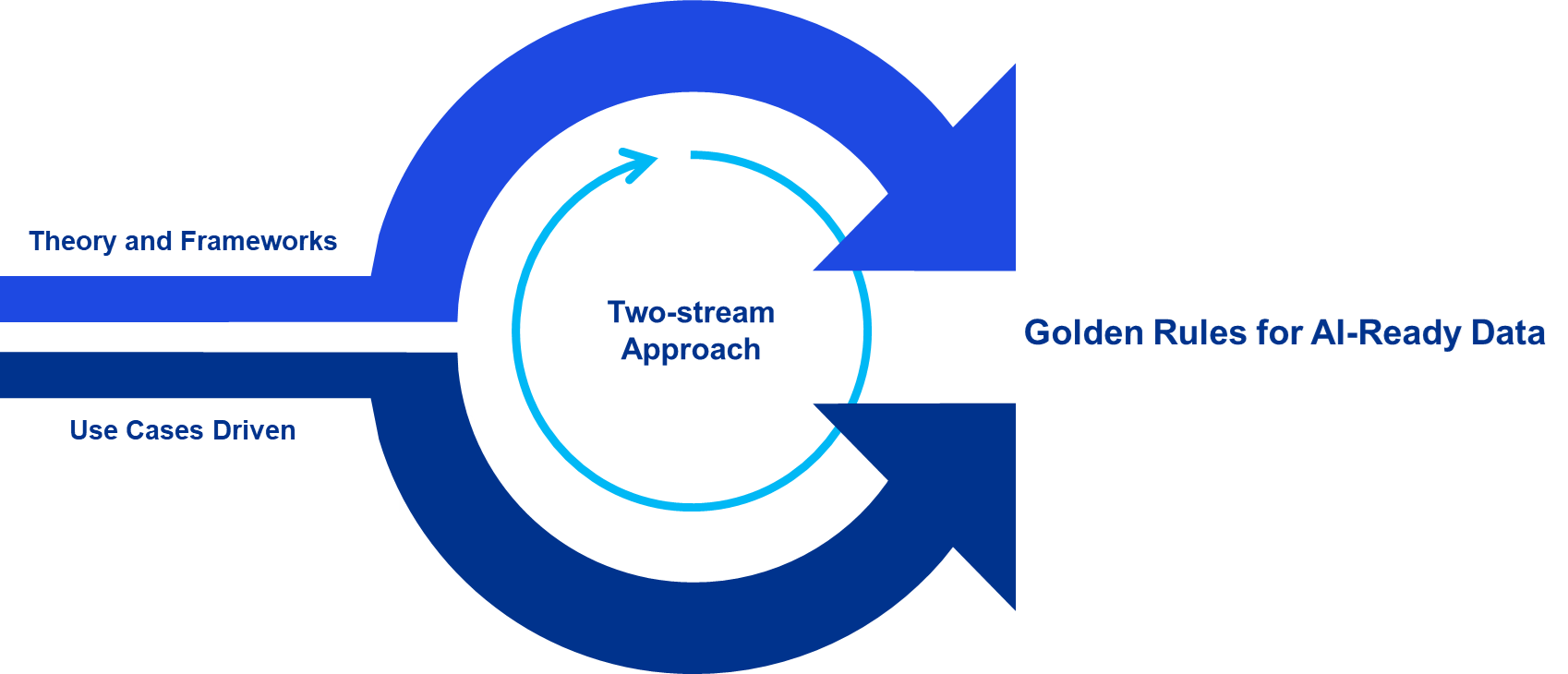
As mentioned, initial AI use cases are generally focused on task optimization through summarizing, and, for example, translating data. Therefore, a proper approach must allow for AI use cases to evolve towards agentic and even autonomous AI, resulting in new requirements on AI-ready data. Furthermore, such an approach should be balancing the current (theoretical) frameworks and leverage these where possible – most frameworks will remain relevant for AI models – against the maturity of use cases.
Case in point: a large Dutch financial institution wanted to scale its AI initiatives, but faced a significant hurdle: how to manage the unstructured data within a data governance framework that was solely designed for structured data. For this client, we developed a two-stream approach:
- A workstream with regard to theory and frameworks. Perform an inside-out analysis to identify all relevant policies and frameworks that would be affected by the introduction of AI models and by managing AI-ready data. Subsequently, perform an outside-in analysis by leveraging our available AI-ready frameworks to bring in new guidance, resulting in an overview of required changes and suggested approaches.
- A workstream with regard to use cases. In parallel, we worked hands-on in use cases to identify what was truly needed and to test the practicality of the suggested framework changes from the other workstream. By iteratively implementing solutions and documenting lessons learned, we built up internal ‘case law’, a practical knowledge base that continuously refines the approach, which was translated into a set of ‘AI-ready Data Golden Rules’.
The interaction between both workstreams was crucial for the result; a set of pragmatic Golden Rules for AI-ready data which were incorporated in the ‘AI Way of Working’, ensuring that all (future) use cases reflect on these aspects and further grow AI and data literacy across the organization.