In July 2026, exceptionally low water levels on the Danube, driven by severe drought and prolonged heat, disrupted inland shipping and threatened cooling water availability for Hungary's Paks nuclear power plant. As the plant supplies approximately half of Hungary's electricity, the event exposed vulnerabilities across both transport and energy infrastructure. A single climate hazard triggered operational and economic disruption far beyond the location of the initial impact.

      For companies, this event highlights an important gap in how climate risks are often assessed. Most assessments focus on the exposure of physical assets to hazards such as flooding, heat, drought and wildfire. While this remains an essential foundation, it does not always capture how disruptions occur in practice. Impacts can also be transferred through the infrastructure systems and services that support operations, including energy, water, transport and digital networks.

      At KPMG, we believe resilience depends as much on understanding such critical dependencies as it does on understanding asset exposure to climate hazards. Organizations that can identify the systems and services they depend on, assess their exposure to climate risks, and understand potential vulnerabilities are better equipped to navigate disruptions through informed adaptation decisions.
      Climate risks travel through infrastructure networks

      Climate-related disruptions are no longer isolated events limited to individual business operations. As flooding, heat, drought, and other climate hazards place growing pressure on essential infrastructure, impacts can spread across sectors and geographies, amplifying economic consequences through systems on which companies depend.

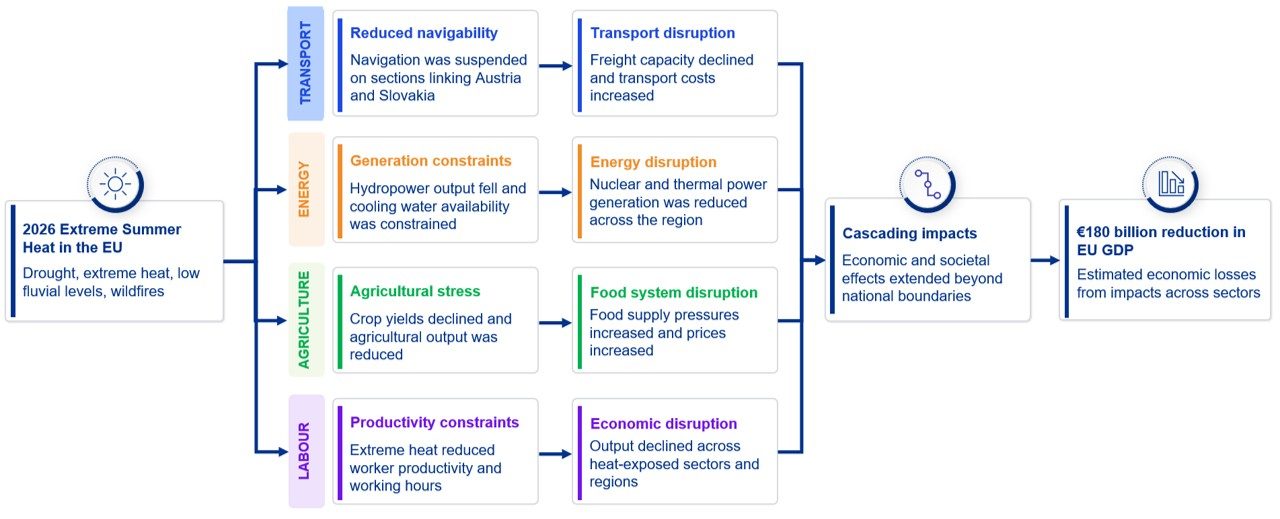
      The Danube drought provides a clear example of how climate-related disruptions can strain multiple interconnected systems simultaneously, creating impacts that extend across sectors and national boundaries:

      • Inland shipping was suspended along sections of the river linking Austria and Slovakia, freight capacity declined, and transport costs increased as cargo shifted to alternative routes.
      • At the same time, power generation was reduced across Central and Eastern Europe as hydropower output fell in Serbia and cooling water constraints affected nuclear and thermal power plants in Hungary, Romania and other countries across the region.

      The drought affected both transport and energy systems. Triodos Bank estimates that, despite uncertainty over overlapping effects, the combined impacts of extreme heat and drought across labour productivity, agriculture, energy, transport and other sectors could reduce EU GDP by around 1%. This is equivalent to approximately €180 billion and broadly matches the EU’s expected economic growth for 2026.

      The evidence is clear: infrastructure has become a key pathway through which climate hazards translate into operational disruption, economic losses and broader systemic risk.

      climate 1

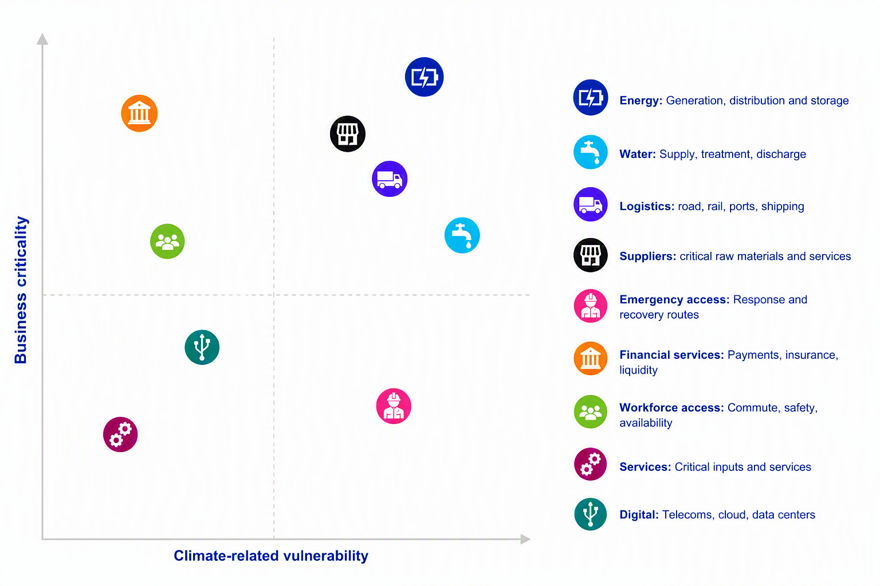
      The limitations of an asset-focused view on climate risks

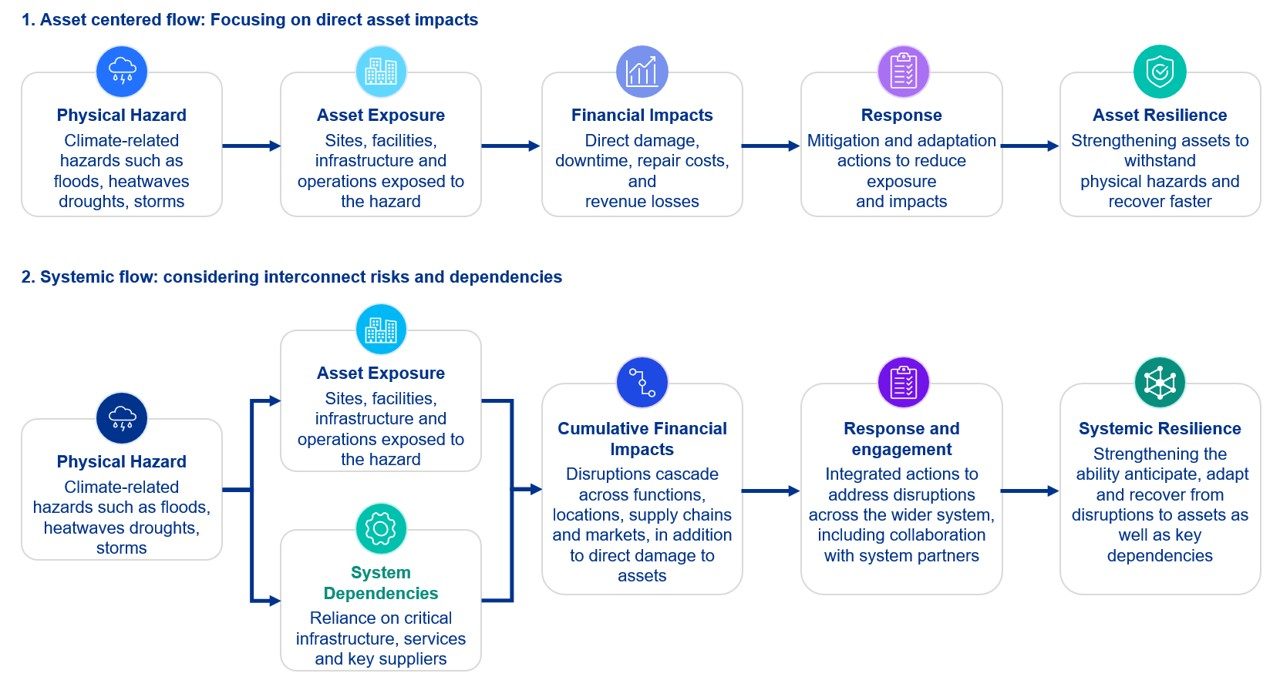
      Corporate climate risk assessments have matured significantly in recent years. Many organizations now use climate scenarios, location-specific hazard data, vulnerability scoring and financial quantification to understand how physical hazards may affect assets and operations. While these assessments have improved internal understanding and helped organizations target adaptation investments more effectively, they remain largely focused on how flooding, heat, drought, and other climate hazards could affect facilities, workers, and production. These risks are important, but they provide only a partial view of how disruption occurs in practice.

      As the previous section established, climate impacts do not always affect organizations through direct damage alone. Organizations rely on a range of external infrastructure, services, and suppliers to operate. As a result, disruptions to these resources and services can impact operations even when assets remain unaffected. Interruptions to power, transport, water, or digital connectivity can quickly threaten continuity.

      climate 2

      These resources and services can be understood as critical dependencies: the external systems, services and partners that support essential business functions. While system dependencies are well understood operationally, they are not always assessed as part of climate risk assessments. Understanding the full spectrum of climate risk therefore requires organizations to identify which dependencies are most important, how they could be affected by climate hazards, and what consequences their disruption could have for operations, supply chains, and customers.

      This broader perspective is becoming an increasingly essential component of adaptation planning.

      climate 3

      A systems approach to climate risk management

      At KPMG, we help organizations understand how climate hazards can affect both their assets and critical dependencies, and how these impacts can result in operational and financial consequences. To address these risks, we apply a five-step approach that builds on asset-focused climate risk assessments. The approach helps organizations identify climate-vulnerable dependencies, understand how risks can propagate through interconnected systems, and translate these insights into actions.

      1. Identify climate-vulnerable dependencies. Building on the assessment of assets and critical business functions, organizations should first map the infrastructure, services and suppliers that support them. Assess which dependencies are exposed to relevant climate hazards and could become sources of operational disruption.
      2. Assess associated risks under future climate scenarios. Evaluate how climate hazards may affect assets and critical dependencies under different climate futures. This helps organizations understand how vulnerability may change over time and which dependencies could face greater exposure.
      3. Evaluate cascading impacts on the business. Assess how disruption to assets and critical dependencies could affect operations, supply chains, customers, and markets. Identify where climate impacts may spread across connected systems and create the most significant operational disruptions and financial losses.
      4. Identify adaptation opportunities across the wider system. Determine where risks can be reduced through adaptation measures such as strengthening individual assets, increasing flexibility in sourcing, logistics, and energy supply, as well as reducing reliance on vulnerable infrastructure. Where risks sit beyond organizational control, coordinated action with suppliers, infrastructure operators, utilities and public authorities will often be needed.
      5. Develop adaptation pathways under climate uncertainty. Establish no-regret actions that can be implemented today while defining future decision points, trigger thresholds, and adaptation options across plausible pathways. These should account for evolving climate risks, infrastructure vulnerabilities, and changing adaptation needs.

      By combining asset-level analysis with an assessment of critical dependencies and cascading impacts, organizations can develop a more complete view of climate risk and make informed adaptation and resilience decisions.

      Resilience in an interconnected climate future

      Forward-looking organizations will consider the resilience of critical infrastructure, services and supply networks alongside their own operations when evaluating future risks and investment priorities. Many of these risks cannot be addressed by organizations alone and require collaboration with system partners, including infrastructure operators, utilities, and public authorities.

      As climate impacts intensify, organizations that take a broader view of risk will be better positioned to identify vulnerabilities that may otherwise remain hidden. Resilience will depend not only on understanding how climate hazards affect individual assets, but also on understanding the critical dependencies that support business operations and value creation. By assessing how disruptions can propagate through interconnected systems, organizations can make more informed adaptation and investment decisions in an increasingly uncertain climate future.

      For more information, please contact our experts.


      Contact

      Charbel Moussa

      Partner and Head of ESG

      KPMG in the Netherlands

      Heerali Singh

      Senior Consultant

      KPMG in the Netherlands

      Marousha Kooijman

      Consultant

      KPMG in the Netherlands

      What does it really mean to work at KPMG?

      Get inspired by stories, videos, and blogs from colleagues

      Lachende vrouw met telefoon