
      Today, ESG requirements have a simultaneous impact on reporting, supply chains, products, financing, risk and governance. Companies find themselves caught between numerous regulatory developments, increasing data requirements and rising expectations from the market and stakeholders. 

      This is precisely where our approach comes in. Organise. Manage. Shape. represents an integrated perspective on ESG issues. Rather than addressing individual requirements in isolation, the aim is to identify interconnections, refine management logic and systematically integrate ESG into operational and strategic decisions.

      This creates an approach that structures complexity, breaks down silos and makes ESG an effective component of corporate governance. Companies gain clarity in an environment characterised by regulatory dynamics and increasing pressure to implement changes.

      Sustainability in SMEs: What matters now

      The publication outlines current ESG requirements and highlights their specific implications for small and medium-sized enterprises

      Abstrakte Abbildung

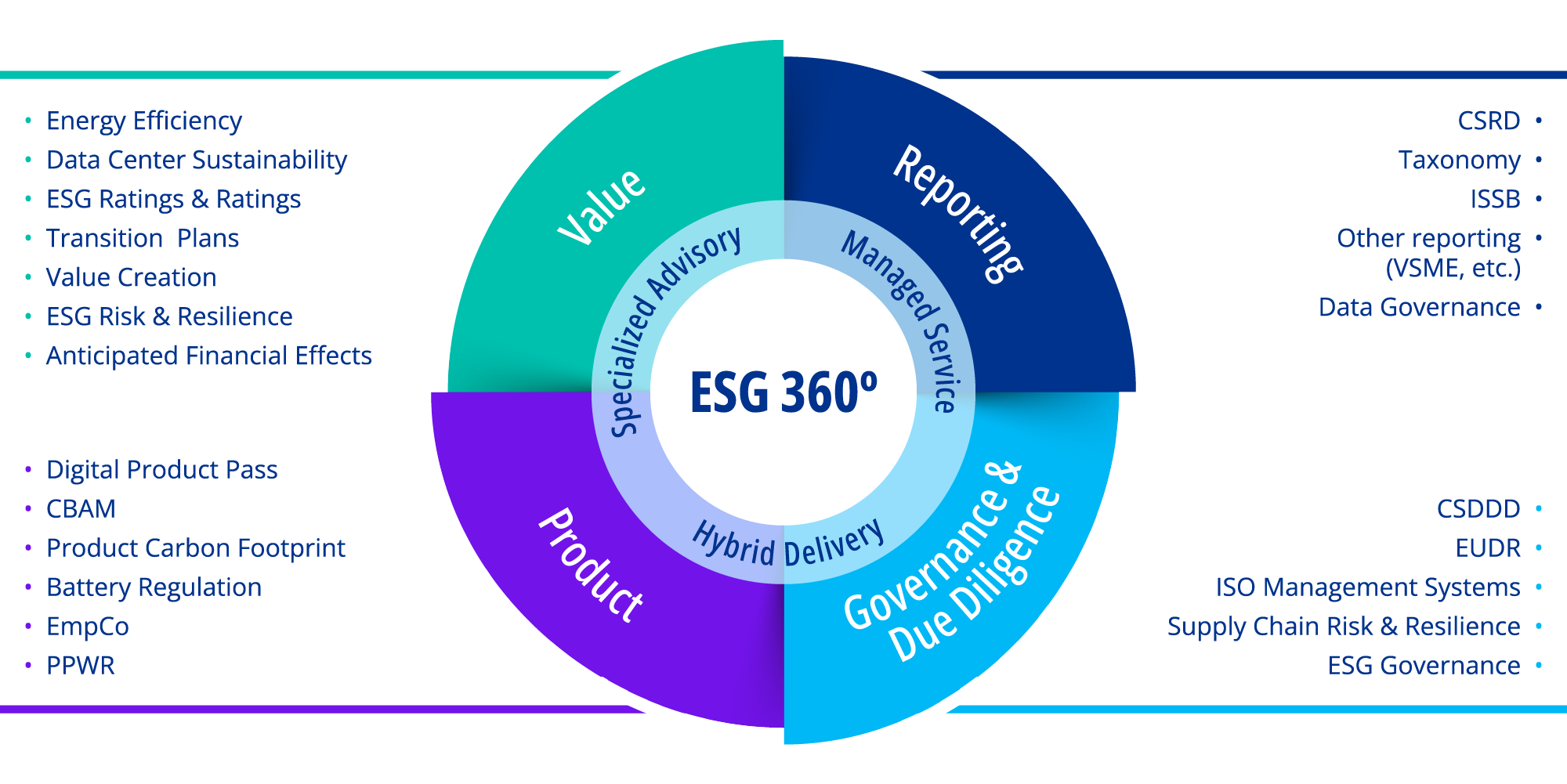
      Four perspectives, one integrated management approach

      The focus is on four key areas:
      Reporting, Governance & Due Diligence, Product and Value.

      These aspects cannot be managed effectively in isolation. ESG data influences governance issues and risk assessments. Product requirements impact supply chains, compliance and market access. ESG-related risks and opportunities are reflected in financing, ratings and strategic planning.

      Our approach highlights these interdependencies and helps companies to systematically categorise ESG requirements and translate them into robust management models.

      ESG as a management dimension within the organisation

      • ESG is not a standalone reporting topic, but rather an integral part of corporate governance.

        Regulatory requirements have a profound impact on processes, decision-making and value creation, and require a clear management perspective.

      • Integrated management reduces complexity and strengthens the organisation.

        Bringing together reporting, governance, product requirements and value contributions creates transparency, avoids duplication of effort and improves decision-making processes.

      • Data is becoming the key driver of management and transformation.

        Verifiable and reusable ESG information forms the basis for compliance, risk analysis, financing and strategic planning.

      • Product and supply chain requirements are becoming increasingly important from a strategic perspective.

        New regulatory requirements have a direct impact on development, procurement, quality management and traceability, and should be incorporated into management models at an early stage.


      Identify connections. Refine your approach. Maximise impact.

      Classify. Manage. Shape. – this is how we create a framework for taking a holistic view of ESG requirements and placing them within a robust business context.

      Companies learn how relevant topics can be linked, how management models can be further developed, and how ESG can be effectively integrated into the organisation.

      Discover the content across the key areas of action now and gain a deeper understanding of reporting, governance & due diligence, product and value.


      Selected areas of action from the ESG dimensions

      • Managed Services – Ensuring sustainable value creation

        With the managed service approach, you can outsource the day-to-day management of ESG-related processes. Standardised, technology-driven workflows reduce operational overhead and free up internal resources. This enables ESG processes to be managed efficiently and regulatory requirements to be met reliably. 

      • CSRD in SMEs – A pragmatic approach to implementation

        With the second wave of the CSRD, sustainability reporting is becoming a reality for large mid-sized companies. They face the challenge of implementing regulatory requirements efficiently and in a manner that is audit-ready. A pragmatic approach focuses on key content, integrates new requirements into existing processes and deploys resources in a targeted manner.


      • CBAM – Managing product and supply chain requirements

        With CBAM, the requirements for transparency and data availability along the supply chain are increasing, particularly with regard to emissions and product information. Emissions data, supplier information and regulatory obligations have a direct impact on procurement, product design and cost structures. Companies face the challenge of establishing reliable emissions data, engaging suppliers and fully and accurately meeting reporting obligations and future verification requirements.

      • ISSB – Reporting as a management tool

        Internationally active companies must align local ISSB reporting requirements with consistent group sustainability reporting (e.g. ESRS/CSRD). The increasing global adoption of the ISSB™ standards is leading to varying timetables and implementation approaches. The key challenge lies in achieving efficient, audit-ready integration into existing ESG reporting frameworks.


      From duty to performance

      How companies can use ESG as a growth driver for real value creation.

      Abstract illustration

      More KPMG Insights

      Your contacts