
      We look back on a decade characterised by low interest rates, low inflation, rising share indices, high returns in the alternative environment combined with low borrowing costs and a relatively stable geopolitical situation.

      These conditions have enabled many companies in the financial sector to reduce their cost-income ratios (CIRs). However, the entire financial market is now facing a challenging time: it is operating in a VUCA (Volatility, Uncertainty, Complexity, Ambiguity) world, i.e. in a volatile, uncertain, complex and ambiguous environment.
      Exploiting unused potential

      In this situation, companies should exploit previously untapped potential in their processes, technologies and organisation and position themselves for the future. In particular, the automation and control of processes in an end-to-end view and the linking with relevant KPIs are essential in order to survive in the market. Our 360° expertise in operational excellence is your compass through uncertain times, helping you to achieve your goals.

      auto_stories

      Lünendonk-Studie zeigt, es bedarf mehr effektiver Datennutzung, Digitalisierung und funktionsübergreifender Teams.

      How banks optimise their operating models

      Cost reduction alone is not enough: What is important for a successful transformation.

      Frau in der Stadt

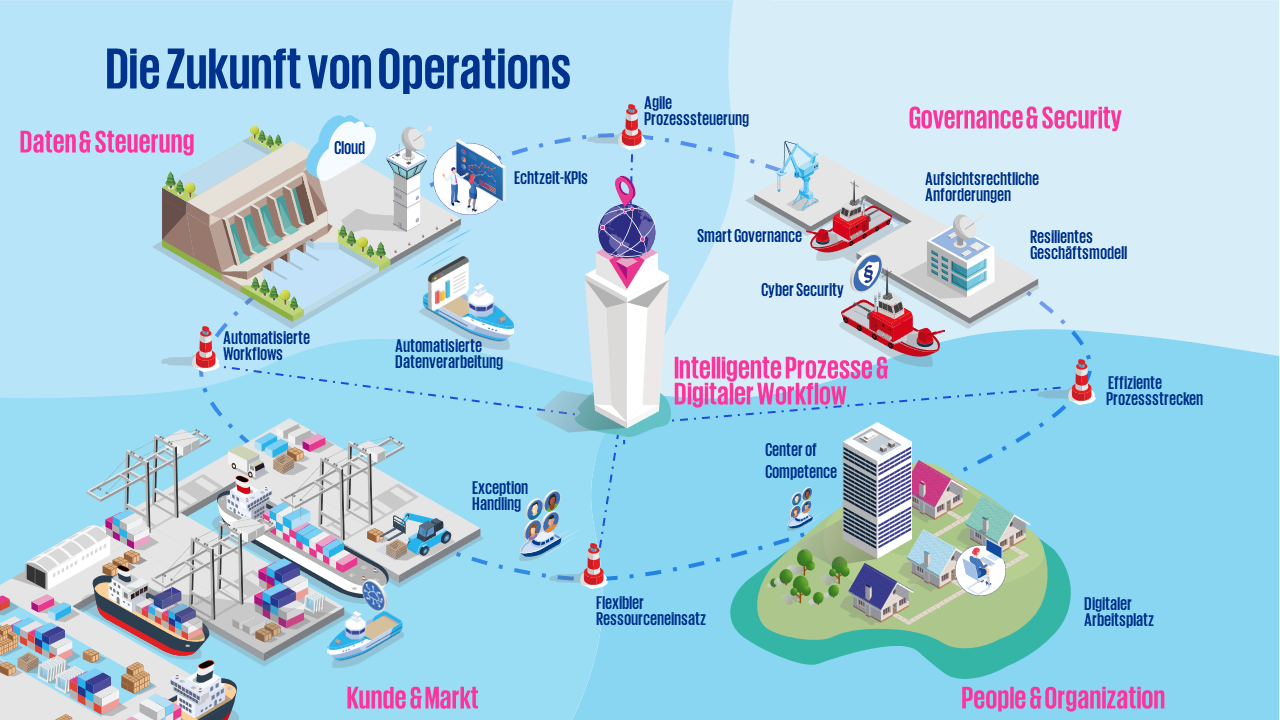
      Five theses that will change the future of operations

      • All processes are modular, open to technology, self-learning and prescriptive.
      • The organisational structure of Operations now only consists of various cross-functional competence centres.
      • In day-to-day business, people are only responsible for exceptional cases, the rest is done by the machine.
      • The management of operations is based on real-time data, interlinked with strategy, product, business and regulation.
      • The digital platform forms the basis for a symbiosis of human and artificial intelligence.

      Fields of action on the path to the future of operations

      Our customers' challenge

      • Little own process understanding
      • Process analysis is carried out without the inclusion of relevant data
      • Implementation of fragmented "temporary" optimisation solutions
      • Lack of process KPIs prevents performance measurement and process control

      Our offer

      • Tool selection and implementation of process mining in the E2E process
      • Development of optimisation solutions taking into account future-proof technological possibilities
      • Implementation of data pools and data models for a data-supported continuous improvement process
      • Visualisation in control dashboards

      Our customers' challenge

      • Insufficient work instructions for guidance in daily work processes
      • Processes are "patterns" and do not reflect reality à hardly any target-actual comparisons possible
      • Content is stored redundantly and currently only rarely supports information and knowledge management

      Our offer

      • Company-specific evaluation and support in selecting modelling tools
      • Qualification of employees through (customer-specific) modelling training courses
      • Process documentation according to the latest standards and creation of a process map
      • Linking sfO and communication concept to ensure the transfer of information

      Our customers' challenge

      • No E2E process responsibilities or authority to act
      • Rigid structures instead of flexible, value stream-oriented organisation
      • Area of tension due to increasing technical requirements and shortage of skilled labour
      • Hardly any targeted use of specialised service providers as a process component

      Our offer

      • Value stream analysis and design of a flexible organisational structure
      • Conception of E2E process responsibility incl. competences in conjunction with the process map
      • Development of future-orientated target competence matrix for employees
      • Support for business process outsourcing projects

      Our customers' challenge

      • Unused standardisation potential
      • Existence of a large number of product variants and process variations
      • No process modules that can be flexibly integrated in terms of content (one process fits all)

      Our offer

      • E2E process analysis with the aim of business and IT modularisation
      • Cost-benefit and utilisation analysis of existing products and definition of target product portfolio
      • Creation of a product-process matrix to identify the necessary process steps for each product
      • Development of a target operating model

      Our customers' challenge

      • Future-proof and competitive business model
      • Growth and cost pressure
      • Implementing changed (regulatory) requirements in a resource-efficient manner
      • Realisation of potential that goes beyond the formulation and implementation of an IT specification

      Our offer

      • Best-practice procedure model for the transformation of business processes for the purpose of digitalisation & automation
      • Shortening of automation projects based on predefined value propositions
      • Use of workflow tools with a focus on credit processes (e.g. customer portal, contract creation, credit decision, etc.)

      Our customers' challenge

      • Outdated and rigid technologies, high effort and costs for maintenance, further development and modernisation
      • Lack of flexibility and scalability with increasing requirement density
      • Keeping up with technology trends and the associated attack vectors and maintaining the necessary level of security

      Our offer

      • Holistic architecture strategies and consideration of the latest infrastructure concepts (e.g. cloud)
      • Sourcing strategies for scalability and flexibility
      • Establishment of (cyber) security concepts as an integral component
      • Planning and implementation of the transformation(s)

      Our customers' challenge

      • Redundant data storage, different update procedures and lack of overarching correlation
      • Individual processing of issues such as addressing existing and new customers & sales
      • No usability of existing empirical values for e.g. trend analyses in the context of NPP

      Our offer

      • Target-oriented linking of data sources based on definitions of rules and logics (e.g. pattern recognition, trend analyses)
      • Design and implementation of comprehensive platforms for orchestrating process chains
      • Establishment of mechanisms for the enrichment of downstream processes

      More KPMG Insights


      Your contacts


      Hot topics in the financial sector

      Blockchain and digital assets, cloud and cyber security, data management and artificial intelligence, ESG and the metaverse: The transformation is affecting the financial industry at all levels.

      As one of the leading auditing and advisory firms in the financial sector, KPMG has in-depth industry and market knowledge and a strong partner network.

      You can read about the services we provide to support our clients in the financial sector on our focus pages. Browse through our financial sector hot topics on the left.