With nearly half of all Asian family offices established in the last five years alone, Hong Kong must meet the needs of a new generation that think more strategically, more internationally, and more long-term than ever before


      Looking at the findings of KPMG’s latest Global Family Office Compensation Benchmark Report1, one observation stands out above all others: the centre of gravity in the family office world is expanding eastward. Nearly half (46%) of all Asian family offices surveyed have been established within the past five years alone – a formation rate that outpaces every other region in the report. And while Singapore has rightly earned much of the spotlight in recent years, I would argue that Hong Kong is entering a defining moment of its own. 

      Family offices are no longer the quiet, informal structures of a generation ago. They are increasingly sophisticated, professionalised, and globally mobile institutions. Globally, 44% of family offices now operate from two or more locations, the majority are managing assets in the USD 501 million to USD 5 billion range, and wealth preservation has overtaken pure wealth administration as the dominant objective.

      These trends matter enormously for Hong Kong. They tell us that the families we serve are thinking more strategically, more internationally, and more long-term than ever before. They are also looking harder than ever at where to base their operations. A more worldly-focused next-generation means less attachment to single jurisdictions in how they structure their family office, and increases the need for fully globalised banking solutions.

      That is also why Hong Kong’s proposition for family offices must continue to be compelling: the profits tax concession for qualifying single family offices, a trusted common law framework, free movement of capital, and one of the deepest concentration of wealth management talent in Asia are all advantages that need to be built upon with intention. 

      Karmen Yeung

      National Head of Private Enterprise

      KPMG China

      A market defined by first-generation dynamism

      In recent years, the vast majority of family offices setting up in Hong Kong are an entirely new set up. Many are led by founders who have been extraordinarily successful in building business, but who have not yet had the opportunity – or the impetus – to professionalise the management of their personal and family wealth. For these families, there are multiple entry points, but the Hong Kong profits tax concession for qualifying single family offices – combined with a zero capital gains environment – offers a strong and tangible incentive. 

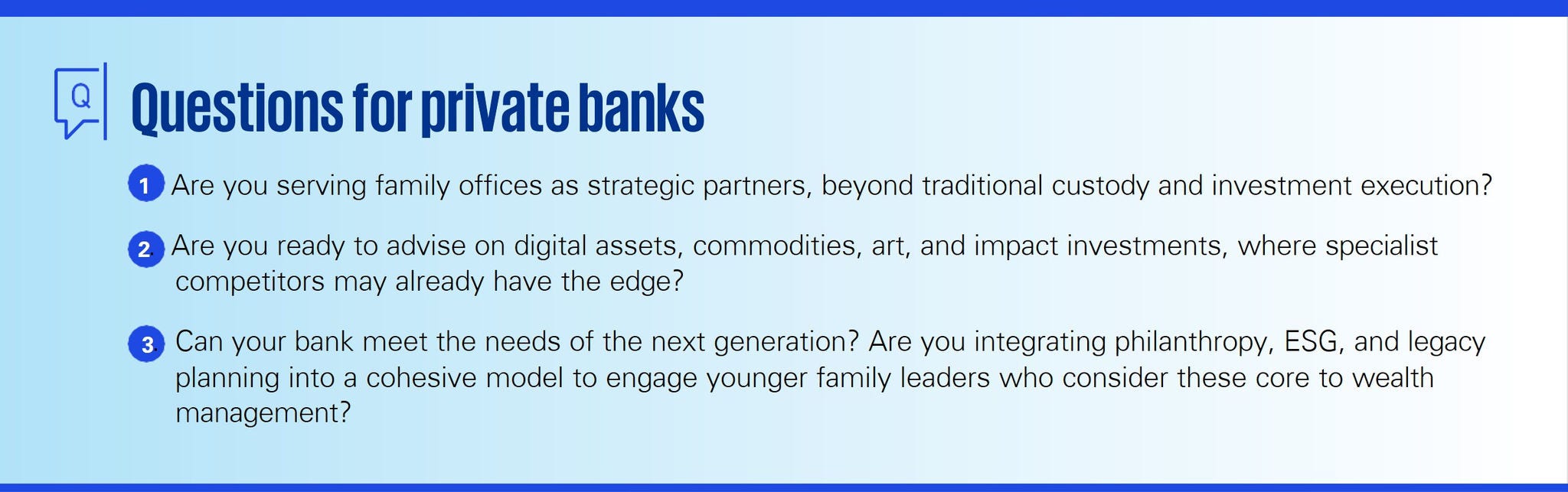
      Once established, these families often embark on a journey of professionalism that touches every aspect of their financial lives. They begin to formalise investment governance, review asset allocation, establish reporting frameworks, and – critically – engage more deeply with the financial institutions that hold and manage their capital. They expect their bank to go further and become a strategic discussion partner that uses their expertise to provide deeper insights, provide comprehensive wealth management and add perspective on best-practices within the private wealth ecosystem.

      A defining characteristic of Asian family offices is that much of the underlying wealth remains relatively new. Many of today’s first and second-generation principals built their fortunes from entrepreneurial beginnings, often in industries tied to Asia’s economic opening up. As a result, the families navigating wealth transition today are doing so with a diffierent set of pressures and expectations than their European or North American counterparts, where multi-generational wealth structures and rigid governance frameworks have compounded over decades. It is this demographic reality – wealth that is new, founder led and approaching its first handover – that places governance at the very centre of the agenda. 

      Governance: the defining test of the generational handover

      When wealth is first  or at most second generation, the most consequential event on the horizon is the handover from the founding principal to the next generation – and it is precisely this transition for which most family offices are currently least prepared.

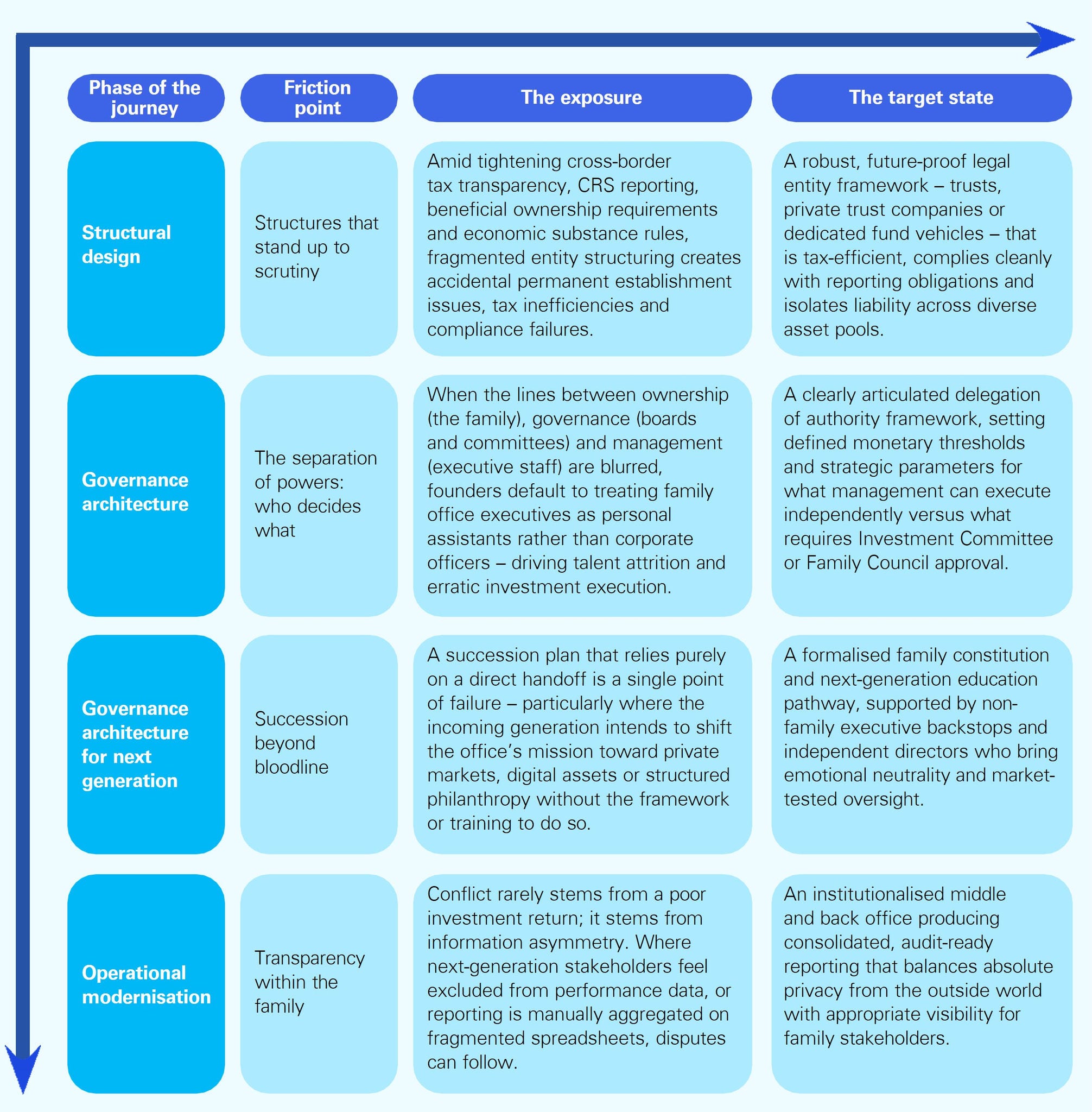
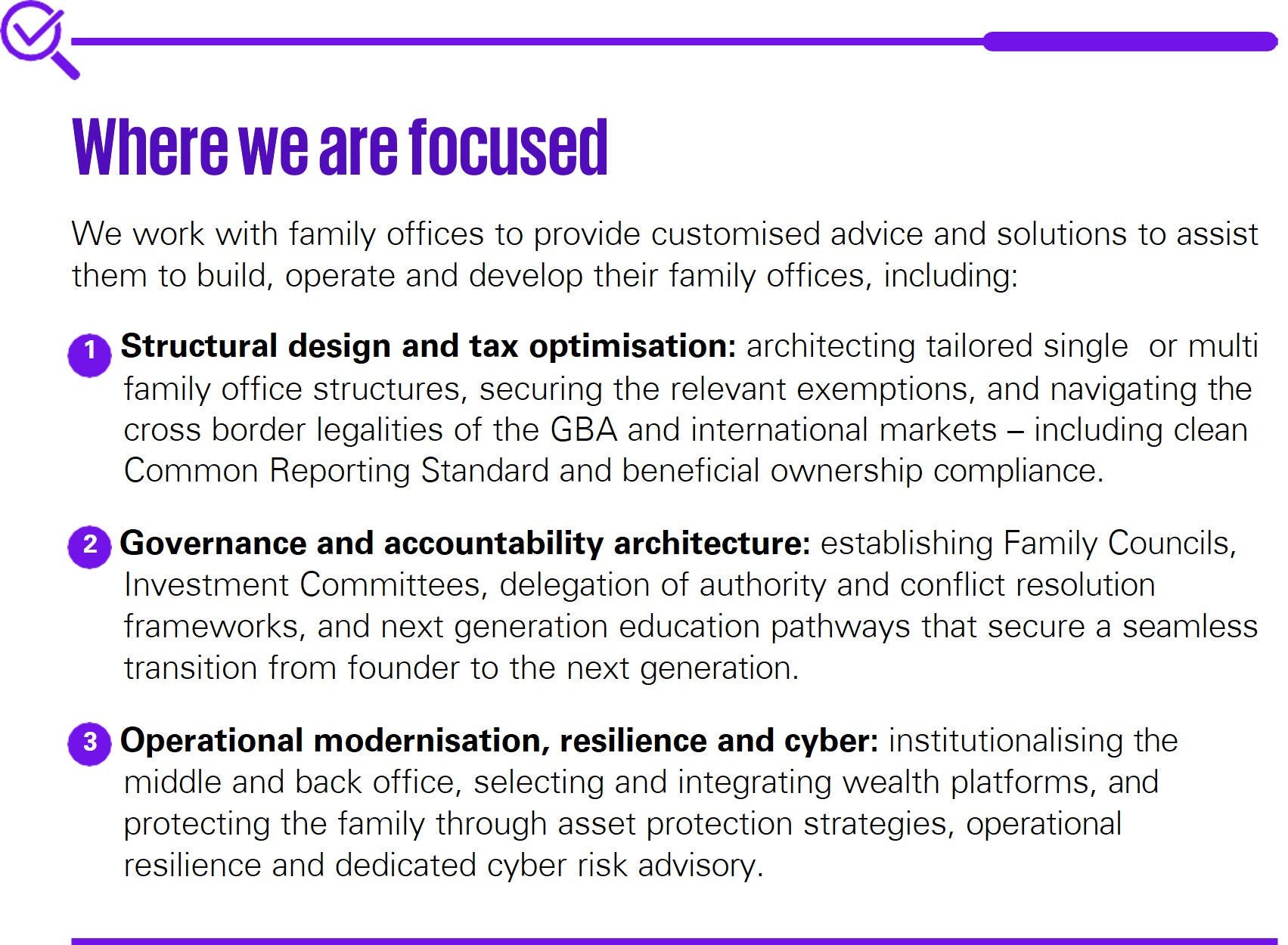
      Moving from a founder led “kitchen table” operation to a formalised institution requires reconciling two very different operating systems – the emotional and often subjective dynamics of a family, and the logical, objective requirements of a regulated commercial enterprise. Where the two are not aligned deliberately, friction can follow. In our experience that friction tends to concentrate in four areas.


      Setting up a family office is relatively straightforward; ensuring it survives a multi generational handover is where the true challenge lies.

      Benchmarking remains a weak spot

      As family offices institutionalise their governance, the same discipline is beginning to reshape how they invest – starting with the basic question of how they measure success. One finding from KPMG’s global report that should give the industry pause is that 51% of family offices do not have a return-on-investment benchmark in place. Of the 49% that do, only 38% benchmark against a recognised index.

      Without a benchmark, it is genuinely difficult to assess whether an investment team is adding value, whether compensation tied to performance is being fairly calibrated, or whether the family is being adequately rewarded for the risks it is taking. As family offices in Asia continue to professionalise, we expect benchmarking to become an area of significant focus.

      Emerging and niche investment categories

      Some of the most interesting data from KPMG’s global report sits in the investment categories that the industry has discussed at length, but where allocation figures remain modest. In our view, this is where the next phase of portfolio evolution will play out – and where Hong Kong’s supporting ecosystem will play an important role.  

      1. Digital assets remain peripheral globally but are growing in Asia

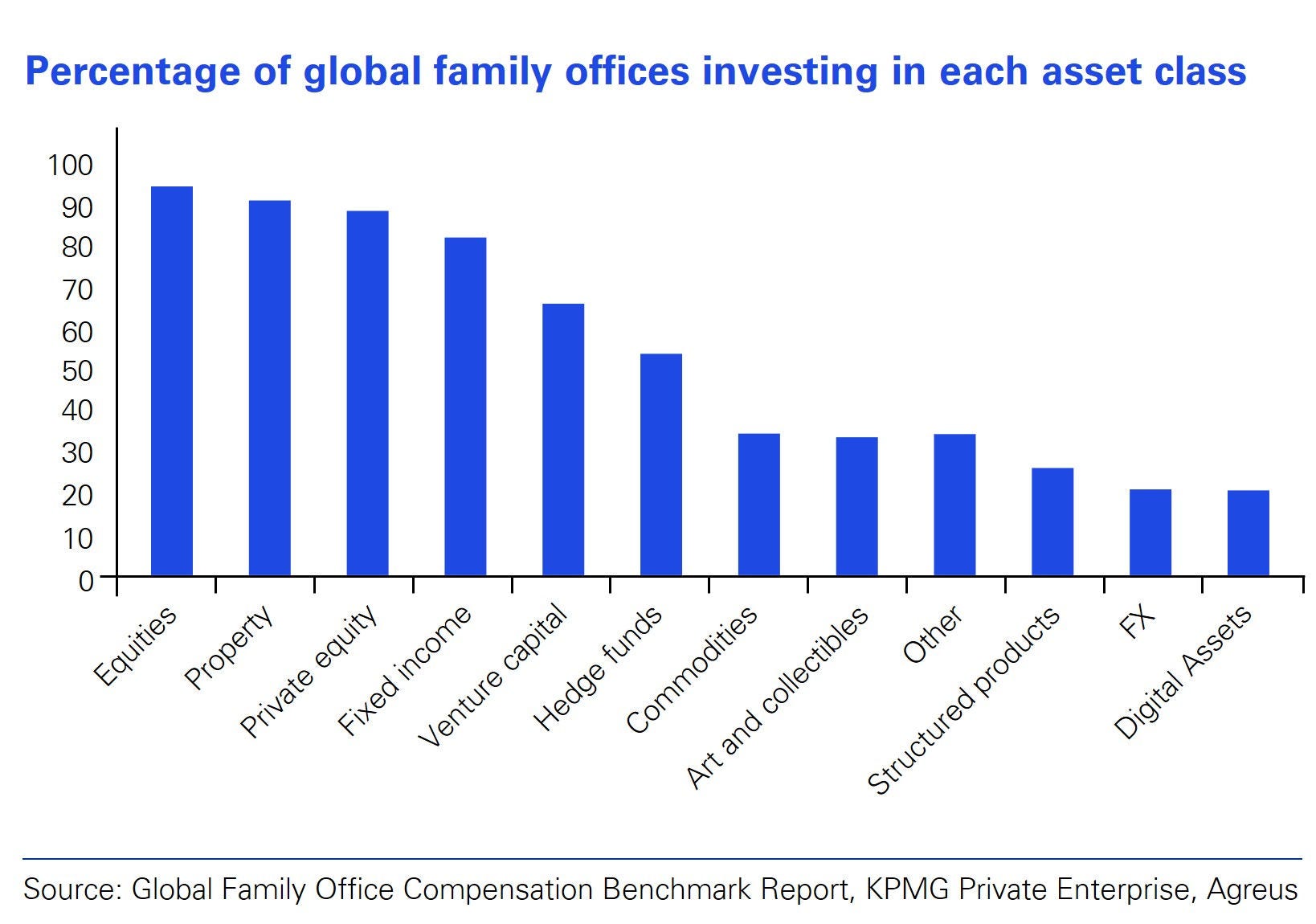
      Nearly 80% of family offices globally currently have no allocation to digital assets. However, the expectation is that this will change, particularly in jurisdictions that provide regulatory clarity and appropriate incentives. In Hong Kong 28% of family offices plan to increase digital asset holdings over the next three years2, driven by next-generation interest and regulatory progress. 

      The more important point for Hong Kong is what this means in terms of positioning. The HKSAR Government has proposed expanding the scope of qualifying investments for family office tax concessions to include digital assets and precious metals3. If implemented, this would place Hong Kong among a small number of jurisdictions offering a coherent regulatory and tax framework for family offices seeking measured exposure to this asset class – a distinction that is likely to matter more as generational wealth accelerates and younger principals bring a different risk appetite to the table.

      2. Commodities (including gold) are seeing renewed interest

      Commodities (including gold) have seen increased allocations, and, from an inflationary protection perspective, formed part of nearly a third of all family office portfolios. The practical implication is that family offices are increasingly behaving like institutional investors in how they think about inflation protection and portfolio resilience.

      3. Art and collectibles remain a passion allocation

      Roughly a third of family offices report some allocation to art and collectibles. Hong Kong has been deliberately building infrastructure to serve this segment, including the Hong Kong Airport Authority’s large-scale artwork storage facility, and the wider ecosystem of auction houses, advisory services and freeport logistics. With Asia’s ultra-wealthy increasingly treating art and collectibles as both passion assets and portfolio diversifiers, Hong Kong’s integrated infrastructure – from climate-controlled storage to global auction access – provide important infrastructure to attract family office capital.

      4. Private social investments: an expanding frontier

      A distinctive feature of Hong Kong’s family office ecosystem is the growing integration of private social investments into portfolio strategies. Currently, 45% of surveyed family offices and UHNWIs participate in philanthropy and 30% in impact investing. These levels are projected to grow to 64% and 43% respectively over the next three years4. Family offices will benefit from banks that can offer personalized advice and assist in creating a philanthropic approach that aligns both current and future generations.

      For the next generation of family principals, the distinction between financial returns and social impact is less binary than it was for their predecessors. Younger wealth owners increasingly view philanthropy and impact investing not as separate activities from the family office’s core mandate, but as extensions of it – vehicles for expressing values, building legacy, engaging the next generation, and generating long-term sustainable returns alongside measurable social outcomes.

      The opportunity for banks lies in developing more comprehensive end-to-end solutions to accommodate these needs. Hong Kong is well-positioned with the green and sustainable finance ecosystem maturing rapidly: total government green bond issuances have reached HKD 240 billion5, the HKSAR Government has issued the world’s first tokenised government green bond, and the recently published Taxonomy for Sustainable Finance provides clearer definitions for what qualifies as a sustainable investment. 

      Financial Results


      Compare the results of banks across a variety of metrics in the charts for each of the five categories of banks in Hong Kong

      Performance Rankings | Licensed banks | Digital banks | Restricted licence banks | Deposit-taking companies | Foreign bank branches


      Hong Kong Banking Report 2026

      Positioned for Growth

      Hong Kong Banking Report 2026

      Hong Kong Banking Report 2026

      Positioned for Growth

      Submit RFP

      Find out how KPMG's expertise can help you and your company.