


      This article first appeared in the Q1 2026 issue of the SID Directors Bulletin published by the Singapore Institute of Directors.

      In a world defined by volatility and rapid technological change, boards are being challenged to rethink how value is created and protected. As global trade tensions, regulatory shifts, and tech-driven disruption reshape the business landscape, a services-as-a-strategy model is emerging as a powerful catalyst for resilience, agility and long-term growth.

      From global trade tensions and tariff shocks to pandemic disruptions and regulatory shifts, the operating environment has fundamentally changed. For boards, this represents both a challenge and an opportunity.

      Yet, research shows that business leaders, while accelerating investment in artificial intelligence (AI) and automation, are still taking a wait-and-see approach. A survey of 402 senior executives across major industries in the US by HFS and KPMG in July 2025 indicated that two out of three businesses are waiting to see what happens or cutting costs. Only one in five actively engages in scenario planning.

      In a world where fast action counts, resilience must be built into the business model. The services-as-a-strategy model offers a transformative approach that positions services not as a support function, but as a core driver of business value. This shift changes how firms invest, manage risk and deliver value to stakeholders. 
      Volatility as the new landscape

      The volatility of recent years has made this clear. The Covid-19 pandemic exposed weaknesses in global supply chains. Tariff changes disrupted pricing and sourcing strategies. Regulatory shifts, especially in areas like data privacy and sustainability, have added complexity to compliance. These events are part of a broader pattern of disruption that is unlikely to subside. Boards must recognise that volatility is now a permanent feature of the business landscape and act accordingly.

      Services-as-a-strategy offers a compelling response to this new reality. It enables organisations to move away from inflexible systems toward service-based models that are dynamic and adaptable. It involves replacing or augmenting traditional built systems (often rigid, capital-intensive and slow to evolve) with modular, cloud-based, AI-enabled service platforms that are continuously updated, scalable and designed to deliver strategic outcomes.

      This approach allows businesses to access capabilities on demand, adapt quickly to change and reduce exposure to risk, all while maintaining strategic control.

      For boards, this shift aligns with key governance priorities: operational resilience, cost efficiency, innovation and regulatory compliance. It also supports broader strategic goals, such as digital transformation, customer-centricity and talent optimisation.

      Services-as-a-strategy offers a framework for businesses to evolve in the new operating environment. It enables boards to address the following challenges.

      1. Overcoming the limitations of built systems

      Traditional built capital expenditure systems are expensive to maintain, slow to adapt and difficult to scale. They require significant upfront investment, long implementation timelines and ongoing maintenance. In contrast, service-based models offer a modular, pay-as-you-go approach that reduces financial risk and accelerates time-to-value.

      Capabilities are continuously updated by the provider, ensuring that firms stay current without the burden of managing upgrades internally. Compliance, security and performance are also managed by the provider, freeing up internal resources and reducing operational complexity.

      Boards should view this shift not just as a cost-saving measure, but as a strategic enabler. It allows organisations to redirect capital toward innovation, respond more quickly to market changes and build resilience into their core operations.

      2. Keeping pace with technological change

      The pace of technological change is accelerating. Generative AI, agentic AI, quantum computing and blockchain are evolving faster than most organisations can build. Service providers absorb research and development costs and deliver cutting-edge capabilities, enabling firms to benefit from innovation without rebuilding infrastructure.

      For boards overseeing digital transformation, the ability to access advanced technologies without  the delays and costs of internal development is a significant competitive advantage. It enables firms to innovate faster, respond to customer needs more effectively and stay ahead of industry trends.

      Moreover, service-based models support experimentation. Firms can test new technologies, pilot new solutions and scale successful initiatives quickly. This agility is essential in a volatile environment, where the ability to pivot can determine success or failure.

      3. Multiplying workforce capabilities

      Services-as-a-strategy also acts as a workforce multiplier. It enables access to specialised talent (AI experts, cyber security professionals, compliance specialists) without the overhead of hiring or navigating trade-related constraints. This is especially valuable in a global economy where talent shortages and labour market disruptions are common.

      By leveraging service-based models, firms can reduce their dependence on tariff-sensitive labour markets and shift focus from physical goods to digital flows. This enhances resilience and flexibility, allowing organisations to adapt to changing conditions and maintain continuity.

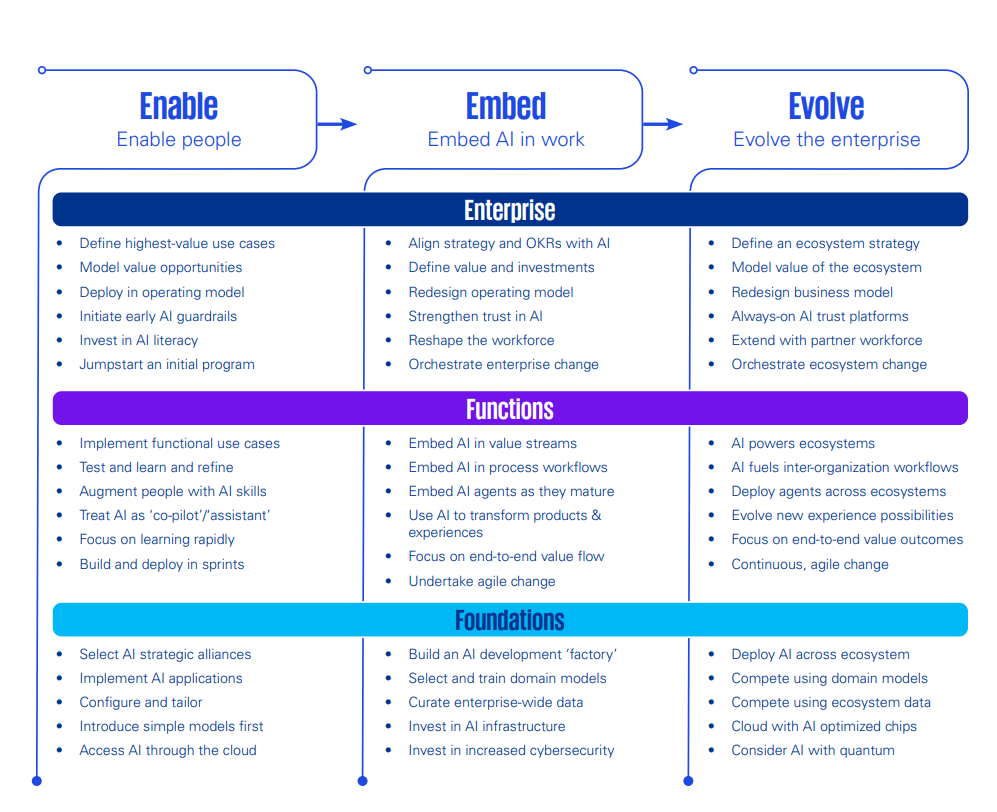
      To realise the full potential of services-as-a-strategy, firms must build AI and digital capabilities across three phases: Enable, Embed and Evolve (see box, “Framework to Operationalise Services-as-a-Strategy”). Each phase requires action at the enterprise, functional and foundational levels, ensuring that transformation is embedded across the organisation, not siloed within a single team.

      Framework to Operationalise  Services-as-a-Strategy

      In the Enable phase, organisations appoint a responsible executive, define their AI strategy and identify high-value use cases. They also improve AI literacy, establish ethical guardrails and launch pilots using cloud platforms and pre[1]trained models. This phase lays the foundation for scalable, responsible innovation.

      The Embed phase focuses on integrating AI into workflows, products and services. It involves reskilling the workforce, modernising legacy infrastructure and prioritising trust, ethics and security. This phase ensures that AI is not just a tool, but a core part of the operating model.

      The Evolve phase involves redesigning business models and ecosystems using frontier technologies. It includes deploying AI and quantum computing to solve complex challenges, build a future-ready workforce and align innovation with strategic goals. This phase positions the organisation for long-term success in a volatile environment.

      Boards play a critical role in each phase. They must provide strategic oversight, ensure alignment with organisational goals, approve investment decisions and monitor progress. They must also ensure that transformation is inclusive, ethical and sustainable, to create value for all stakeholders

      Boards should consider how this model supports talent strategy. Firms can build capabilities quickly, access expertise on demand and reduce exposure to geopolitical and regulatory risks. Workforce transformation allows employees to focus on higher-value tasks while routine functions are automated or outsourced.

      4. Enabling strategic agility

      In uncertain markets, agility is key. Service-based models allow firms to test new products, enter new markets and pivot quickly without committing to costly infrastructure.

      For boards, this agility translates into strategic flexibility. It allows organisations to respond to emerging opportunities, mitigate risks and adapt to changing customer expectations. Firms can experiment with innovative business models and technologies without the constraints of legacy systems.

      In retail, for example, AI-based product recommendations are driving personalised customer experiences. In financial services, automation is streamlining compliance and risk management. In healthcare, digital platforms are enabling remote care and data-driven diagnostics. Across sectors, services-as-a-strategy is enabling firms to innovate faster and deliver more value.

      5. Enhancing regulatory responsiveness

      In jurisdictions like Singapore, where regulatory landscapes can shift rapidly, service providers often embed compliance updates directly into their platforms. This helps firms stay ahead of evolving requirements in areas such as data privacy, financial reporting and sustainability.

      Built-in audit trails and traceability features simplify governance and reduce the cost and complexity of compliance. It ensures that organisations remain compliant, reduces exposure to regulatory risk and supports transparent reporting.

      Boards should also support ethical and responsible innovation by ensuring that providers incorporate ethical frameworks, security protocols and trust mechanisms into their platforms that align with stakeholder expectations and regulatory standards.

      The board’s role

      AI is no passing trend. It is an accelerating and transformative force that will continue to evolve, disrupt and redefine how businesses operate. For boards, the challenge is not simply to adopt AI technologies, but to guide their organisations through a structured evolution that balances short-term efficiency with long-term strategic transformation.

      The journey to becoming an intelligent enterprise is a deliberate, phased approach.

      Successful AI transformation demands balance. Boards must oversee both short-term wins and long-term strategy; technological ambition and responsible governance; automation and the human qualities of creativity, empathy and judgment. This balance is essential not only for operational success, but for maintaining trust with customers, regulators and employees.

      When implemented well, services-as-a-strategy enables firms to capture the promise of hyper[1]personalisation, sharpen decision-making and unlock new business models, all while maintaining compliance and customer trust.

      This positions businesses to move beyond back-office automation and toward full-scale transformation of their functions. In Singapore, leading brands are already using AI to forge stronger customer connections, deliver more meaningful experiences and prepare for frontier technologies.

      Boards should champion services-as-a-strategy, guide responsible AI adoption, and ensure transformation is embedded across the enterprise. In doing so, they can position their organisations as resilient, trusted and ready to lead in a future defined by innovation and change.


      Related content

      Intelligent industries

      Blueprints for creating value through AI-driven transformation
      Discussion

      Our people

      Gary Chia

      Partner, Head of Consulting

      KPMG in Singapore