

The global payments landscape is reshaping the banking industry, creating unprecedented opportunities for growth and innovation. Instant Payments and ISO 20022 are at the forefront of this transformation, acting as catalysts for payments modernisation across the financial sector. Download the PDF for an in-depth exploration of the market trends driving payments modernisation.
Payments modernisation as a catalyst for growth
Payments modernisation as a catalyst for growth
Market forces shaping the new era in payments
The evolution of payments extends beyond technological upgrades; it's a strategic repositioning that unlocks growth, innovation, and competitive advantage. Key trends include:
Instant payments: Revolutionising transaction speed and convenience while offering richer transaction data.
ISO 20022: Emerging as a global standard for high-value payments, fostering uniformity and global financial service advancement.
Data utilisation: Harnessing data through ISO 20022, Open Banking, and APIs to identify new revenue streams and enhance customer services.
Strategic partnerships: Collaboration with technology giants and payment innovators is essential, broadening service offerings and scalability.
Disintermediation: Traditional banks face competition from fintechs and newcomers, driving industry-wide innovation.
B2B payments and embedded finance: Rapid digitalisation is transforming business payments and enabling smarter, integrated financial solutions.
Global reach: Growing globalisation and e-commerce emphasise the need for efficient cross-border payments.
Market forces driving payments modernisation
Banks are responding to unprecedented market forces, including the impending ISO 20022 mandate and Instant Payments, amid intense competition. Key catalysts for change include:
Regulatory compliance: Evolving regulations, such as ISO 20022, drive payments modernisation, enhance data analytics, and address privacy regulations.
Operational efficiency: Modernised payments platforms streamline operations, aligning with API-first strategies to enhance competitiveness.
Competitive landscape: Digital transformation shifts customer interactions to platform business models, prompting partnerships and competition from fintech providers.
Customer expectations: Exceptional customer experiences are critical, emphasising convenient, flexible payment options and simplified processing.
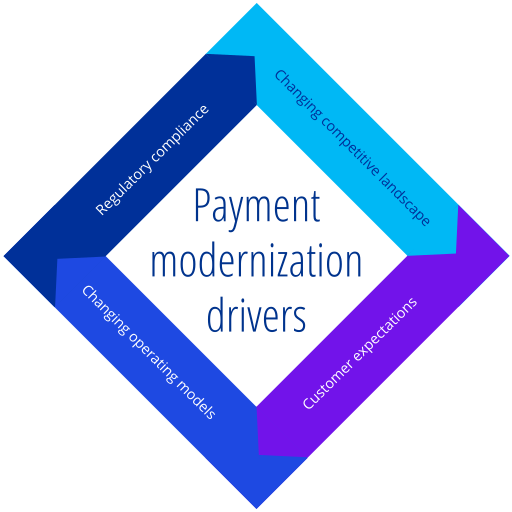
Aligning payments modernisation strategy
In the digital age, payments modernisation involves integrating regulatory compliance, operational models, customer experience, and competitive agility into a comprehensive vision for the future.
The potential benefits of payments modernisation
Modernised payments platforms can offer significant advantages, including reusability, simplified infrastructure, product standardisation, streamlined operations, enhanced fraud and risk management, and support for product innovation.
Market forces, such as ISO 20022 and instant payments, are driving payments modernisation, offering opportunities for better payment experiences, value-added services, and strategic positioning. A future-ready payments infrastructure is important for regulatory compliance and scalable growth.
As banks navigate unprecedented market dynamics, payments modernisation emerges as a catalyst for improved payment experiences and value-added services. It paves the way for growth and innovation across the industry, underlining the importance of a future-ready payments infrastructure.
Explore modernisation trends in payments with KPMG to understand their impact on your organisation. KPMG professionals are ready to discuss payments challenges, strategies, processes, partners, and technologies.
Related content


Our people

Antony Ruddenklau
Partner, Head of Financial Services, Global Head of Fintech and Innovation, Financial Services, KPMG International and Head of Payments, Asia Pacific
KPMG in Singapore