

Sustainable supply chains integrate environmental, social, and governance (ESG) considerations into every stage of sourcing, production, and distribution. Rather than focusing solely on cost and efficiency, they prioritize ethical labour practices, climate resilience, resource efficiency, and transparency. The benefits are multifaceted: companies can reduce reputational and operational risks, respond more effectively to regulatory and stakeholder demands, and unlock long-term value through innovation and improved supplier relationships.
Sustainability due diligence plays a critical role in building more sustainable supply chains by enabling companies to proactively identify and address environmental and human rights risks across their operations and sourcing networks. While the global rise in sustainability due diligence legislation reflects a growing legal imperative in many jurisdictions, the systematic assessment of impacts can also create long-term value by helping companies improve resource efficiency, build resilience, foster ethical partnerships, and meet stakeholder demands.
We support your supply chain due diligence by offering bespoke guidance and access to leading value chain monitoring tools. These solutions help you screen supplier networks to identify environmental and human rights risks, including climate-related impacts, and establish a solid foundation for strategy and governance alignment. Our approach enables you to conduct gap assessments and implement due diligence systems tailored to upcoming EU regulations, such as the CSDDD, EUDR and the Battery Regulation. By combining regulatory insight with tools that enhance traceability and transparency, we help you build resilient and sustainable supply chains that mitigate risks in a shifting geopolitical and reporting landscape.
Amidst growing climate risks and an increasingly volatile geopolitical landscape, building more sustainable supply chains is rapidly becoming a strategic imperative for companies seeking to safeguard value and strengthen resilience. This means going beyond traditional metrics like cost, speed, and efficiency to ensure that raw materials are sourced responsibly, labor conditions are fair and safe, emissions and waste are minimized, and governance practices are transparent and accountable.
This approach requires companies to look deep into their supply networks — often spanning multiple countries and industries— and assess risks and opportunities related to human rights, biodiversity, carbon intensity, water use, and more. It also involves engaging suppliers and partners in continuous improvement, setting science-based targets, and adopting technologies that enable traceability and data-driven decision-making.
Sustainability due diligence – a structured process through which companies can identify, prevent and mitigate environmental and human rights impacts across their operations, supply chains, and business relationships, is a key enabler of this transformation. It provides companies with the tools and processes to systematically assess risks, engage suppliers on performance, and implement corrective actions where needed.
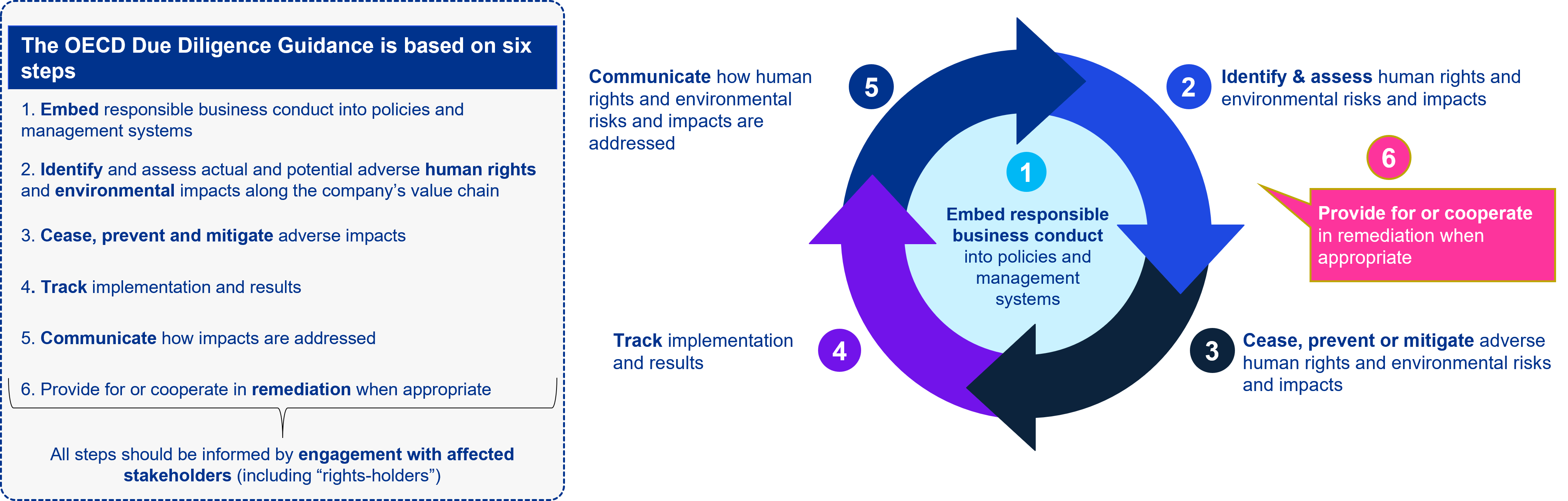 The OECD's due diligence framework provides a risk-based approach for businesses to identify, prevent, and mitigate adverse impacts on human rights and the environment. Source: KPMG, based on OECD (2018).
Sustainability due diligence can create long-term value for companies
As global awareness of corporate responsibility deepens, companies are facing growing pressures to assess and address human rights and environmental risks throughout their supply chains. This includes pressures coming from EU-level initiatives like the EU’s Corporate Sustainability Due Diligence Directive (CSDDD), the EU Deforestation Regulation (EUDR) and the EU Batteries Regulation; national laws like the German Act on Corporate Due Diligence Obligations in Supply Chains (LkSG) and Norway’s Transparency Act, as well as rising expectations from investors, consumers, and civil society.
Increasingly, legal frameworks such as the CSDDD set clear expectations for companies to identify and mitigate risks across their value chains, and non-compliance can lead to fines, reputational damage, and legal consequences. At the same time, a growing number of businesses are embracing sustainability due diligence voluntarily, not just to meet legal requirements, but to create long-term value. By improving transparency and accountability in sourcing practices, they can avoid social and climate-related incidents, strengthen stakeholder trust, and build resilience. Moreover, they can use sustainability due diligence to drive operational improvements, uncover inefficiencies, and foster innovation through more responsible and sustainable partnerships.
KPMG can help you on your journey to sustainable supply chains
At KPMG, we can support you in building a robust and future-proof supply chain due diligence process by combining regulatory expertise with practical tools and partnerships. Through collaborations with leading value chain monitoring solution providers, we offer scalable digital tools that help you trace, assess, and manage risks across your supplier network, covering both environmental and human rights dimensions.
Our solutions are designed to align with a broad and evolving legal landscape, including the CSDDD, the EUDR, the Batteries Regulation, the upcoming Forced Labour Regulation, and other relevant national-level instruments. They also build on our subject matter expertise in international human rights and environmental law, as well as on our in-depth knowledge of international standards on responsible business conduct such as the OECD Guidelines for Multinational Enterprises and related guidance.
Our end-to-end approach can assist you from the initial scoping of your obligations to performing gap analyses of your due diligence processes, selecting and implementing software solutions for supplier risk assessment, and helping you identify actions to mitigate risks, build resilience, and unlock long-term value.


