

      Water reform has brought a new level of clarity to the sector. As a result, confidence is shifting away ​from plans and funding alone toward whether organisations can consistently execute at scale. ​
       
      A May 2026 Department of Internal Affairs report on Water Services Sector Performance Issues and Opportunities highlights that how delivery is organised, alongside funding and intent, will increasingly determine outcomes. ​
       
      Many organisations are attempting to scale delivery within operating models shaped for a very different context, characterised by project‑based, lowest‑cost procurement and fragmented supply chains. In ​today’s environment of rising investment, constrained capacity, and heightened accountability, the ​way delivery is structured matters as much as the volume of investment itself. This is bringing capital ​delivery models, and the operating models that enable them, into sharper focus.​

      Beyond procurement: a broader view of delivery

      Delivery models are often framed narrowly as procurement choices such as alliances, framework contracting, design and construct, or traditional contracting approaches. Viewed more broadly, they shape how delivery operates as a system.  

      A shift from project-by-project delivery towards more programmatic and partnered models changes how organisations operate. The focus moves towards managing portfolios, building long-term relationships with suppliers, and improving performance across whole systems rather than individual projects.

      What differentiates high-performing organisations

      Mature organisations have delivery systems that support broader organisational objectives and contribute to more consistent performance over time. They are better positioned to deliver at scale, attract and retain capability, and provide confidence to regulators, boards and communities. Differences in delivery maturity are often visible through day-to-day behaviour.


      In more mature environments, delivery is characterised by:

      • programme or portfolio-based organisation of work
      • stable and credible forward pipelines
      • stronger, longer-term supplier relationships
      • risk allocation aligned to capability
      • decisions informed by integrated cost, risk and performance data. 

      Delivery models as a lever for sector transformation

      What is increasingly clear is that delivery models are the vehicles through which many of the sector’s priority challenges can be addressed:

      • Workforce constraints can be mitigated through more predictable, programmatic pipelines that support long-term workforce planning and investment in skills.
      • Procurement fragmentation can be reduced by shifting toward collaborative, standardised approaches that focus on total value rather than lowest cost.
      • Data and system fragmentation can be addressed through delivery approaches that require consistent, portfolio-level visibility of cost, risk and performance.
      • Technology adoption can be accelerated by larger scale and better integrated programmes providing the opportunity for more effective digital tools, monitoring and analytics.

      In this way, delivery models act as an integrator, aligning initiatives that might otherwise sit in isolation. They provide a practical mechanism to move from aspiration to execution.


      Where to from here

      Water reform has largely answered the question of what needs to change. The next phase of the sector’s journey
      will be defined by how change is delivered in practice.

      Capital delivery models are emerging as an important lever in shaping that transition. Their impact comes from the way they influence the broader delivery system.

      Organisations that treat delivery models as a strategic capability and align them with operating models suited to future demands are well placed to build delivery approaches that are efficient, resilient and sustainable over time.


      Delivery models and operating models must work together

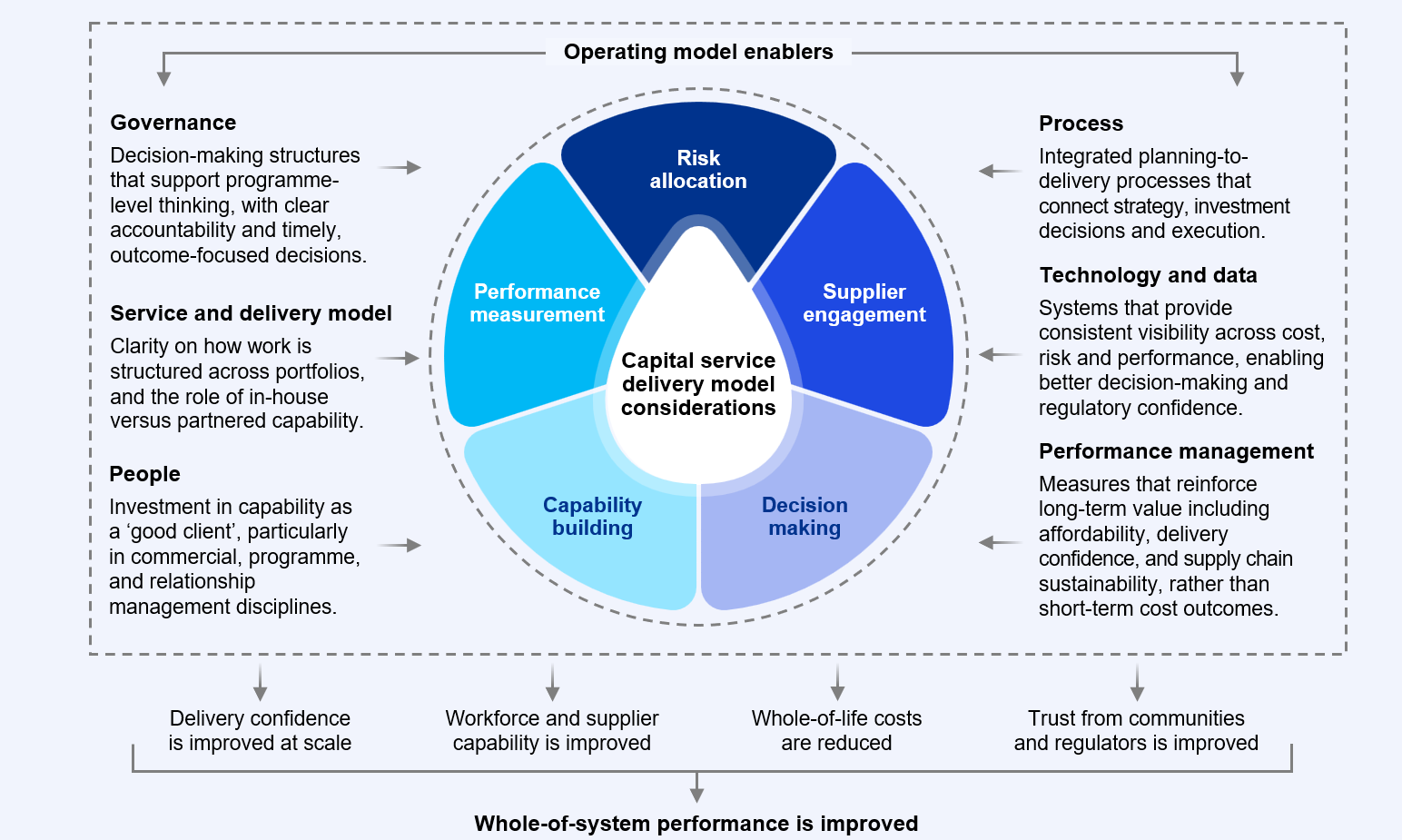
      Delivery models on their own do not determine outcomes. Performance depends on how they are supported through the organisation’s operating model. Those making progress are focusing on a set of connected enablers, as outlined below.

      Viewed together these enablers determine whether delivery models create lasting performance or simply replicate existing challenges in a different form. 


      operating model

      A window of opportunity

      The timing is critical. As new water service providers are brought to life and others continue their transition, there is considerable variation in how delivery is being established across the sector. Whether through new entities or reconfigured internal models, organisations are making foundational decisions about how delivery will work. This presents a unique opportunity to set deliberate approaches from the start.

      The choices made now around delivery models, governance, capability and processes, will shape behaviour, performance and outcomes for years to come. There is risk in deferring these decisions or retrofitting change later. Once delivery systems are embedded, they become difficult to unwind. 


      Let’s continue the conversation 

      We are working with water sector clients across New Zealand to design delivery and operating models that support this next phase of reform, helping organisations move from policy intent to practical, sustainable performance. 

      Get in touch if you are considering how to structure your capital programmes, strengthen your client-side capability, or align your delivery model with Local Water Done Well expectations.


      Mair Brooks

      Partner, Infrastructure Advisory – Major Projects and Infrastructure

      KPMG in New Zealand

      Johlene Nel-du Preez

      Director

      KPMG in New Zealand