
      A recent keynote at the Financial Services Council Conference delivered by Lance Webb, Head of KPMG’s Customer Experience Practice, explored a question becoming increasingly important for organisations across sectors:

      When everyone has AI, what becomes the differentiator?

      The answer is, experience.

      As AI becomes more accessible, products become easier to copy and technology advantage becomes shorter-lived, the organisations that stand apart will be the ones that design, govern and deliver better experiences.

      That does not mean AI is unimportant. Far from it. AI will change how organisations operate, serve, sell, support and scale. But AI alone will not be enough. Competitive advantage will come from how well organisations apply AI to create value for customers, employees and the business.

      Based on a keynote delivered at the 2026 Financial Services Council Conference.

      Written for leaders across CX, UX, marketing, product, AI, service design and transformation, sharing insights from conversations with executives, customer leaders and transformation teams across Asia Pacific.


      AI will change how organisations operate, serve, sell, support and scale. But AI alone will not be enough. Competitive advantage will come from how well organisations apply AI to create value for customers, employees and the business.
      Lance Webb

      The following 10 truths, along with one additional prediction, provide a perspective on where experience design may be heading next.

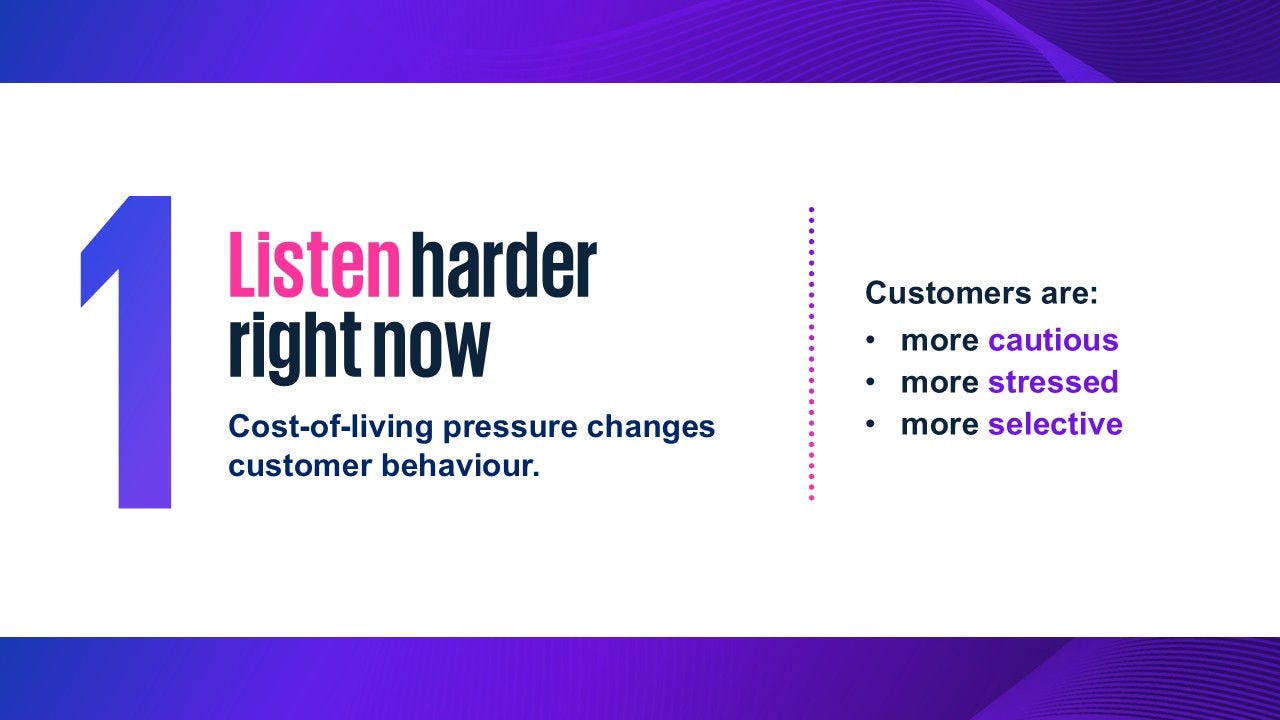
      Customers have changed. Cost-of-living pressure, economic uncertainty and shifting expectations have made people more cautious, more stressed and more selective. Customers are making more considered decisions. They are asking harder questions. They are comparing more. They are thinking more deeply about value.

      At the same time, their expectations have not dropped. Customers still expect experiences to be simple, seamless and personalised. They still expect organisations to understand them. They still expect digital channels to work. They still expect service to be responsive when something goes wrong.

      That creates a difficult tension for organisations. Customers are under more pressure, but they are not giving businesses permission to deliver poorer experiences.

      If there was ever a time to stay close to customers, it is now. The organisations that make better decisions over the next few years will not be the ones relying on old assumptions. They will be the ones listening harder, reading behavioural signals more carefully and understanding what customers are actually experiencing.
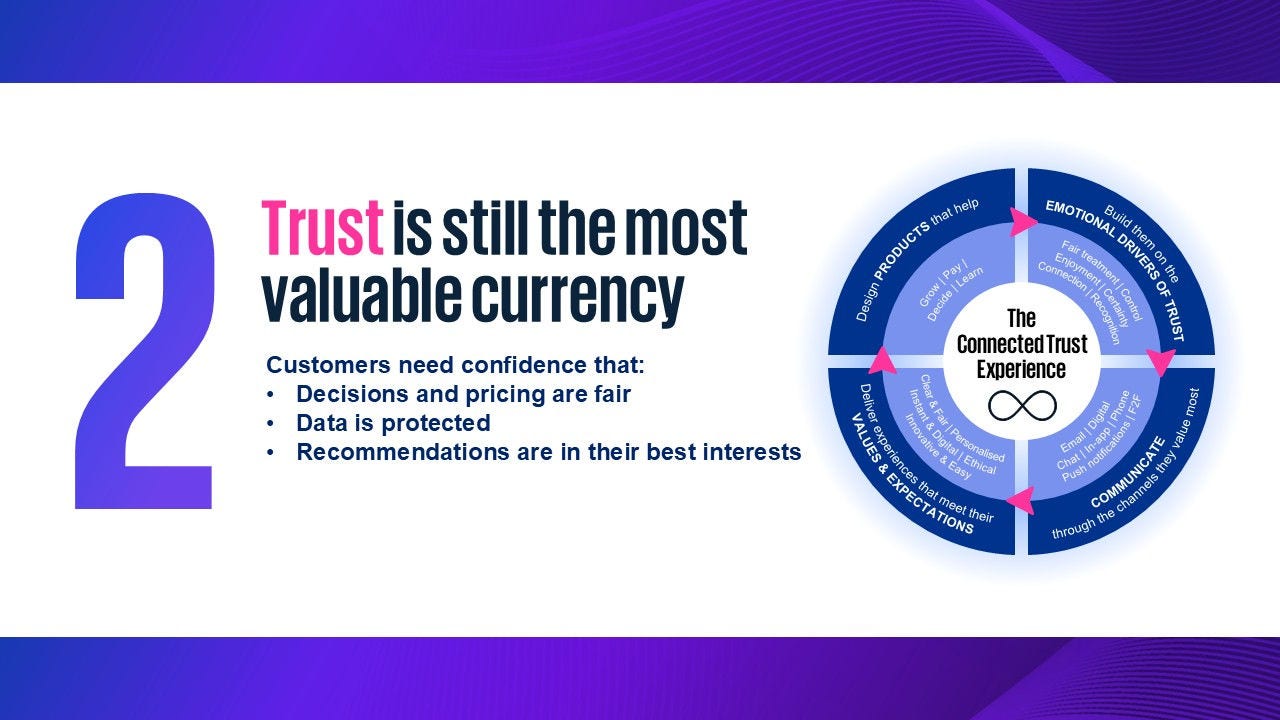
      Trust has always mattered. AI makes it matter even more. As organisations automate decisions, personalise interactions and embed AI into customer journeys, customers will need confidence that what happens next is fair, secure and in their best interests.

      They will want to know: are decisions fair? Is my data protected? Can I trust the recommendation? Can I understand the outcome? Can I challenge it if something feels wrong?

      The principle applies across every industry where customers are sharing data, making important decisions or relying on organisations to act responsibly.

      Trust takes years to build and seconds to lose. In an AI-enabled world, trust cannot sit in a brand promise or a compliance document. It needs to be designed into the experience itself: the language, consent flows, explanations, controls, service recovery and the moments where human judgement still matters. The organisations that earn trust will not simply win customers. They will keep them.

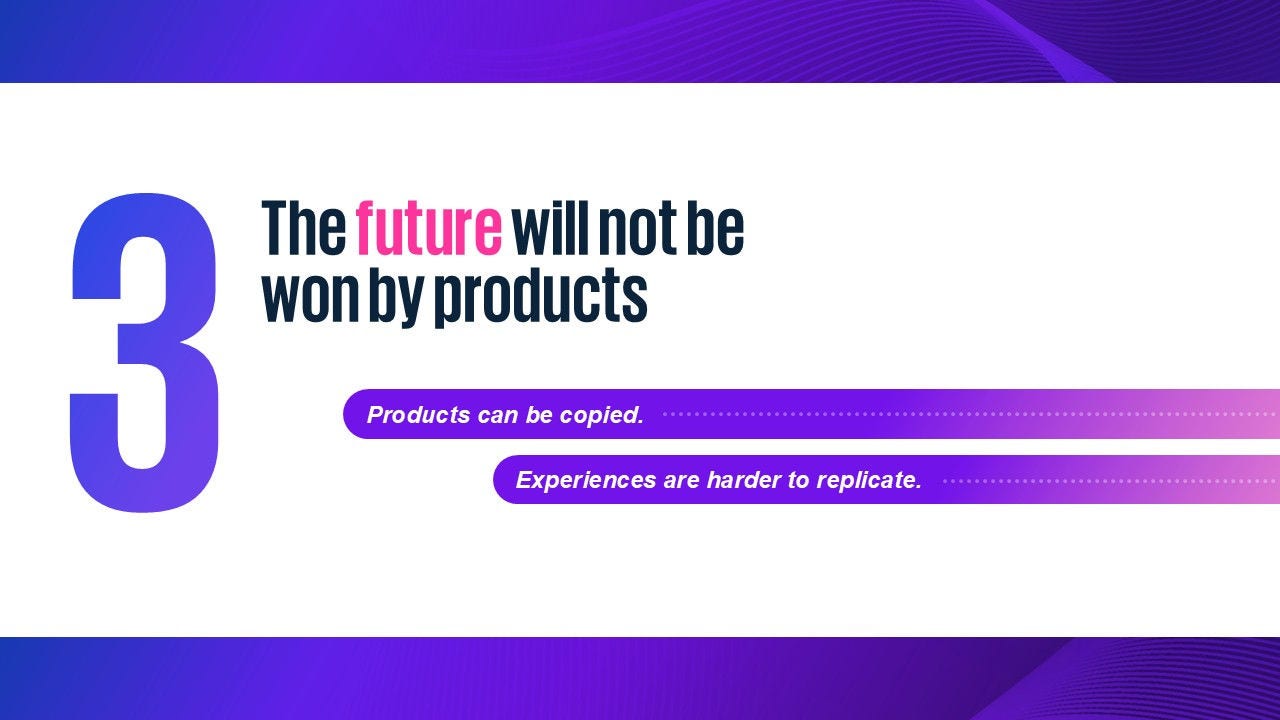
      Here is a simple test. If your competitive advantage can be copied in six months, it probably is not a sustainable advantage.

      Across many sectors, products are converging. Organisations are using similar platforms, vendors, channels, data tools and, increasingly, the same AI capabilities. Features get copied. Pricing moves. Digital experiences become familiar. New entrants raise expectations quickly.

      When products converge, customers start making decisions based on something else. How easy are you to deal with? How well do you understand me? How confident do I feel choosing you? How quickly can you solve my problem? How much effort do you remove from my life?

      This is where experience becomes the difference. Products still matter. But products alone rarely create lasting advantage. The experience around the product is what customers remember, talk about, return to, or leave because of.

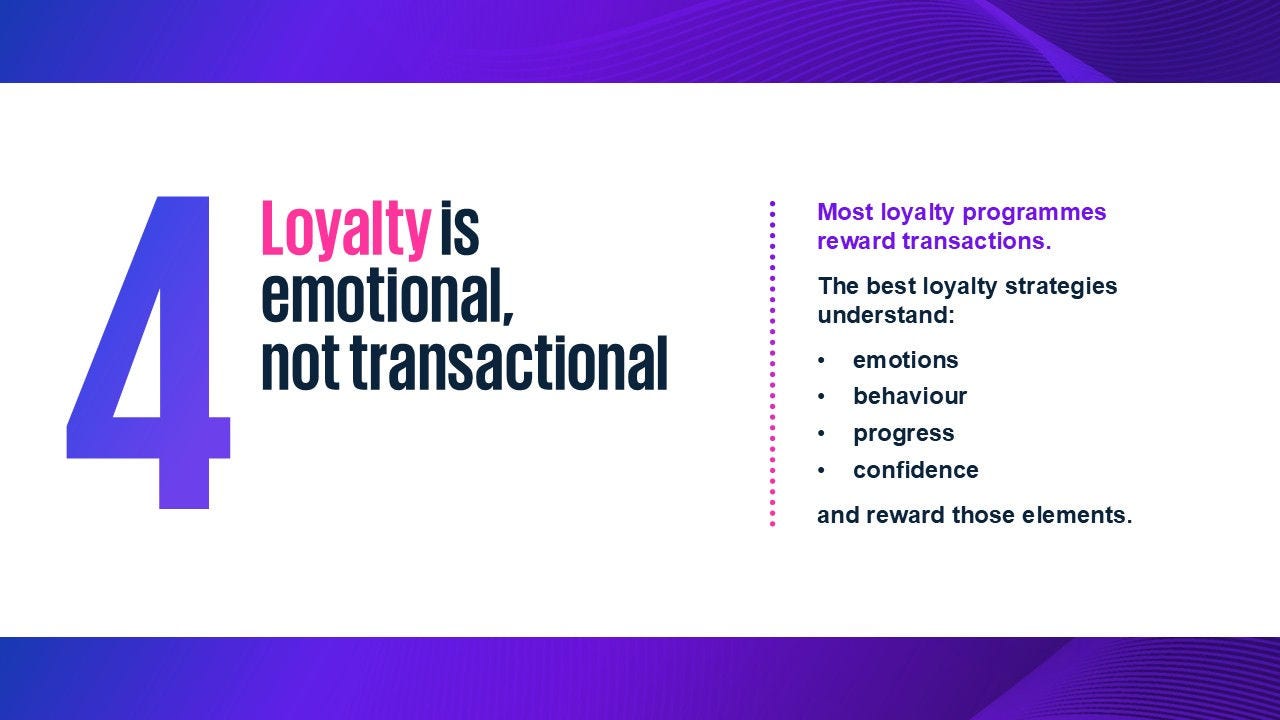
      For years, many organisations have tried to build loyalty through points, rewards, discounts and benefits. Those things can play a role. But very few customers wake up feeling meaningfully connected to a loyalty programme.

      Real loyalty is built through confidence, progress, reduced stress and better outcomes. Customers are loyal to organisations that help them achieve something. Organisations that make their lives easier. Organisations that remove effort at the right moment. Organisations that understand what matters to them and act accordingly.

      The strongest loyalty strategies understand more than spend. They understand behaviour, emotion, progress and confidence. Did the customer feel in control? Did the customer make progress? Did the experience reduce uncertainty? Did the organisation show up when it mattered?

      In many cases, loyalty is less about rewarding the transaction and more about recognising the customer’s context.

      One of the biggest mistakes we see organisations make is trying to improve everything at once. Every journey. Every touchpoint. Every channel. Every interaction. That creates activity. It does not always create impact.

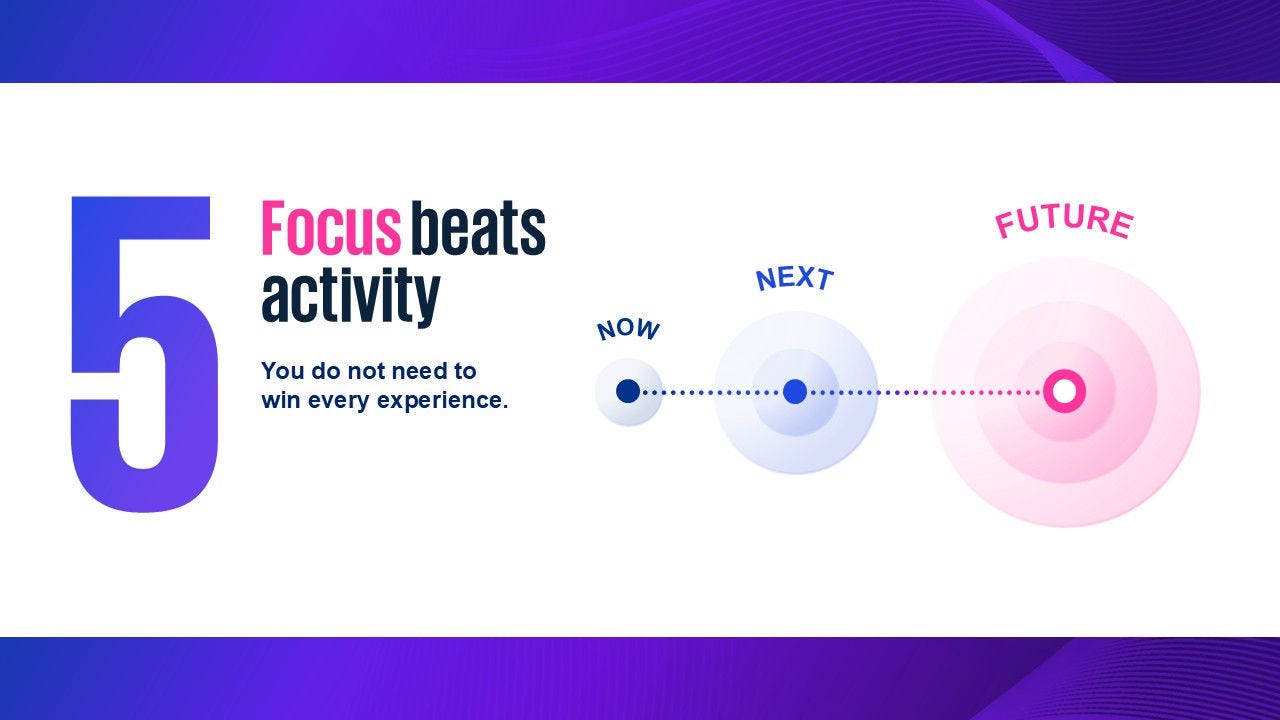
      The reality is organisations do not need to win every experience. They need to win the experiences that matter most.

      What matters now? What will matter next? Where is future customer value likely to come from? Which experiences have the greatest impact on trust, conversion, retention, cost, advocacy or growth?

      This requires discipline. It also requires choices. Customer experience strategy is as much about deciding where to focus as it is about deciding what to improve.

      The organisations creating the most impact are often not doing more. They are being more deliberate about where they place their effort.

      There is a lot of discussion about AI improving productivity, reducing cost and creating efficiency. Those benefits matter. But customers do not wake up hoping your organisation has become more efficient. They care about whether their experience is better.

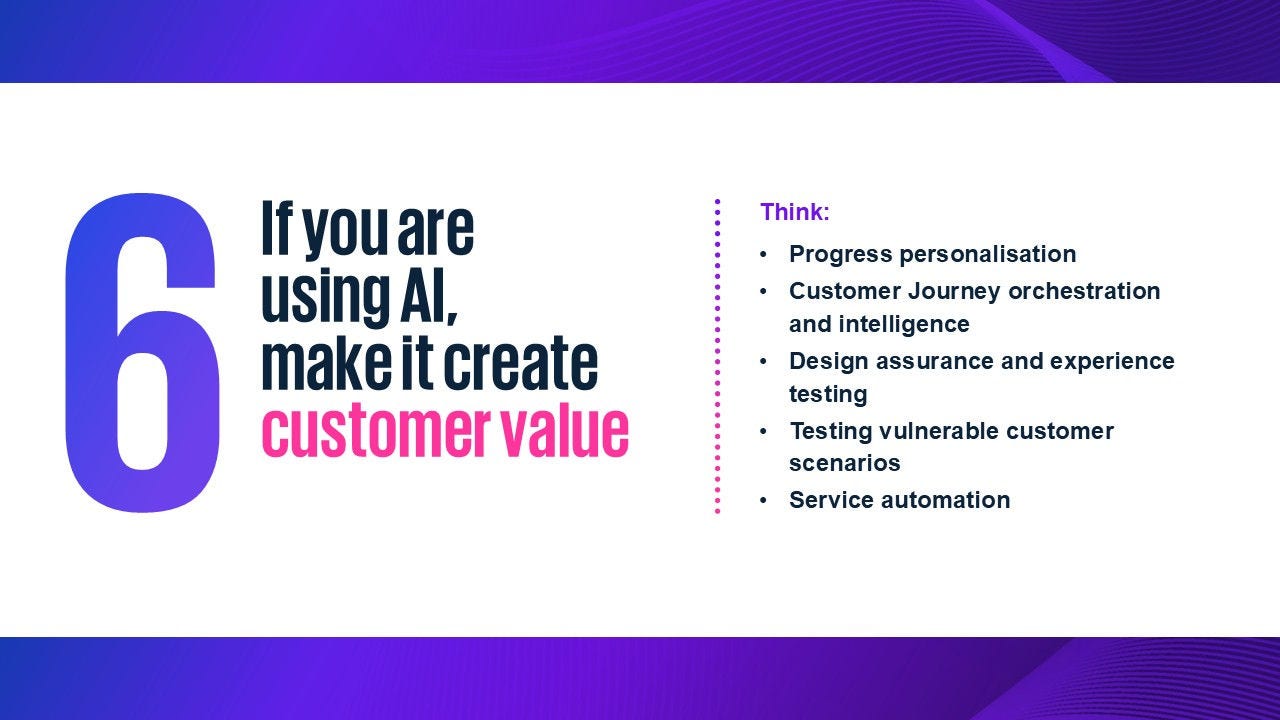
      Can AI help them make better decisions? Can it personalise support in a useful way? Can it reduce effort? Can it solve problems faster? Can it identify vulnerability earlier? Can it help employees deliver better service?

      The real measure of AI is customer value creation.

      This is where many organisations will need to be careful. If AI is experienced by customers as a barrier, a deflection tool or a cheaper version of service, it may damage trust rather than build it.

      AI should make experiences easier, clearer, faster, safer or more valuable. If customers cannot feel the benefit, the AI strategy is incomplete.

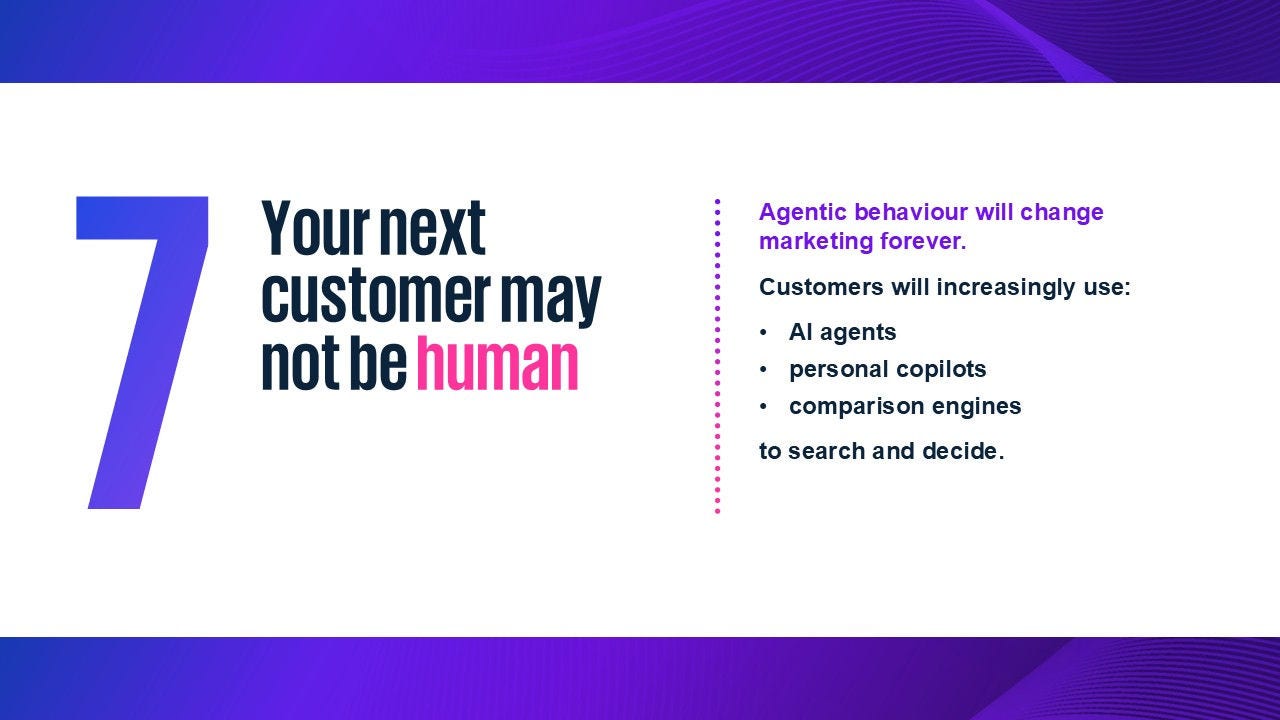
      For decades, organisations have designed experiences for people. Increasingly, they will also need to design for AI agents acting on behalf of people.

      Customers are already beginning to use AI agents, personal copilots and comparison engines to search, compare, shortlist and decide. Over time, those agents may manage more of the journey: researching options, comparing value, checking eligibility, negotiating terms, completing forms and initiating transactions. That changes marketing. It changes search. It changes customer acquisition. It changes digital experience. It changes brand discoverability.

      The question becomes: in the future, will customers choose your brand, or will their AI choose it for them?

      That sounds futuristic, but the shift has already started. Organisations will need to think about whether their products, services, pricing, policies, trust signals and content can be understood by machines as well as humans.

      The next customer journey may not start on your homepage. It may start inside an AI assistant.

      There is enormous pressure on organisations to “do AI”.

      But not every problem needs an AI solution.

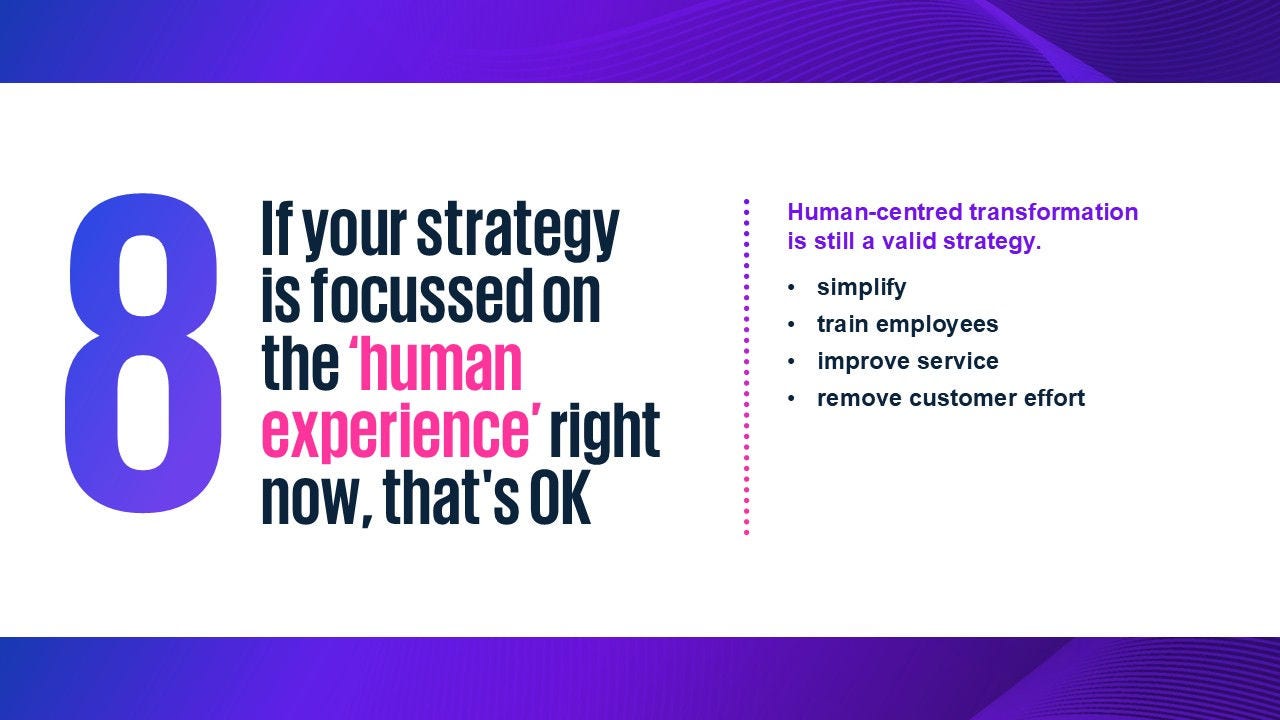
      Many organisations still have significant opportunity in the fundamentals: simplifying experiences, training people, improving service, removing customer effort and fixing broken handoffs.

      Human-centred transformation remains a valid strategy.

      Customers still value experiences that are easy, helpful and human. Employees still need systems, tools and processes that allow them to do good work. Many organisations have not yet fully solved the basics of service design, journey ownership, data quality, channel consistency or customer communication.

      AI can accelerate progress, but it cannot compensate for a poorly designed experience.

      Sometimes the smartest thing an organisation can do is simplify the journey before automating it.

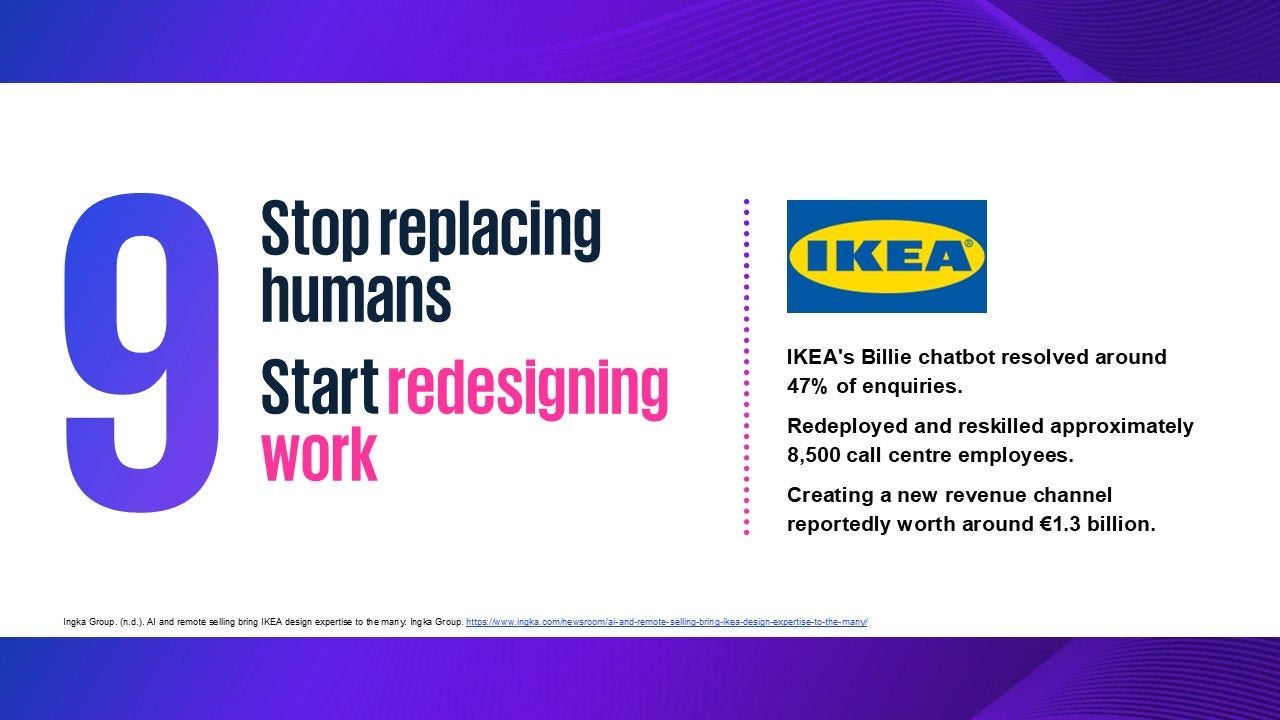
      One of the least helpful questions organisations can ask about AI is: “How many people can it replace?” A better question is: how can AI help people create more value?

      IKEA provides a useful example. According to Ingka Group, its Billie chatbot resolved around 47 percent of customer enquiries. At the same time, approximately 8,500 call centre employees were redeployed and reskilled into higher-value roles, helping create a remote selling channel reportedly worth around €1.3 billion.

      That is the more strategic opportunity. AI should not simply be used to remove people from journeys. It should be used to redesign work. What should be automated? What should be augmented? Where do customers still need human judgement? Where can employees spend less time on repetitive tasks and more time creating value?

      The winners will not be the organisations that remove the most people. They will be the organisations that redesign work so people, systems and AI can each do what they are best suited to do.

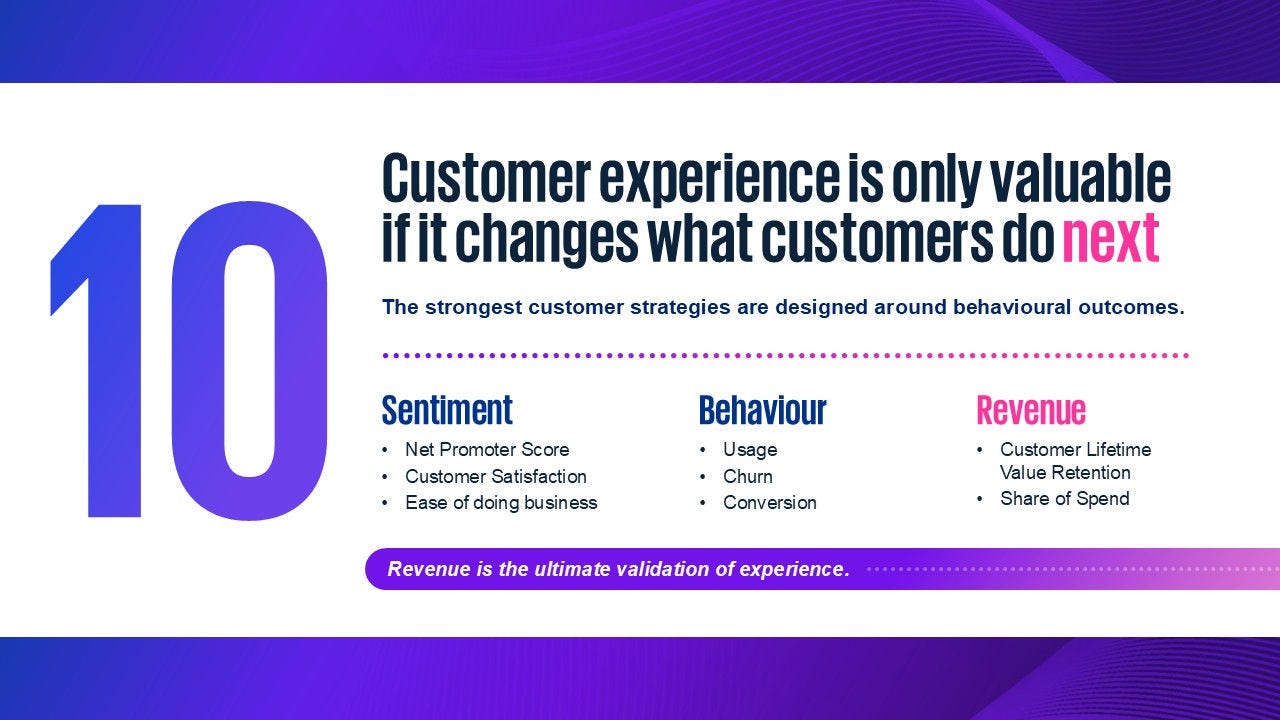
      We spend a lot of time measuring sentiment: NPS, satisfaction, trust, ease. These measures matter. But they are not the end goal. 

      The real test is whether the experience changes customer behaviour. Did customers stay longer? Did they use more services? Did they choose the organisation again? Did they recommend it? Did they complete the journey? Did they increase their share of spend? Did they retain, convert or grow in value?

      The strongest customer strategies are designed around behavioural outcomes. That does not mean reducing customers to numbers. It means being clear about the connection between experience and value. A better experience should help customers do something useful, and that behaviour should create value for the customer and the organisation.

      Revenue is the ultimate validation of experience.

      One additional prediction sits alongside these 10 truths.

      As AI becomes embedded into customer journeys, service designers become more important, not less.

      Organisations will need to design two front doors: one for humans, and one for AI agents acting on behalf of humans.

      That has major implications for acquisition, service, marketing, compliance, digital experience and operating model design.

      A human customer may need a clear message, a simple journey and an emotionally intelligent interaction. An AI agent may need structured data, clear rules, accessible product information, permissions, eligibility criteria, authentication pathways and trusted signals.

      Both matter.

      This is where service design becomes critical.

      Service designers are well placed to connect the moving parts that many organisations struggle to join together: people, process, regulation, systems, communication workflows, data, permissions, identity, intent and governance.

      They can help organisations answer practical questions: what can an AI agent handle? What requires customer consent? What requires human judgement? Where does regulation apply? How is trust designed into the experience? How does the customer stay in control? How are employees supported by AI? How do communication flows work across channels and systems? How does the organisation make experiences understandable to both people and machines?

      This is the next evolution from CX to UX to AX.

      CX is customer experience. UX is user experience. AX is agentic experience.

      AX does not replace CX. It becomes a new layer of CX. If an AI agent has a poor experience interacting with an organisation, the customer has a poor experience too.

      That is why service design will matter so much. The discipline already thinks across journeys, systems, people, policies and moments of truth. In an agentic world, that capability becomes essential.

      Experience becomes the difference

      We are entering a period where many organisations will have access to similar technology. AI capability will become more available. Products will continue to converge. Digital channels will keep improving. Customer expectations will keep rising.

      The question is what leaders choose to do with that capability. Do they use AI to reduce effort or create friction? Do they automate broken journeys or redesign them? Do they use data to personalise value or simply target more efficiently? Do they build trust or quietly erode it? Do they design for customers, employees and AI agents together?

      At KPMG, we have been exploring these questions through our Customer Experience Excellence Study, benchmarking customer experience across 80 New Zealand organisations, including 19 financial services organisations. The study launches in October 2026 and looks at what customers value most and what leading organisations are doing differently.

      One conclusion continues to emerge from this work: The organisations that win will not necessarily be the ones with the most AI. They will be the ones that create the most customer value from it.

      Because when everyone has AI, experience becomes the difference.

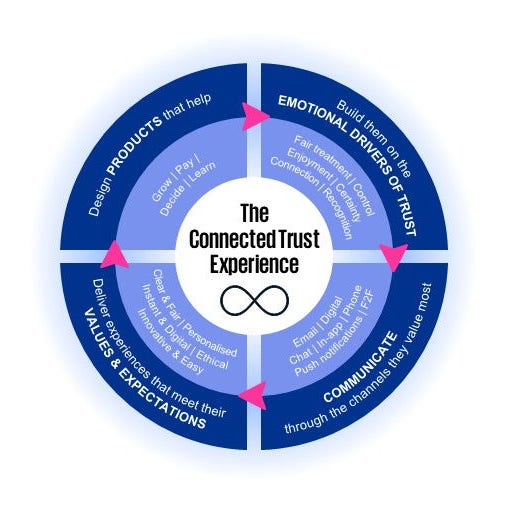
      The connected trust experience

      Reference: Ingka Group. (n.d.). AI and remote selling bring IKEA design expertise to the many. 

      This artcile may incorporate AI-assisted content which has been subject to human review in accordance with KPMG's Trusted AI Framework.


      Get in touch

      Lance Webb

      Head of Customer Experience

      KPMG in New Zealand

      KPMG’s Customer and Growth team helps increase the value of your customer relationships and gain a deeper understanding of what your customers want.