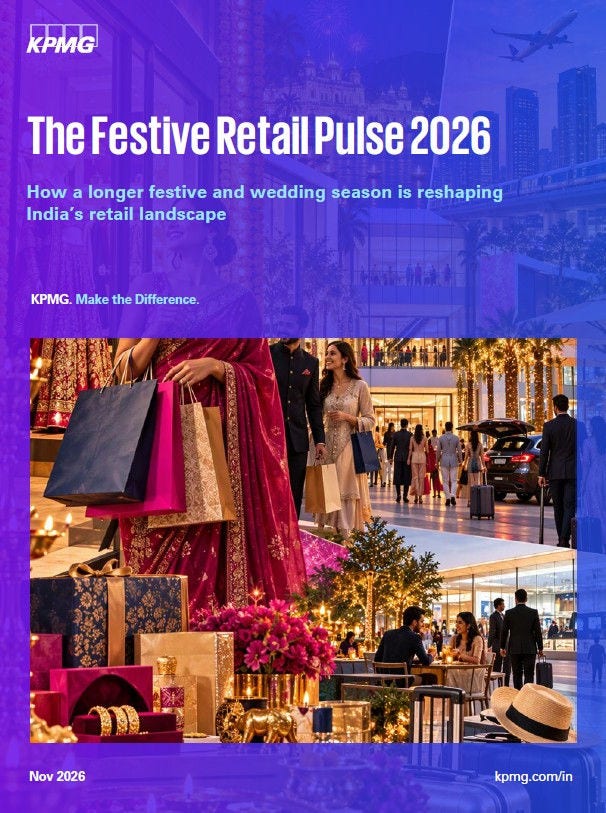
The festive retail pulse 2026 examines how India’s festive and wedding season is evolving from a concentrated sales peak into a longer and more dynamic cycle of consumption. Demand is increasingly spread across regional celebrations, Diwali, travel, weddings and year-end occasions, creating a broader set of moments in which consumers may choose to spend. At the same time, purchase decisions can reflect a combination of priorities across products, services and experiences. Drawing on cited industry and consumer research, the PoV considers shifts in retail sales, purchase intent, category choices, consumer mobility, non-metro participation and external market forces that can influence costs, availability and consumer confidence.
The report looks at the festive season, including the wedding festivities, through the changing shape of consumer demand rather than treating it as a single purchasing window. Different occasions can generate different shopping missions, category requirements and expectations, while consumers may assess purchases through factors such as quality, perceived value, availability, convenience, payment options, delivery confidence and service. These considerations can influence how demand develops across the festive period and how retailers think about the range of interactions that take place before, during and after major festive occasions.
Geography is another important dimension explored in the PoV. The festive opportunity extends beyond some of India’s largest cities, with regional celebrations, local preferences and differences in purchasing behaviour contributing to varied demand patterns across markets. These differences can make factors such as assortment, price points, product availability, trust, fulfilment and service commercially relevant. Understanding such variations may help retailers consider how national strategies can be complemented by more localised approaches across regions and city tiers.
It also considers the wider environment in which festive demand is developing. Consumer confidence, mobility, sourcing conditions, input and landed costs, lead times and product availability can influence purchasing and operating conditions. Rather than viewing these factors independently, it considers how they can interact with changing consumer priorities and category competition during an extended festive and wedding season. This broader perspective is intended to provide context for understanding both demand opportunities and potential operational considerations.
Against this backdrop, the report explores how consumer intelligence, localised assortment, price architecture, inventory positioning, fulfilment and service could help retailers respond to changing demand across occasions, categories and locations. It also considers the role technology and data can play in supporting decisions around demand sensing, inventory visibility, customer engagement and execution. These areas are presented as considerations rather than a uniform approach, recognising that priorities can vary depending on a retailer’s category, customer base, operating model and market presence.