This article was first published on September 09 2026 in International Banker.com. Please click here to read the article.

      The real opportunity does not lie in doing the same things faster; it is in fundamentally reimagining how banks acquire and engage with their customers, evaluate risk, deliver actionable advice, detect and prevent emerging threats, and create sustainable value. As AI becomes embedded into banking, trust must remain at the heart of every decision AI makes. The leaders of tomorrow would be those who can balance innovation with accountability, scale their businesses sustainably, and maintain a balance between autonomy and effective governance.

      The next frontier: from digital banking to intelligent banking

      The banking industry is at an inflection point that most institutions have yet to fully recognise. Over the last two decades, banks have evolved from branch-led operations to digital-first institutions, and now they are entering a new era in which artificial intelligence (AI) is becoming embedded into the fabric of their decision-making.

      The conversation around banking has mostly remained on productivity gains and automation: faster processing, fewer manual steps and a lower cost to serve. This view, however, understates the scale of change that is underway. AI is transforming how financial institutions create value, price risk and engage with customers. India's banking sector is well positioned to undertake this large-scale AI transition, supported by its Digital Public Infrastructure (DPI), the sheer volume of transaction data and a fast-maturing fintech (financial technology) sector. A recent Reserve Bank of India (RBI) analysis1 points to real momentum in AI adoption across Indian banking, particularly in private-sector banks, with use cases in fraud detection, customer service, risk management and compliance. 

      What really sets India apart is the scale of its digital rails. UPI (Unified Payments Interface) alone now processes more than 18 billion transactions a month across roughly 500 million users and 65 million merchants, creating one of the world's richest real-time financial-data ecosystems2. Combined with initiatives such as DigiLocker, Account Aggregators (AAs) and Aadhaar, this ecosystem creates the foundation for AI-driven underwriting, financial inclusion and hyper-personalised banking at a scale that few countries could attempt.

      This creates an opportunity to build a more inclusive, accessible and intelligent financial ecosystem capable of serving millions of individuals and businesses more effectively and efficiently than ever before.

      Reimagining the banking value chain through AI

      AI's influence is no longer confined to isolated functions; it is beginning to reshape the banking enterprise more broadly. Multiple stages of the value chain are now moving from responding to events after they occur to anticipating them before they happen – in some areas, enabling autonomous decision-making.

      Value-chain stageAI todayFuture state
      Customer Sourcing & Prospecting (branches, Direct Selling Agents [DSAs], fintech partnerships, marketplaces)Predictive lead scoring, look-alike modelling, campaign optimisationCustomer-needs prediction, autonomous lead generation
      Customer Verification & KYC (know your customer)Optical Character Recognition (OCR), facial recognition, video KYC, sanctions screeningContinuous KYC, real-time fraud and risk detection
      Credit OriginationDocument extraction, income verification, credit assessmentCashflow-based underwriting and lending, real-time risk pricing
      Credit Underwriting & Approval

      AI-assisted credit scoring and fraud checks

      Dynamic underwriting with continuous risk monitoring
      Customer OnboardingAutomated onboarding workflows, digital forms, chatbot support

      Frictionless onboarding with AI copilots guiding customers through their entire journeys

      Product Cross-Sell & UpsellPersonalised recommendations and next-best offers (NBOs)Highly personalised products based on customer needs
      Relationship ManagementRelationship manager (RM) copilots, customer-insights dashboardsAI-enabled relationship managers providing proactive advice
      Services & CollectionsChatbots, collections analytics, customer-support automationAI agents handling customer service and collections end-to-end
      Fraud & Financial CrimeTransaction monitoring, anti-money laundering (AML) analytics, anomaly detectionPredictive fraud detection and early intervention
      Risk ManagementCredit, market and operational-risk modelsContinuous enterprise risk monitoring with early warnings 
      Treasury & Capital AllocationLiquidity forecasting and market intelligenceAI-assisted balance-sheet optimisation and real-time capital-deployment decisions
      Finance & ComplianceRegulatory reporting, reconciliation and audit supportAutonomous finance built-in controls and real-time compliance monitoring

      The economics of AI: moving beyond the productivity narrative

      Discussions around AI often revolve around efficiency gains because these benefits are immediate and relatively easy to measure; for example, increased utilisation score, lower headcount growth and faster turnaround. However, they represent only a fraction of the broader value that AI has the potential to create.

      Higher returns will come from sharper decisions, better risk outcomes and customers who stay longer and use more bank services. However, none of these benefits come for free. The real cost of AI extends well beyond software licences. Investments in cloud infrastructure, ongoing maintenance, computing capacity, continuous model updates, data modernisation, cybersecurity upgrades, governance frameworks, specialist-talent acquisition and retention, and workforce reskilling all add up to significant, ongoing commitments rather than a one-time expense.

      As a result, prioritisation becomes critical. Banks should focus on use cases that simultaneously deliver strategic impact, measurable business value and operational feasibility. The objective should not be to pursue the greatest number of AI pilots but to concentrate investments on areas in which AI can fundamentally enhance customer outcomes, risk management or growth. Success is unlikely to depend on how many AI initiatives a bank launches; it will depend on whether those initiatives produce measurable business outcomes.

      Cybersecurity, data sovereignty and the new AI threat landscape

      Every major leap in banking technology has widened the industry's attack surface, and AI is no different, except that it is widening it faster than most control environments can keep pace with.

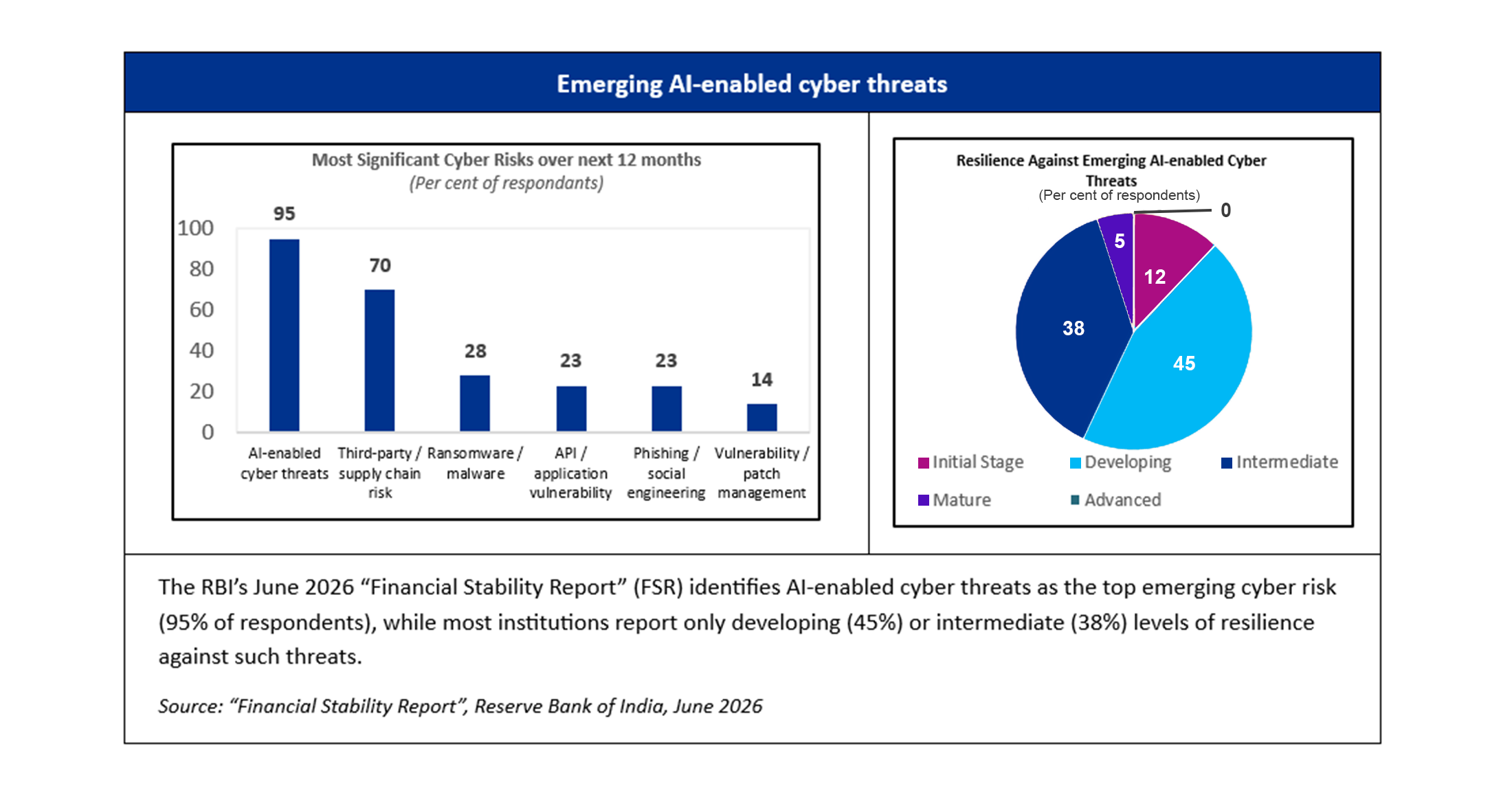
      The risks that financial institutions face now go beyond traditional cybersecurity concerns. Generative AI (GenAI) allows attackers to churn out convincing phishing campaigns, automate the hunt for vulnerabilities and run social engineering at a scale that used to require real manpower, all at close to zero marginal cost. 

      Emerging AI-enabled cyber threats

      Deepfakes and synthetic identities add fraud vectors that would bypass verification controls built in an earlier era. This is no longer a hypothetical risk. Regulators worldwide have flagged how AI-generated content can easily surpass facial authentication, video KYC (know your customer) and account-recovery checks. In India, both the Ministry of Home Affairs and the Indian Cyber Crime Coordination Centre (I4C) have specifically warned financial institutions about the use of deepfakes that could compromise digital financial systems.

      Concern is also growing around data sovereignty and sensitive-information leakage, prompting jurisdictions to impose tighter controls on AI models. The ongoing scrutiny of emerging AI models highlights a broader challenge for financial institutions: understanding not just what an AI model can do, but where the data is processed, who controls it and what risks may be embedded within the model. Regulators have already cautioned banks, underscoring the importance of well-defined third-party AI governance in a sector as heavily regulated as financial services. In other words, cybersecurity is no longer a purely technological challenge for banks. It is now a business resilience, regulatory and board-level issue that must be addressed.

      Accountability cannot be delegated; a robust governance framework is needed

      As AI takes on a bigger share of decision-making, an important question arises: Who answers when the model gets it wrong? The answer, however, remains the same. It is an institution, not an algorithm. Algorithms can support decisions, but responsibility cannot be handed off to them. Banks therefore need governance structures with clear ownership, oversight and escalation for AI-enabled decisions.

      As decisions move from AI-assisted to AI-influenced and, in some cases, AI-initiated, governance will need to keep pace. Some questions become important here. Can a critical decision be explained and challenged? Can bias be detected before it harms a customer, not after? Who is accountable when an automated outcome is incorrect? Regulators are likely to ask similar questions.

      India has already taken significant steps in this direction. The Reserve Bank of India recently introduced the Framework for Responsible and Ethical Enablement of Artificial Intelligence (FREE-AI) for the financial sector, which is based on seven principles: Trust, People First, Innovation, Fairness, Accountability, Explainability and Safety & Sustainability. The framework helps ensure that innovation and risk management go hand in hand, enabling financial institutions to adopt AI more responsibly and sustainably.

      The board also has an important role as AI moves from the experimentation stage to wider deployment. The report titled “AI Governance Principles for Boards”, published by KPMG International and the INSEAD Corporate Governance Centre, argues that boards must look beyond traditional oversight and play a more active role in AI transformation. This includes aligning AI initiatives with long-term value creation, robust data and technology governance, and clear accountability. Boards will need to address immediate AI-related risks while also considering the longer-term transformation AI is likely to bring.

      Sustainable AI: a key imperative

      One aspect of AI that has received far less attention is its environmental footprint. Growing AI use means more computing demand, data storage and energy consumption. The data centres supporting advanced AI workloads require substantial power and cooling, with implications for carbon emissions, water consumption and resource use. For banks, both as users and financiers of AI infrastructure, these considerations are becoming increasingly critical.

      This may require a broader way of evaluating AI investments. As workloads become more compute-intensive, energy consumption, cooling efficiency, carbon intensity and water usage will increasingly sit alongside traditional technology ROI (return on investment). Sustainable AI is, therefore, not only an environmental consideration but a strategic economic consideration as well. How efficiently institutions use computing resources could increasingly influence the long-term value they derive from AI.

      The workforce-reinvention imperative

      AI's long-term impact on banking may be less about replacing the workforce and more about changing how people work. Relationship managers will increasingly work alongside AI copilots or intelligent agents. Risk professionals will oversee AI-driven models, while compliance may spend less time executing manual processes and more time monitoring algorithmic decisions. The banker of the future will still need strong financial expertise, but also the ability to oversee, validate and challenge intelligent systems. Human judgement will, however, remain a critical part of that equation.

      The road ahead

      Over the next decade, banking is likely to move beyond automation towards more autonomous forms of intelligence. AI agents will assist customers and employees to make better decisions, monitor risks, optimise portfolios and participate in increasingly complex processes. Financial services, in turn, are likely to become more predictive, personalised and embedded in customers' everyday lives.

      However, technological sophistication alone will not determine which institutions succeed. Much will depend on how well banks manage the choices that come with it: where AI should be used, where human judgement should remain and how accountability is maintained as systems become increasingly autonomous.

      AI's greatest impact on banking may, in the end, not be the automation of work. It may be the transformation of the judgement itself.


      [1] Reserve Bank of India (RBI): “FREE-AI Committee Report - Framework for Responsible and Ethical Enablement of Artificial Intelligence,” August 13, 2025. (https://rbi.org.in/Scripts/PublicationReportDetails.aspx?ID=1306)
      [2] Press Information Bureau (PIB): “India’s UPI Revolution: Over 18 billion Transactions Every Month, A Global Leader in Fast Payments,” July 20, 2025. (https://www.pib.gov.in/PressNoteDetails.aspx?NoteId=154912&ModuleId=3&reg=48&lang=2)

      Author

      Manoj Kumar Vijai

      Non-Executive Chairman

      KPMG in India

      How can KPMG in India help

      New challenges and opportunities are quickly reshaping financial services

      Solutions to guide your AI transformation journey

      Navigating regulatory complexity through resilience, transparency and innovation

      KPMG Insights Edge

      KPMG Insights Edge

      On the go access to KPMG in India’s insights and publications