Summary

      The draft legislation to implement an enhanced intellectual property (IP) tax deduction regime in the Hong Kong SAR (Hong Kong) was published in the Gazette on 16 October 2026. Subject to completion of the legislative process, the enhanced IP tax deduction would apply retrospectively in relation to (i) eligible IP rights purchased or (ii) licences to use the eligible IP rights acquired under contracts entered into on or after 1 April 2026.

      In this tax alert, we discuss the key enhancements to the IP tax deduction regime and share our observations.


      Background

      In January 2026, the HKSAR Government launched a stakeholder consultation1 on its proposals to enhance Hong Kong’s IP tax deduction regime. After considering the feedback received during the consultation, the Government set out its refined proposals in a Legislative Council paper published in May 20262.

      On 16 October 2026, the Inland Revenue (Amendment) (Tax Deductions for Intellectual Property Expenditure) Bill 20263 (the Bill) was gazetted to set out the necessary legislative amendments to implement the proposed enhancements to the IP tax deduction in Hong Kong.

      The key enhancements

      Largely in line with the Government’s refined proposals released in May 2026, the Bill seeks to implement three key enhancements to the existing regime:


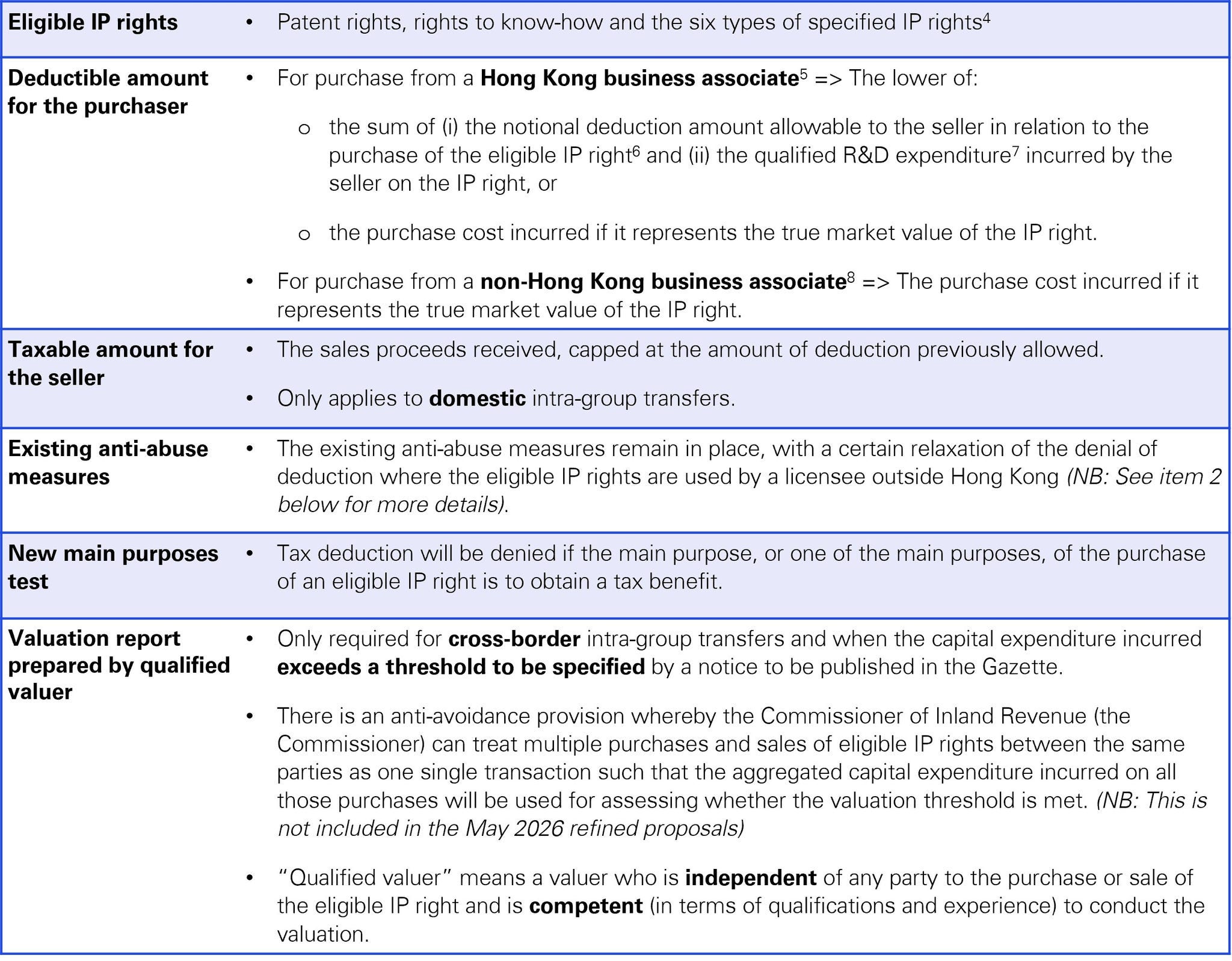
      1. Deduction of purchase costs for eligible IP rights acquired from associates


      Tax deduction would be allowed for capital expenditure incurred by a taxpayer on the purchase of an eligible IP right from an associate, subject to specified conditions and anti-abuse safeguards.


      KPMG observations:


      • Under the Bill, when determining how much of the purchase cost incurred by a buyer is deductible for an eligible IP right acquired from a Hong Kong business associate (which in turn depends on the amount of deductible purchase cost when the seller acquired the right), only any denial of tax deduction under section 16EC(4) of the Inland Revenue Ordinance (IRO) previously applied to the seller would be disregarded.

        It therefore appears that where the seller was previously denied a tax deduction for the acquisition cost of an eligible IP right because it was purchased from an associate (i.e. section 16EC(2) of the IRO applied), the buyer would not be able to claim a tax deduction for that amount as part of its purchase cost incurred.

      • Further guidance on (i) when a valuer would be regarded as “competent” in terms of qualifications and experience and (ii) how much time will be allowed for a taxpayer to produce a valuation report upon the Commissioner’s request, etc. will be welcomed. As a related matter, we will provide our recommendation on the valuation threshold in our submission on the Bill. 

      2. Relaxation of denial of deduction for eligible IP rights used by a licensee outside Hong Kong


      Tax deduction of the purchase cost of an eligible IP right will be available even if the IP right is used by a licensee outside Hong Kong if the related IP income is taxable in Hong Kong under the foreign-source income exemption (FSIE) regime.


      KPMG observations:


      • Despite this relaxation, tax deduction would still be denied in the case where the eligible IP right concerned is used by a licensee outside Hong Kong but the IP income derived from the licensing arrangement is regarded as Hong Kong sourced (e.g. where the eligible IP right is purchased in Hong Kong and the licensing agreement is effected in Hong Kong). 

      3. Deduction of capital expenditure incurred for acquiring licences to use eligible IP rights


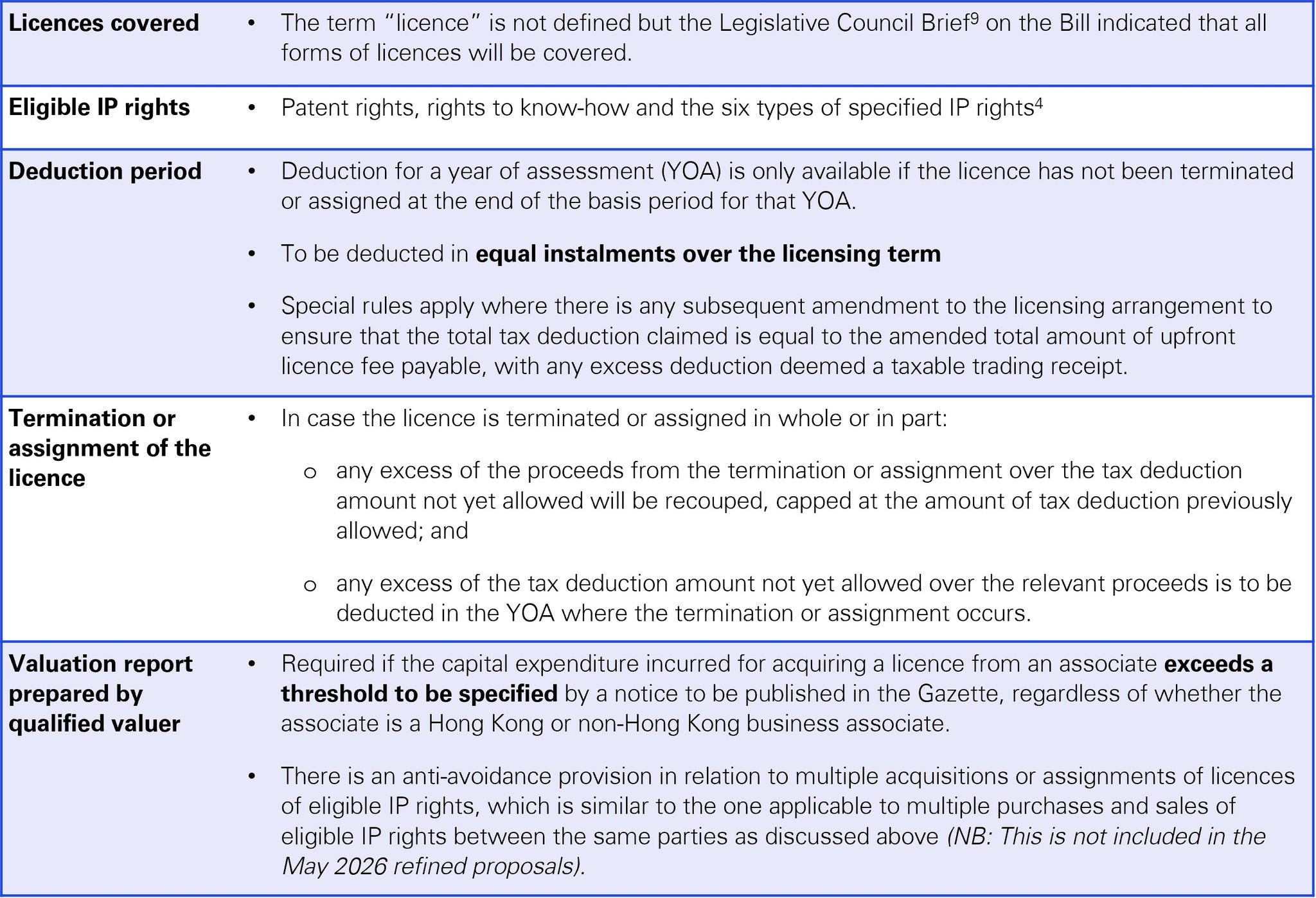
      The Bill introduces a new tax deduction for capital expenditure incurred on acquiring licences to use eligible IP rights (i.e. upfront licence fees). We summarise below the key features of the new deduction:


      The proposed deeming provision to treat upfront licensing income not otherwise chargeable to profits tax received by a Hong Kong licensor as taxable trading receipts included in the May 2026 refined proposals has now been removed.

      Implementation timeline

      The Bill will be introduced into the Legislative Council on 28 October 2026.  Subject to the enactment of the Bill, the proposed enhancements will be implemented with retrospective effect for the purchase or licensing of eligible IP rights under contracts entered into on or after 1 April 2026.

      KPMG observations

      • The Bill marks a significant step towards establishing a more inclusive tax deduction regime for IP-related expenditure. The expanded scope of the deduction to cover purchase of eligible IP rights from associates would help facilitate intra-group transfers of IP rights driven by bona fide commercial reasons. Removing the denial of deduction for the purchase cost in the case where the eligible IP right is used by a licensee outside Hong Kong but the related foreign-sourced licensing income is taxable in Hong Kong under the FSIE regime will partially address the tax asymmetry issue (i.e. income is taxable but the related cost is not deductible). 
      • There have been several enhancements to the tax deduction for intangible assets in Hong Kong in recent years, from the more industry-specific tax deduction for spectrum utilisation fees in the telecommunications sector10 to the present more general refinement of Hong Kong’s IP tax deduction regime. Looking ahead, we would welcome further tax reform to (i) address the issue of “blackhole expenditures” more broadly and (ii) remove the denial of tax deduction for the purchase cost where an eligible IP right is used by a licensee outside Hong Kong but the related licensing income is regarded as Hong Kong sourced and taxable.
      • On franchise arrangements, we recommended in our consultation submission that further clarification be provided on the deductibility of upfront payments made under such arrangements. We are glad to see that the Legislative Council Brief9 has indicated that, in light of industry feedback, the Inland Revenue Department will address the applicability of tax deduction to the relevant upfront licence fees in the cases of franchise agreements in its future guidance note.
      • Even though under the enhanced tax deduction regime, both recurring royalty / licensing payments that are revenue in nature and upfront licensing fees that are capital in nature may be deductible, the two types of payments are subject to different deduction rules. A clear distinction between these two types of payments under a licensing arrangement supported by sufficient documentation is therefore recommended.

      If you have any questions or require assistance regarding the above developments, please feel free to contact us via taxservicesenquiry@kpmg.com.


      1. For more details, please refer to our previous Hong Kong SAR Tax Alert via this link: https://kpmg.com/cn/en/insights/2026/02/tax-alert-03-hk-the-government-proposals-on-enhancing-intellectual-property-tax-deduction-in-hk.html 

      2. For more details, please refer to our previous Hong Kong SAR Tax Alert via this link: https://kpmg.com/cn/en/insights/2026/05/tax-alert-09-hk-the-government-refined-proposals-on-intellectual-property-tax-deduction-in-hk.html

      3. The Bill can be accessed via this link: https://www.legco.gov.hk/yr2026/english/bills/b202610162.pdf

      4. The six types of specified IP rights are (i) copyrights, (ii) registered designs, (iii) registered trademarks, (iv) protected layout-design (topography) rights, (v) protected plant variety rights and (vi) performer’s economic rights. 

      5. Hong Kong business associate means an associate carrying on a trade, profession or business in Hong Kong. 

      6. This refers to the amount of deduction that would be allowable to the seller as if the existing anti-abuse rules in section 16EC(4) of the Inland Revenue Ordinance (IRO) did not apply.

      7. Qualified R&D expenditure means any R&D expenditure (as defined in Schedule 45 to the IRO) incurred on any R&D activity (as defined in Schedule 45 to the IRO) for the IP right of which deduction is allowable under section 16B of the IRO.

      8. Non-Hong Kong business associate means an associate other than a Hong Kong business associate.

      9. The Legislative Council Brief on the Bill can be accessed via this link: https://www.legco.gov.hk/yr2026/english/brief/cedbcr061823_20261014-e.pdf 

      10. For more details, please refer to our previous Hong Kong SAR Tax Alert via this link: https://kpmg.com/cn/en/insights/2023/12/tax-alert-29-hk-the-proposed-tax-deduction-for-spectrum-utilisation-fees-for-the-telecommunication-industry.html


      Hong Kong SAR Tax Alert - Issue 18, October 2026

      Hong Kong moves to expand intellectual property tax deduction as draft law is published

      Hong Kong SAR Tax Alert - Issue 18, October 2026

      Hong Kong SAR Tax Alerts

      These are ad hoc newsletters covering topical tax issues in Hong Kong

      Submit RFP

      Find out how KPMG's expertise can help you and your company.