As transition finance shifts from a moral discussion to a core commercial opportunity, banks need to build credibility grounded in clear taxonomies and high-quality data


      For much of the past decade, transition finance has been framed as a question of values — a moral test for banks navigating the path to net zero. That framing is now changing. Across our conversations with banking clients in Hong Kong SAR, the Chinese Mainland and globally, the transition is increasingly a question of economic or financial benefits as much as a question of values, and two major shifts stand out.

      The first is straightforwardly commercial. For the banks that have moved early, transition finance is quickly becoming one of the most significant business lines on the balance sheet. In 2025, banks globally generated more revenue from providing loans and underwriting bond sales for green-related projects than they earned from fossil fuel companies1, a reversal of the position only four years earlier. 

      The second is resilience. If a bank does not have a clear view of how transition will play out, it is very hard to argue that it is building a resilient portfolio for the future, or properly managing the risks in the book it has today. Encouragingly, we are increasingly seeing large global banks frame their climate and environmental agenda in the language of resilience — and in this context resilience and value tend to pull in the same direction. Financing and developing a clear understanding of clients’ decarbonisation needs is a necessary journey to building a durable future business. 

      For Hong Kong, this is a real opportunity. As a hub where Chinese and international institutions align on disclosure standards, cross-border financing structures and investor expectations, banks here are well placed to become genuine partners to their customers – particularly those in hard-to-abate sectors – as they navigate the journey from “brown” to “greenish”, and ultimately to low-carbon business models. The question is what that partnership actually looks like in practice.
      From counterparty to partner

      The most commercially successful banks globally have understood that transition finance is not about lending to green only. It is about supporting customers through the transition journey, with the competitive edge coming from the depth of advisory engagement rather than a preferential rate for green clients. Helping a client structure complex deals, fund new technologies and translate a transition plan into a financeable strategy is where value is now being created. 

      In Hong Kong the commercial opportunity is substantial but under-tapped. Recent KPMG and DBS research found that only 17% of Hong Kong-listed companies surveyed had leveraged financial instruments to fund their sustainability endeavours. Among them, most of these firms relied on sustainable loans and, to a lesser extent, green bonds2. Notably, none of the surveyed companies had yet utilised dedicated transition financing – the instrument specifically designed to help carbon-intensive businesses fund their shift away from fossil fuels. For companies that did disclose green investment detail, only around 1–2% of annual capital was being directed toward green and sustainability-related initiatives. The gap between ambition and deployed capital is precisely the space banks should be moving into. 

       We are already seeing strong progress on this front. Over the past year several major banks in Hong Kong have begun to provide financing tied to measurable improvements in a client’s sustainability performance, rather than to a fixed product category. Similar innovation is appearing across Southeast Asia, with commercial banks in markets such as Vietnam exploring how to bring transition products to their corporate customers.

      Daisy Shen

      Head of Environmental, Social and Governance (ESG)

      KPMG China

      Angus Choi

      Partner, ESG Advisory, Hong Kong SAR

      KPMG China

      Richard Bernau
      Richard Bernau

      Global ESG Banking Lead,

      KPMG International

      Begoña Ramos
      Begoña Ramos

      Head of ESG Banking and ESG Strategy Group,

      KPMG in the U.S.

      How banks can build credibility

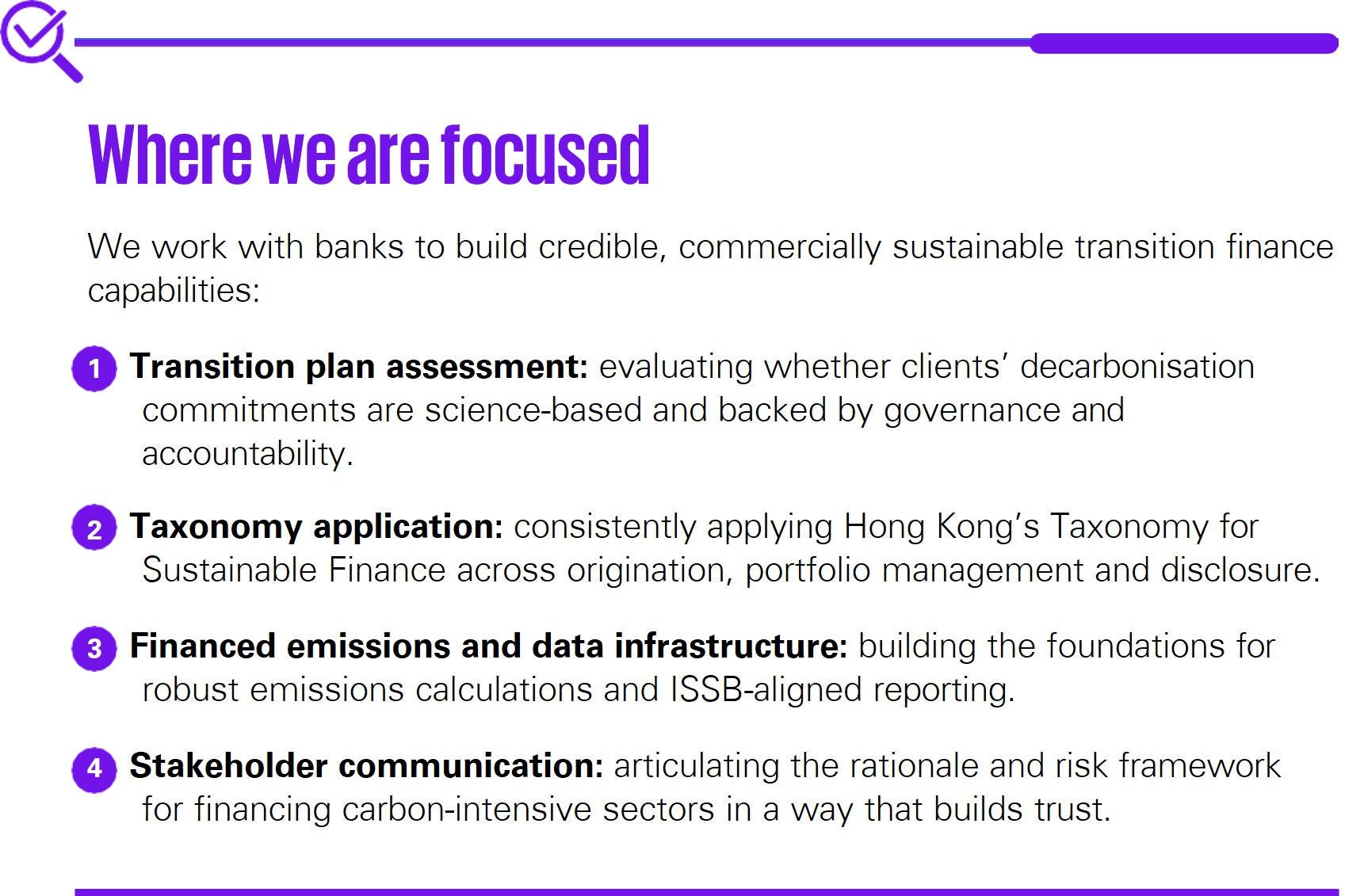
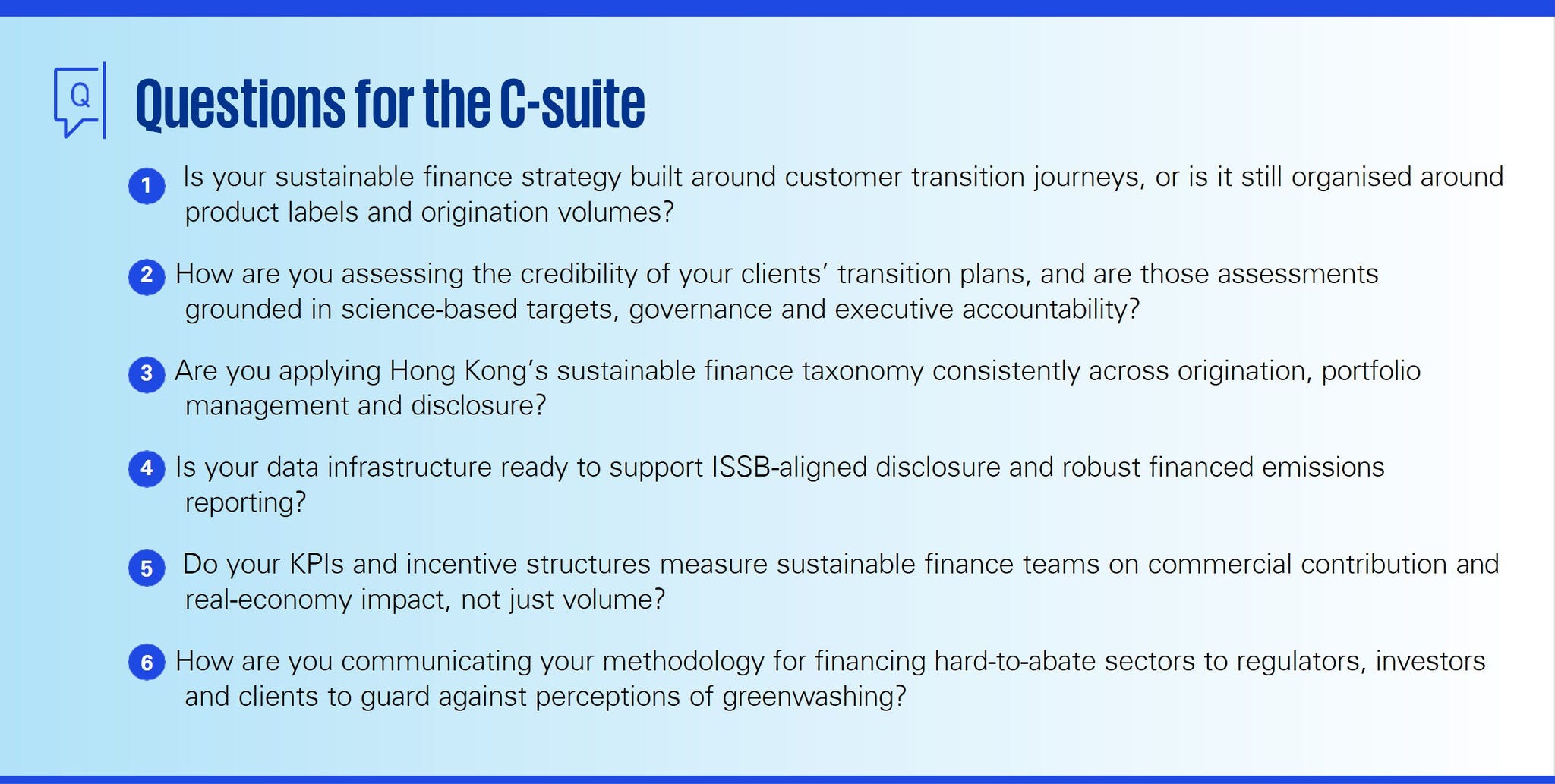
      The economic case for transition finance only holds if the underlying lending is credible. And as banks expand their support for hard-to-abate sectors, the risk of being accused of greenwashing rises in parallel. Many institutions have, until recently, remained cautious about financing carbon-intensive clients for precisely this reason. The answer is not to retreat from these sectors — that would simply leave them under-capitalised at the moment they need to transform — but to build the frameworks that allow banks to engage their clients with confidence.

      Two areas are particularly important. The first is the assessment of customers’ transition plans. Banks need to test whether a client’s commitments are science-based, whether targets are backed by appropriate governance, and whether senior management remuneration is genuinely linked to delivery. The second is the consistent application of a clear transition taxonomy. Hong Kong is already among the more advanced jurisdictions globally on this front, with its recently issued Hong Kong Taxonomy for Sustainable Finance3 aiming to enhance interoperability with the EU and Mainland China taxonomies. A consistently applied taxonomy gives banks an objective basis for labelling transition activity and a clear way of tracking progress against public commitments.

      Underpinning all of this is the quality of data. KPMG’s 2025 report with DBS4 found that over half of surveyed consumer good companies had yet to disclose their Scope 3 emissions, mainly due to data challenges. Meanwhile, as banks prepare for ISSB-aligned disclosure, there’s growing scrutiny on how financed emissions are calculated. Globally recognised standards such as PCAF (the Partnership for Carbon Accounting Financials) are helping banks by enabling more comprehensive tracking of emissions across a wider range of financial products, but the quality of underlying data remains critical.

      The view from the Chinese Mainland

      Policy direction in the Chinese Mainland will continue to shape a significant portion of global transition finance demand, with Hong Kong serving as the natural conduit. The 2026 Government Work Report5, for example, calls for greater financial support from state owned banks for green infrastructure, energy efficiency, carbon reduction, supply chain upgrades and the upgrading of traditional high emitting industries. We can expect these priorities to translate into growing demand for transition oriented financing solutions.

      As Mainland regulators channel more capital into technology and green transition, Hong Kong provides the venue where these flows can meet international capital discipline. The city’s banks are well placed to set the example for how transition finance should be done: with credible methodologies, transparent communication of risk and rationale to stakeholders, and a clear link between financed emissions and real-economy decarbonisation outcomes.

      Financial Results


      Compare the results of banks across a variety of metrics in the charts for each of the five categories of banks in Hong Kong

      Performance Rankings | Licensed banks | Digital banks | Restricted licence banks | Deposit-taking companies | Foreign bank branches


      Hong Kong Banking Report 2026

      Positioned for Growth

      Hong Kong Banking Report 2026

      Hong Kong Banking Report 2026

      Positioned for Growth

      Submit RFP

      Find out how KPMG's expertise can help you and your company.