As Hong Kong advances its fixed income and currency markets, embedding robust standards of ethical conduct from the outset will be as critical as the new infrastructure being built


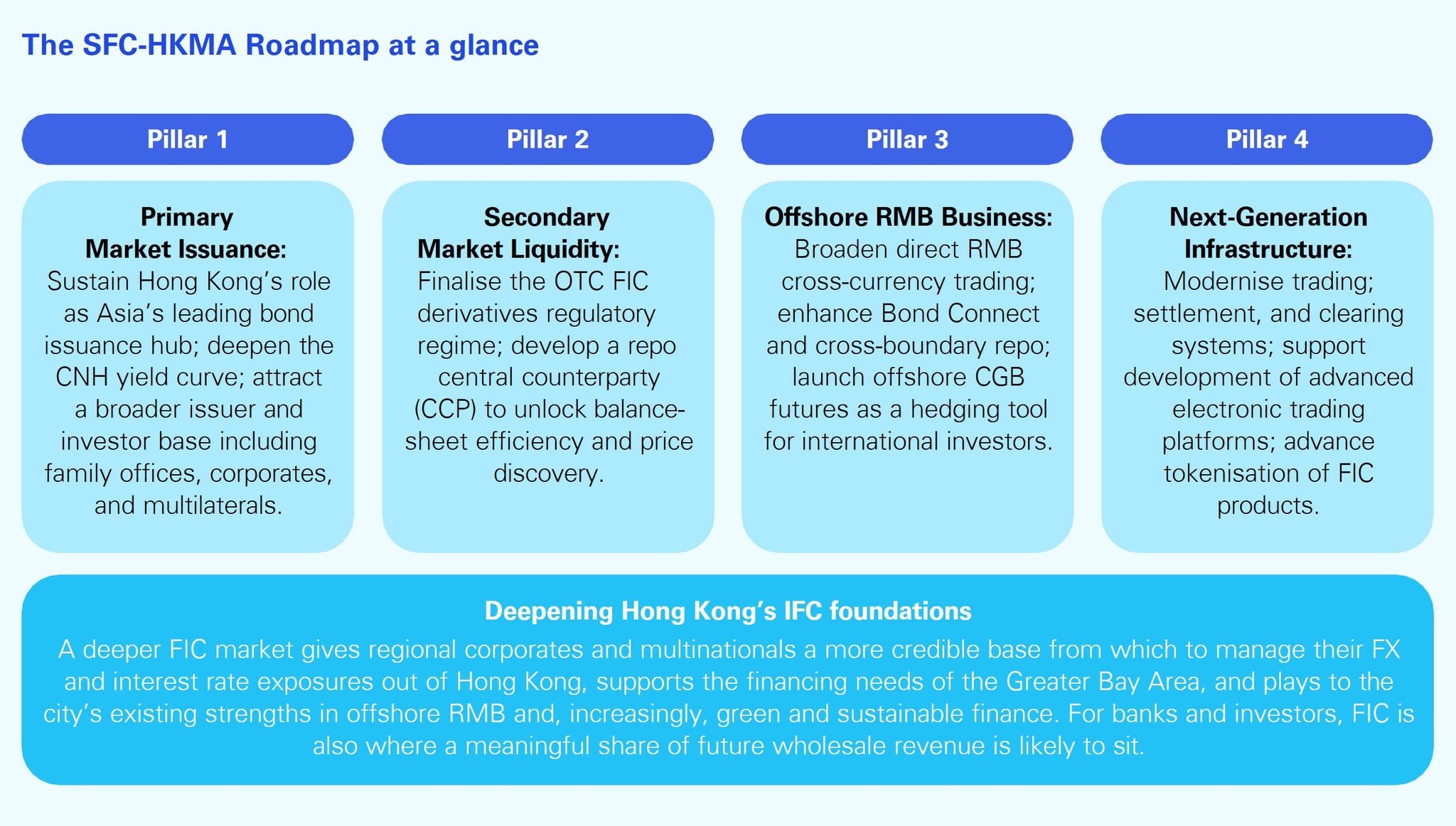
      Fixed income and currency (FIC) markets do not exist for their own sake. They exist to connect issuers with investors, to help corporations manage currency and interest rate risk, to channel financing toward the real economy, and to provide the infrastructure through which Greater China’s growth story engages with global capital. The SFC-HKMA Roadmap for the Development of Fixed Income and Currency Markets1, launched in September 2025, is rooted in that logic: a deeper, more diverse FIC market is ultimately a better market for everyone who depends on it – from Mainland enterprises raising cross-border capital, to regional treasurers managing risk, to international investors seeking access to Asia’s growth, and for Hong Kong’s continued growth as an IFC. 

      However, developing new market infrastructure is only part of the story. New platforms, products, clearing arrangements and digital infrastructure will not, on their own, be suffcient to encourage market participants to engage at scale. Institutions also need the confidence that the market operates on the basis of fairness, transparency and sound conduct.

      This is precisely the issue the Financial Markets Standards Board (FMSB) has been working to address since its inception in the wake of the UK LIBOR, FX and precious metals benchmark scandals that shook wholesale markets in the 2010s. Its experience over the past decade shows that a collaborative, practitioner-led effort is exactly what is needed to ensure Hong Kong’s FIC markets develop in a way that is fair, inclusive, and purposefully connected to the needs of the real economy.

      tips_and_updates

      FMSB sits in a unique position: practitioner-led, globally respected, and operationally independent of any single regulator or firm. Its standards and Statements of Good Practice — covering topics from front-office supervision and grey market trading to electronic execution and carbon markets — address precisely the ambiguous areas that regulators find hardest to codify and market participants find most costly to navigate. 


      Jianing Song

      Head of Banking and Capital Markets, Hong Kong SAR

      KPMG China

      Paul McSheaffrey

      Senior Banking Partner, Hong Kong SAR

      KPMG China

      Myles McGuinness
      Myles McGuinness

      Chief Executive Officer, Financial Markets Standards Board

      Christopher Rich
      Christopher Rich

      General Counsel, Financial Markets Standards Board

      The imperative for Hong Kong to imbed integrity alongside new infrastructure

      Hong Kong’s FIC markets are already demonstrably deep and mature.  The city accounts for nearly 30% of Asian international bond issuances and has topped the regional league table for nine of the past ten years2. It is the world’s fourth-largest FX market3 by daily turnover and the pre-eminent offshore centre for RMB FX and interest rate derivatives. 

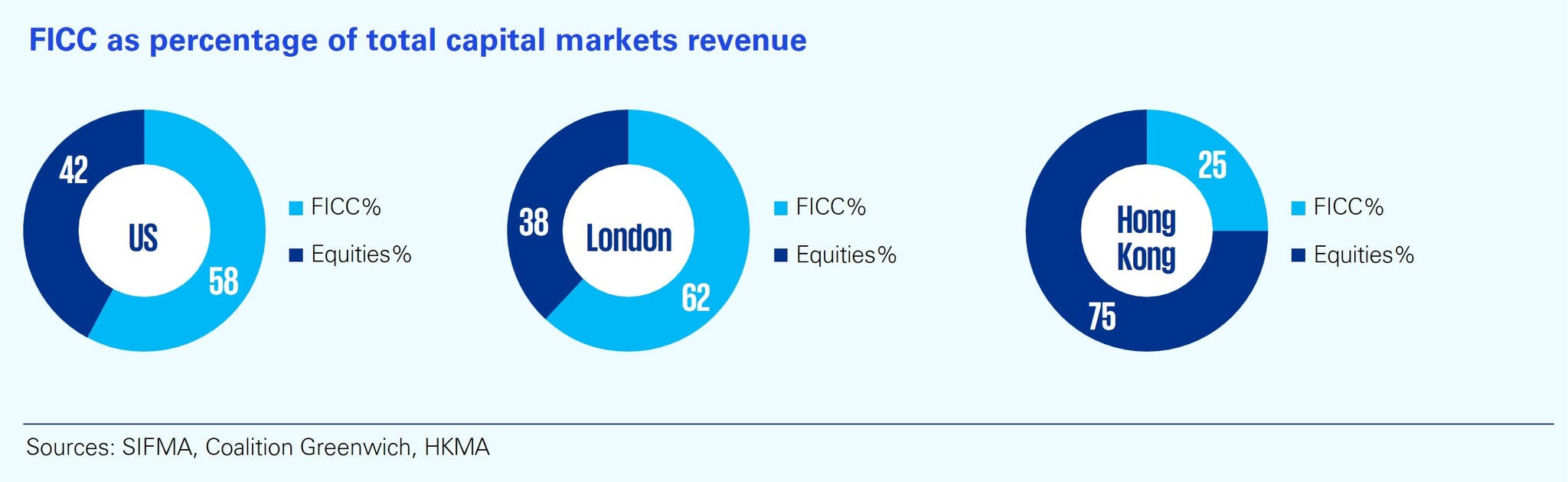
      Longer term, the ambition for Hong Kong is to have an FIC market that is equivalent or bigger than London and New York. Hong Kong’s capital markets are heavily skewed towards equities by comparison, and closing that gap is a clear, long-term, multi-year opportunity that will not happen overnight. 

      As Hong Kong sets out in its journey to scale its FIC markets and attract a broader, more international investor base, it would be remiss not to draw on the hard-won lessons from the wave of misconduct scandals that engulfed wholesale markets over the past two decades. The manipulation of benchmarks, the abuses uncovered in spot FX trading, and the collusion cases that resulted in record fines globally reflected structural vulnerabilities in how over-the-counter (OTC) markets were designed, governed and supervised. As Hong Kong’s FIC ecosystem grows in depth and complexity, these are vulnerabilities that local market participants and regulators need to anticipate rather than react to, and it will be key as the ecosystem grows in a trusted manner.

      Lesson one: fair and effective markets begin with robust and enforceable standards

      Deep, liquid markets require trust, and trust requires clear, well-understood and consistently applied standards of market practice. As Hong Kong develops new trading venues, expands its repo market and builds out its OTC derivatives regime, there is a genuine opportunity to strengthen conduct standards from the outset – rather than retrofitting them once problems emerge. 

      The SFC–HKMA Roadmap rightly acknowledges some of these challenges. In making the case for a purpose-built electronic FIC trading platform, it notes that FIC products are primarily transacted OTC, giving rise to bilateral counterparty credit risk, limited centralised price discovery and lower transparency, compounded by fragmented liquidity pools and thin secondary markets.

      To address these challenges, firms and their staff must demonstrate strong adherence to consistently applied standards of conduct, and equally important are formal and informal mechanisms that give these standards real weight – ensuring they are not just aspirational but enforceable and meaningful in practice. With global regulators continuing to scrutinise areas such as pre-hedging, block trading and electronic communications, Hong Kong has an opportunity to draw on the experience of other FIC hubs, including through FMSB, to build standards that support growth and innovation while reducing the risks of cross-border regulatory arbitrage.

      Lesson two: benchmark integrity cannot be an afterthought

      Hong Kong’s aspiration to develop a robust CNH yield curve and to lead in offshore RMB price discovery places benchmark integrity at the heart of the FIC roadmap. The painful experience of LIBOR, the FX fix and the gold fixing scandals demonstrated that submission-based or thinly-traded benchmarks can be particularly vulnerable to manipulation. 

      As CNH benchmarks evolve, governance arrangements, transparent methodologies, broad-based input data and effective oversight of submitters should be priorities rather than afterthoughts. In the same vein, the move toward greater electronification and next-generation infrastructure is a rare chance to design transparency into the system from the start. 

      Lesson three: the market cannot police itself

      Historically, the buy-side has often lacked the tools, incentives or willingness to police sell-side behaviour, and even sophisticated institutional investors can struggle to detect abuse when markets are opaque. That places a particular onus on individual accountability – ensuring that senior managers, traders and other participants are personally responsible for the standards of conduct in their areas, supported by appropriate qualifications, training, surveillance and remuneration structures that genuinely align incentives with long-term value creation.

      As Hong Kong expands the scope and ambition of its FIC markets, and as more firms establish trading and treasury operations in the city, there is a strong case for ensuring that the framework for individual accountability keeps pace with the market it governs. The forthcoming work on finalising the OTC derivatives licensing regime is a natural opportunity to embed these expectations from the outset.


      Financial Results


      Compare the results of banks across a variety of metrics in the charts for each of the five categories of banks in Hong Kong

      Performance Rankings | Licensed banks | Digital banks | Restricted licence banks | Deposit-taking companies | Foreign bank branches


      Hong Kong Banking Report 2026

      Positioned for Growth

      Hong Kong Banking Report 2026

      Hong Kong Banking Report 2026

      Positioned for Growth

      Submit RFP

      Find out how KPMG's expertise can help you and your company.