In determining how to account for holdings of cryptoassets, a company needs to:
- identify its rights and obligations attached to the cryptoasset;
- assess the main purpose of holding the cryptoasset; and
- apply judgement in identifying the relevant accounting standard and developing an accounting policy.
The rights and obligations attached to cryptoassets and companies’ reasons for holding them can vary. Therefore, it is important that a company assesses the accounting for a cryptoasset based on the specific facts and circumstances.
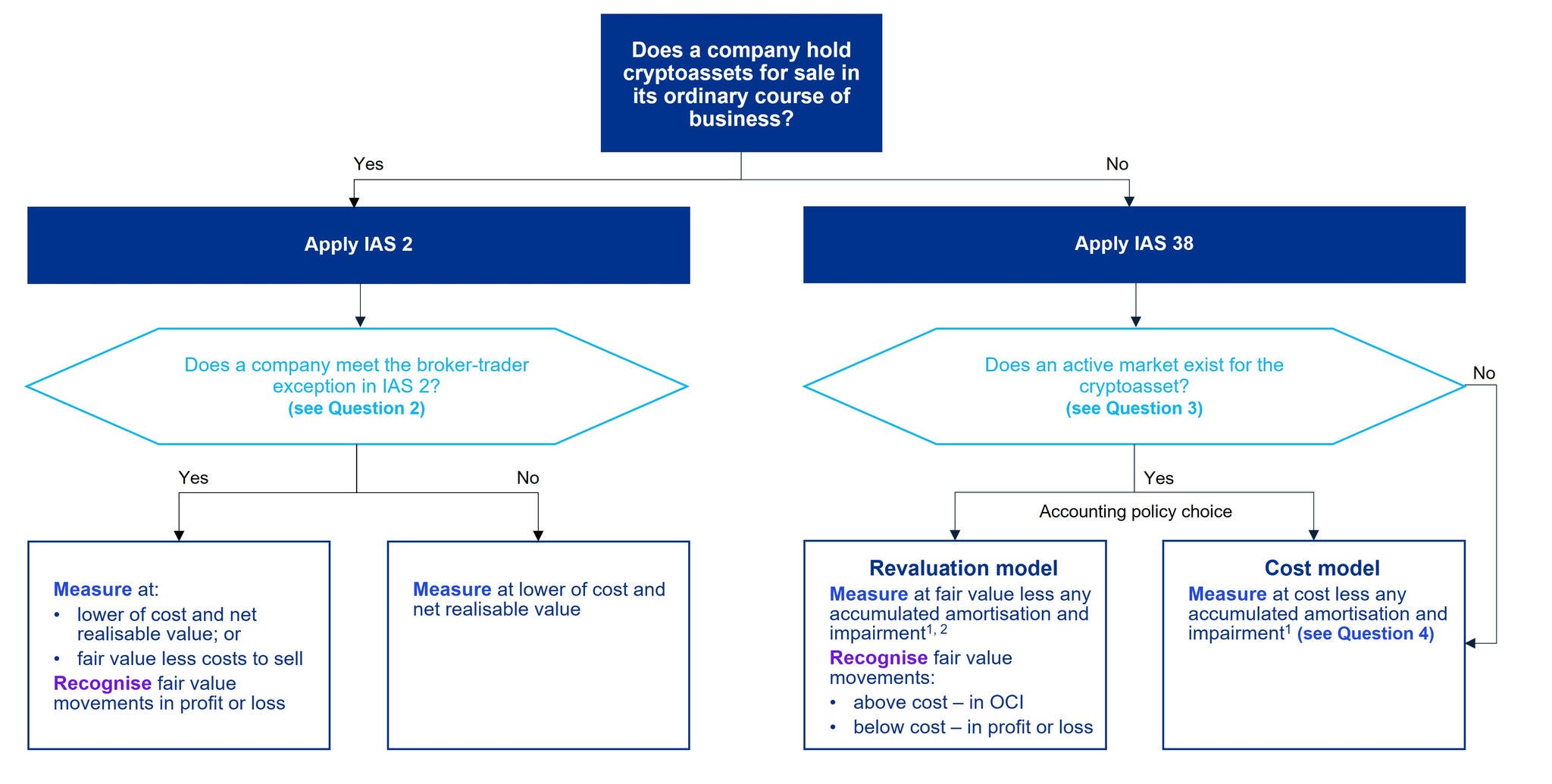
Many cryptoassets are accounted for as intangible assets under IAS 38 Intangible Assets or as inventories under IAS 2 Inventories. Relevant considerations under these accounting standards are discussed further below.
In some cases, cryptoassets may be in the scope of another accounting standard. For example:
- a stablecoin that gives the holder the right to redeem it for cash may be a financial asset under IFRS 9 Financial Instruments; or
- a cryptoasset that represents an ownership interest in an underlying asset may be accounted for under the accounting standard applicable to the underlying asset (e.g. IFRS 9, IAS 16 Property, Plant and Equipment or IAS 38).
The following diagram sets out the measurement approaches for cryptoassets in the scope of IAS 2 and IAS 38.