African CEOs navigate economic change as AI, talent and sustainability reshape growth

      The third edition of the KPMG Africa CEO Outlook provides insight into how African CEOs are navigating an increasingly complex business environment and positioning their organisations for future growth.

      Across East, West, Southern and North Africa, CEOs are navigating different economic conditions, risks and investment priorities, with a shared focus on strengthening resilience and positioning their organisations for long-term growth.

      Confidence remains strong despite the complexity of the operating environment. 79 percent of African CEOs are confident in their organisation’s growth prospects, while 86 percent reported revenue growth in their latest financial year. This confidence is being tested by a changing risk environment. Cybersecurity and data security are a leading threat to growth, cited by 31 percent of African CEOs. 

      AI presents a similar balance between ambition and delivery. 72 percent identify AI as a top investment priority, yet only 14 percent believe their organisations are keeping pace with or moving ahead of AI developments. People remain central to that transformation, with 84 percent of African CEOs expecting headcount to increase over the next three years, while skills gaps and AI upskilling remain significant challenges. Building practical capabilities will be critical to translating AI investment into value.

      Sustainability also remains an important consideration as organisations balance long-term ambitions with changing business demands. African CEOs are approaching sustainability with greater commercial discipline, balancing long-term climate objectives with energy reliability and affordability. 

      The organisations best positioned for long-term growth will be those that invest in the right capabilities, respond to their markets and remain ready to adapt as conditions evolve
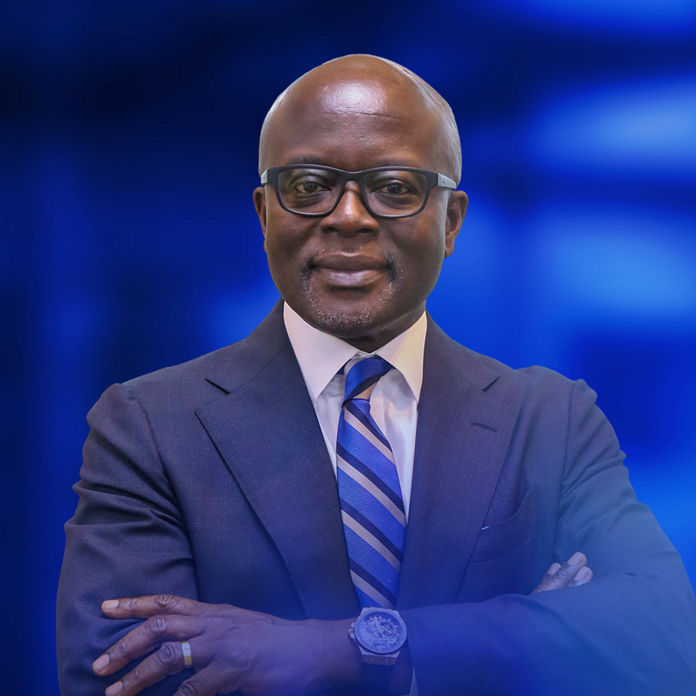



      African CEOs are navigating a changing environment with confidence and a clear focus on growth. What stands out is their willingness to invest in technology, strengthen their organisations and build the capabilities needed for the future. These investments will be important in positioning African businesses for sustainable, long-term growth."
      Tola Adeyemi

      Senior Partner & CEO, KPMG One Africa

      Economic outlook


      African CEOs pursue resilient growth amid economic uncertainty 


      African CEOs remain confident in their growth prospects, even as a complex operating environment places greater demands on resilience, productivity and capital discipline. Confidence in the global economy stands at 66 percent among African CEOs, broadly in line with the global benchmark of 65 percent. Confidence in domestic economies is 72 percent, while 79 percent are confident in their own organisations. Both measures trail global peers, highlighting the gap between corporate ambition and the wider conditions for growth.

      Recent performance provides grounds for optimism: 86 percent of African CEOs reported revenue growth in their latest financial year. Yet expectations are more restrained. Only 58 percent anticipate annual earnings growth of at least 2.5 percent over the next three years, against 68 percent globally. The challenge is to convert revenue momentum into stronger earnings through productivity, cost discipline and selective investment.

      The contrast between recent revenue performance and future earnings expectations is a defining feature of the 2026 outlook. While African CEOs remain optimistic about growth, their more measured earnings expectations point to the importance of opera tional efficiency, effective cost management and investments that deliver measurable returns. These priorities will be critical to sustaining business performance amid economic uncertainty.

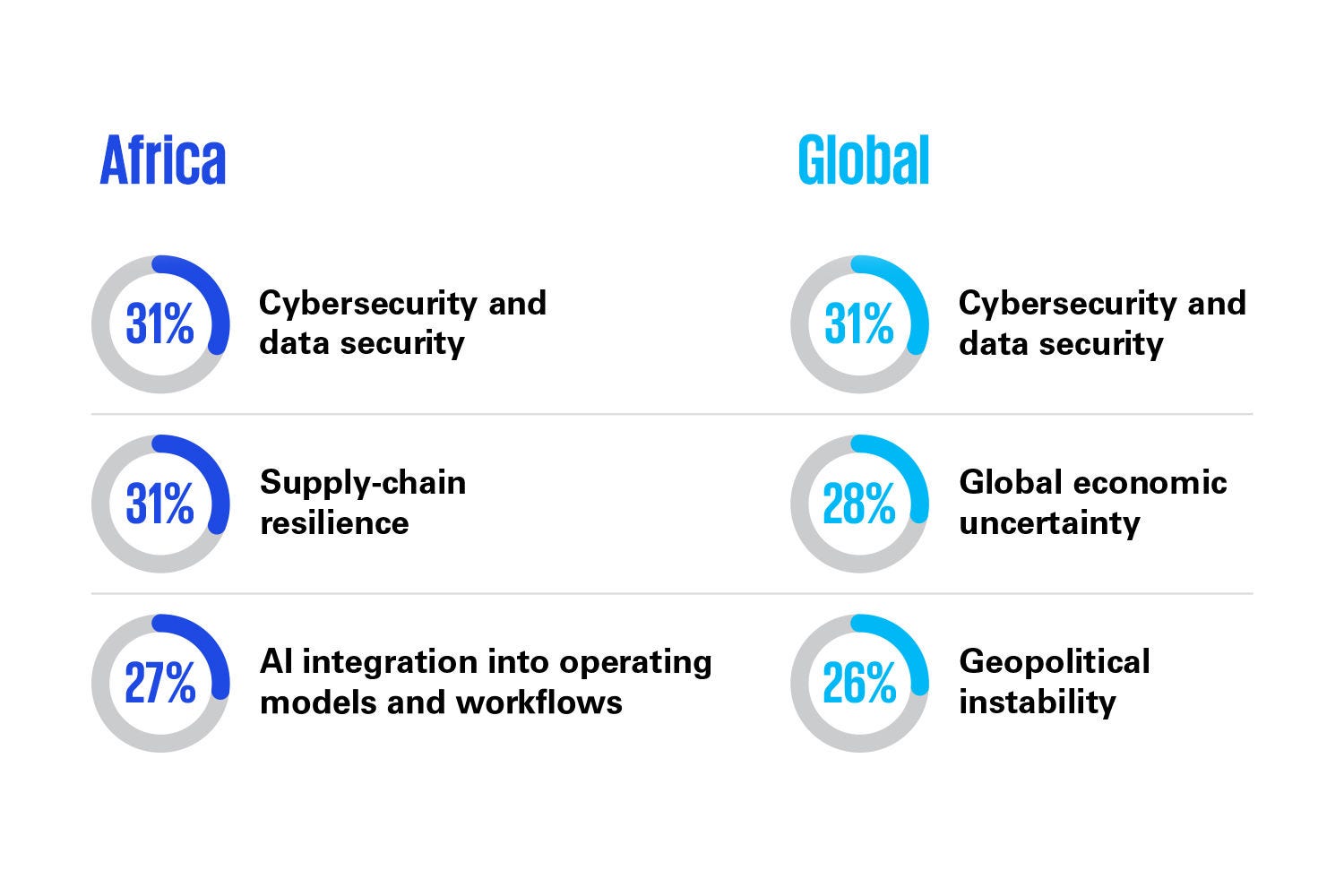
      Cybersecurity and data security are a leading growth threat for African and global CEOs alike, cited by 31 percent in each group. African leaders also highlight supply-chain resilience (31 percent) and the integration of AI into operating models (27 percent). Global peers place greater emphasis on economic uncertainty and geopolitical instability. These differences point to a common need for resilience, shaped by operating pressures.

      Africa-CEO

      Investment priorities broadly reflect the key risks identified by CEOs, with investment levels exceeding reported threat perceptions. While 31 percent identify cybersecurity and data security as a threat to growth, 45 percent are increasing investment in cybersecurity and digital-risk resilience. Similarly, 27 percent cite AI integration as a growth threat, while 31 percent are increasing investment in integrating AI into operations. These are different survey measures, but together they illustrate how leaders are seeking to move from exposure to operational preparedness.


      Technology and AI


      AI investment accelerates as focus shifts to measurable returns 


      Artificial intelligence remains firmly on the strategic agenda of African business leaders. Yet while investment ambition is approaching global levels, confidence in the ability to keep pace with change is markedly lower. The next phase of AI adoption will be defined less by experimentation and more by the organisational capacity to turn technology into sustained value.

      Across Africa, 72 percent of CEOs identify AI as a top investment priority, compared with 79 percent globally. However, only 14 percent believe their organisations are keeping pace with or ahead of AI developments, compared with 66 percent globally. The sharper difference therefore lies in perceived readiness rather than investment intent: African CEOs are considerably less confident that their organisations are advancing quickly enough to keep pace with AI.


      The gap does not imply that African businesses are standing still. Many are investing in use cases that promise efficiency, improved customer experience and better decisions. But without dependable data, clear ownership and accountable delivery, pilots can struggle to become integrated enterprise capabilities.

      For CEOs, the imperative is to align AI investment with clearly defined business outcomes, supported by modern infrastructure, trusted information and effective oversight. The strongest returns are likely to come from solutions that are embedded in workflows, not isolated from them.

      The distinction between commitment and capability matters. AI initiatives often begin in discrete teams or functions, but their enterprise value depends on whether data, processes and accountability can be connected across the organisation. Without these foundations, investment may generate promising pilots without changing productivity, customer outcomes or the economics of the business at scale.


      African CEOs anticipate longer timeframes for AI returns. While 48 percent expect returns within one to three years, compared with 71 percent globally, 42 percent expect returns beyond three years, compared with 12 percent globally. These expectations of longer time for AI value realisation may be linked to the relatively lower perception of keeping pace with AI developments

      Turning AI ambition into measurable business value requires more than technology investment. It demands trusted data, capable people and disciplined execution."
      Joelene Pierce

      Managing Partner, Technology and Innovation

      KPMG One Africa


      Talent


      Building future-ready workforces for a changing business landscape 


      African CEOs are entering a new phase of workforce transformation. The question is no longer whether artificial intelligence will change work, but whether organisations can redesign roles, build critical skills and equip leaders quickly enough to translate investment into productivity and sustainable growth. The survey reveals a clear tension: ambition remains high, but confidence in the pace of execution trails global peers.

      While 86 percent of African CEOs are confident or cautiously optimistic about keeping pace with AI, compared with 95 percent globally, just 14 percent believe they are moving at the right pace or ahead of the curve, against 66 percent globally. The gap suggests that the challenge lies in translating ambition into action, rather than a lack of intent. Importantly, 84 percent still expect headcount to increase over the next three years, versus 89 percent globally—suggesting that AI is reshaping the composition of employment rather than simply eliminating jobs.


      Workforce confidence is not yet matched by execution

      The findings suggest that the ability to execute workforce change may increasingly distinguish organisations that realise value from AI from those that struggle to scale it. Aligning technology investment with workforce planning, leadership accountability and the redesign of everyday work will be important if optimism is to translate into measurable performance

      African CEOs are pursuing a portfolio of workforce responses. Some 86 percent intend to retain and retrain high-potential employees, 82 percent are redesigning roles, career paths and team structures for human–AI collaboration, and 74 percent are hiring AI and technology talent. At the same time, 56 percent anticipate reductions in selected workforce areas, compared with 52 percent globally.

      These findings are not contradictory and point to workforce rebalancing. Organisations are investing in existing talent and AI Capabilities while anticipating reductions in selected.. The strategic opportunity lies in managing the transition deliberately—identifying which activities to automate, which roles to augment and where people should be redeployed.

      These shifts suggest that recruitment, learning and organisational design can no longer be considered in isolation. A more integrated approach links future capability requirements to growth ambitions, creates pathways for employees to move into emerging roles and maintains clear communication about how AI will affect work. Such measures can help sustain employee trust while supporting productivity and retention.

      The operating-model question is especially important: introducing AI into unchanged processes can entrench inefficiency, while removing roles before governance and controls mature may introduce new risks. Workforce transformation therefore requires coordinated decisions across business leadership, technology, risk and people functions.

      The future of work will be defined by how organisations invest in their people. As AI and emerging technologies reshape the workplace, leaders must focus on building the skills, adaptability and leadership capabilities needed to unlock human potential and drive sustained performance."
      Segun Sowande

      Partner and Head of Clients and Markets

      KPMG One Africa


      Sustainability


      Sustainability ambitions face the test of execution and measurable value 


      African CEOs are not stepping back from sustainability. Survey responses point to greater discipline in where sustainability creates business value, with sharper prioritisation, growing execution focus and pressure to demonstrate measurable outcomes.

      48 percent of African CEOs are embedding sustainability more deeply into core business strategy, while 40 percent are sharpening their focus on the sustainability issues most critical to business performance. Compared with Global Core CEOs, however, deeper strategic integration remains less common, at 48 percent versus 63 percent.

      The regional evidence also shows that this transition is not uniform. Southern Africa reports the strongest deeper integration at 59 percent, followed by West Africa at 53 percent. East Africa and North Africa show a more selective response: 56 percent of CEOs in East Africa and 50 percent in North Africa are focusing more tightly on material sustainability issues, while deeper strategic integration stands at 38 percent and 35 percent, respectively. For Southern Africa and Western Africa, focusing more tightly on material sustainability issues is lower at 26 percent and 30 percent respectively.

      Taken together, the findings suggest that sustainability ambition is becoming more focused and actionable, with CEOs increasingly prioritising the issues most relevant to resilience, investment and long-term performance.

      Across the survey, African CEOs increasingly frame sustainability through the lens of resilience and commercial value. Energy provides a clear example. African CEOs are somewhat more likely than global peers to prioritise energy-demand optimisation (41 percent versus 37 percent) and dedicated generation or storage capacity (15 percent versus 13 percent). At the same time, fewer African CEOs plan to diversify towards renewable or lower-carbon external supply (40 percent versus 49 percent globally).

      Regional priorities provide useful context rather than separate stories. West African CEOs place relatively greater emphasis on energy optimisation and dedicated generation, Southern African CEOs report stronger strategic integration and confidence in 2030 net-zero delivery, and East and North African CEOs are more strongly prioritising the sustainability issues they consider most material to their businesses

      The more demanding test is whether sustainability changes investment decisions. Across Africa, only 22 percent of CEOs comprehensively incorporate sustainability costs and potential returns into every major capital decision, compared with 29 percent globally. Another 49 percent consider sustainability in selected decisions.

      The regional results point to a shared execution challenge across the surveyed markets: comprehensive integration is about 24 percent in East Africa, 21 percent in Southern Africa, 17 percent in West Africa and 15 percent in North Africa. The strategic case for sustainability is increasingly evident in CEO responses, while consistent integration into investment decisions remains less mature.


      The sustainability conversation in Africa is shifting from ambition to action. The real test of leadership lies in embedding sustainability into strategic decision-making, strengthening organisational resilience and creating enduring value for stakeholders."
      Benson Ndung'u

      Managing Partner, Clients & Markets and Corporate Affairs

      KPMG One Africa


      About the KPMG 2026 Africa CEO Outlook

      The 12th edition of the KPMG Global CEO Outlook, conducted with 1,400 CEOs and 176 Africa CEOs between 11 August and 21 September 2026, provides unique insight into the mindset, strategies and planning tactics of CEOs.


      NOTE: some figures may not add up to 100 percent due to rounding.

      1 The definition presented to CEOs for ethical challenges included considerations such as trust, bias in data sets, privacy, accountability, transparency, intellectual property, and misinformation.


      Connect with us

      Get in touch if you’re a journalist with a media inquiry.