

The period from the late 19th century to the early 20th century, coinciding with the Industrial Revolution and the establishment of the world’s largest accounting firms, is referred to as the “Golden Age of Accounting.” The key figures of this era were pioneers who founded the legendary practices that would later become the foundations of KPMG.
Our History
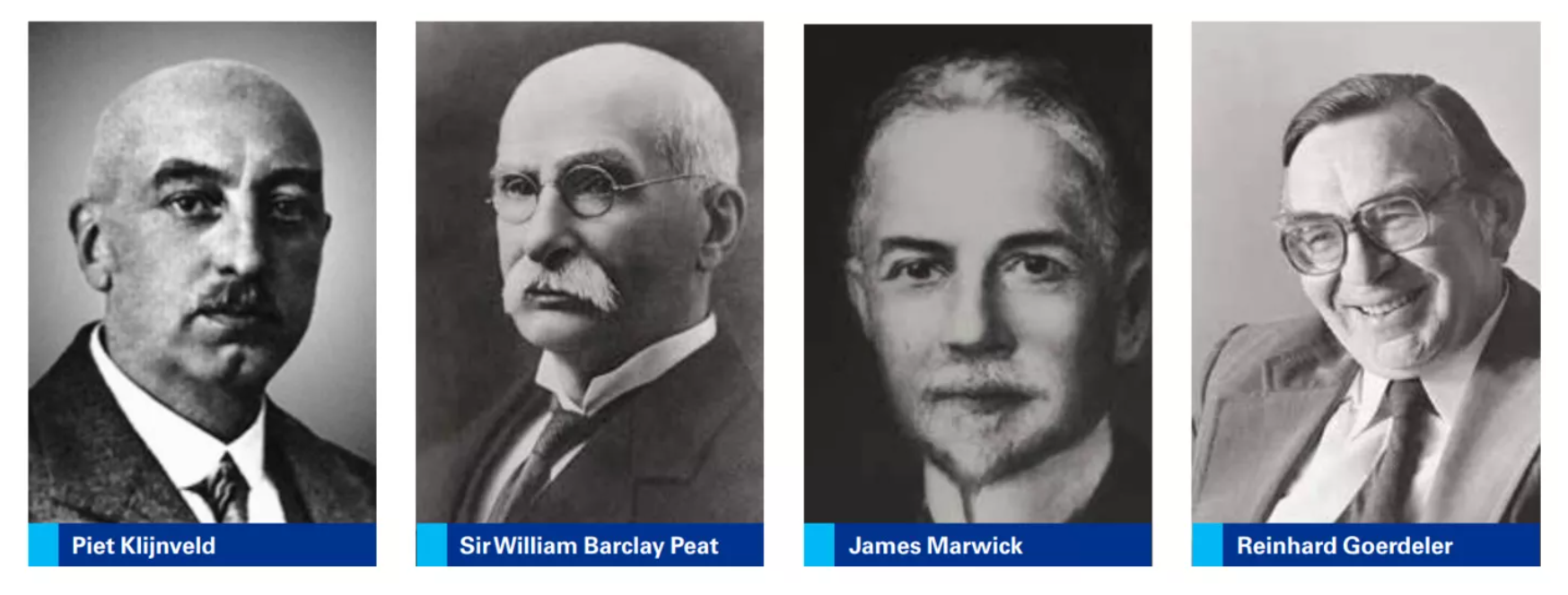
Piet Klynveld
Entrepreneur Piet Klynveld founded a small accounting firm in 1917 in Amsterdam, the Netherlands—at the time a dynamic hub for trade and investment for European and Asian industrialists. During this period, many foreign enterprises, including royal families, governments, and even the Bank of England, were engaged in extensive commercial activities in the Netherlands, transforming Amsterdam into an active marketplace not only for financiers but also for importers and exporters across nearly every sector.
Klynveld served as the chief accountant for many of these emerging businesses. To meet the growing demand of his expanding client base, he collaborated with a local tax firm, Meijburg & Company. He later recruited talented accountants to serve leading businesses that would go on to become prominent companies in the Netherlands and globally.
One of these accountants was Jaap Kraayenhof, who joined Klynveld and eventually became Senior Partner of the Dutch firm Klynveld Kraayenhof & Company (KKC).
Specializing in banking and export services, KKC maintained its name and independence while serving Dutch clients expanding into Europe and South America. In 1979, Klynveld Main Goerdeler was formed with the ambition of creating a strong international Europe-based firm.
Sir William Barclay Peat
Born in Scotland, Sir William Barclay Peat was the second son of James Peat and Margaret Barclay, who came from the banking family that founded Barclays Bank—one of England’s largest banks. Raised in a privileged environment, Peat studied law at the prestigious Montrose Academy in Scotland, but he did not pursue a career in law.
Instead, in 1870, at the age of 17, he moved to London to forge his own path. He began working as an accounting clerk at a London firm and quickly rose through the ranks, becoming a partner by the age of 24. In 1891, Peat took over the leadership of the firm, renamed it WB Peat & Company, and laid the foundations of an accounting legacy that continues to this day.
Roger White, an informal company historian, former KPMG partner, and author of Peats to KPMG—Gracious Family to Global Firm (published in the UK in 2004), notes: “The Peat family retained control of the partnership under the condition that a senior partner would be a Peat for at least three generations.”
The Peat name continues to hold a place in the accounting world today.
Sir William Peat’s great-grandson, Michael, worked for KPMG for five years and is currently one of Prince Charles’s most trusted aides. Educated at Eton and Oxford, Sir Michael Peat is a chartered accountant who has received significant praise for his strict financial stewardship at Buckingham Palace, including his role as Treasurer to the Queen.
James Marwick
James Marwick is described by Roger White as “a large man, standing two meters tall, with boundless energy and broad shoulders.” He further notes, “My impression of the Scotsman is that he was, in every sense, a great man in terms of personality, presence, and his ability to shape events.”
The young Marwick trained as a chartered accountant but soon set his sights beyond the profession. He began his accounting career in Glasgow and, in the 1890s, seized the opportunity to travel to Australia during a banking crisis to conduct bank inspections for a group of Scottish investors.
Energetic and passionate, Marwick later sailed from Australia to Canada, though he remained determined to return. However, he was so impressed by the business opportunities and the growing banking client base in North America that he moved to the United States in 1894, where he began searching for a business partner.
According to White, Marwick and Roger Mitchell—both former classmates at the University of Glasgow—met by complete coincidence on a street in New York City in 1897. Mitchell had been sent to the United States to manage his family’s textile business. Together, they formed what was described as the ideal “front office/back office partnership.”
Following the establishment of Marwick, Mitchell & Company in New York, Marwick traveled extensively to open offices across various cities in the United States. Percy Garrett, who managed the London office, once wrote that the tireless Marwick traveled approximately 15,000 miles per year.
In 1911, Marwick and Mitchell joined forces with Sir William Barclay Peat to form Marwick, Mitchell, Peat & Company. Eight years later, they separated. Marwick retired in 1917, leaving Mitchell in charge. Mitchell continued as Senior Partner until 1925, when he and Peat reunited and renamed the firm Peat, Marwick & Mitchell.
Reinhard Goerdeler
Reinhard Goerdeler was the son of Carl Goerdeler, who served as Mayor of Leipzig, Germany, between 1930 and 1937.
In 1953, Reinhard Goerdeler joined Deutsche Treuhand-Gesellschaft (DTG), which had been established in 1890 by Deutsche Bank to oversee its clients’ investments in American railways. As the German economy recovered, Goerdeler began traveling across Europe, opening small offices for DTG and collaborating with firms such as Klynveld Kraayenhof & Company (KKC) to better serve international clients.
In the 1970s, Goerdeler recognized the need for a more formal structure for European clients and began working toward the creation of an international firm.
In July 1979, an agreement was signed and Klynveld Main Goerdeler (KMG) was formed. Reinhard Goerdeler also played a key role in the 1987 merger between KMG and Peat Marwick International, which was widely regarded as the first “mega-merger” of its kind.

KPMG’s Journey Over the Years
The Journey of KPMG Over the Years
Early mergers in the firm’s history
Peat and Mitchell first met aboard a transatlantic voyage from Europe to America in 1911. During the weeks-long journey, they had the opportunity to get to know each other and, by the end of the trip, began planning to combine their strengths. The firm subsequently began operating under the name Peat, Marwick, Mitchell & Co.
Rapid transformation in the 1970s and 1980s
In 1978, Peat, Marwick, Mitchell & Co. (International) underwent a restructuring and was renamed Peat Marwick International (PMI).
At the same time, Klynveld Kraayenhof & Co. was also pursuing expansion. Just one year later, in 1979, the firm joined forces with DTG and McLintock Main Lafrenz to form Klynveld Main Goerdeler (KMG).
Less than a decade later, in 1986, PMI and KMG merged. The merger was publicly announced on 1 January 1987, resulting in the formation of Klynveld Peat Marwick Goerdeler. At the time, this was the largest merger in the accounting industry.
Continued growth
Throughout the 1990s and 2000s, the KPMG network continued to expand into emerging markets. In countries such as Russia, India, and Myanmar, KPMG member firms contributed to economic development and the creation of new opportunities.
Today, the member firm network operates across 154 countries and employs approximately 197,000 professionals. Each individual contributes to building trust, driving progress, and creating positive change for clients, communities, and society at large, in line with our purpose.
