

A climate transition plan demonstrates the ability of a company to transform its business model in order to align with the global transition to an economy with net zero emissions. For this reason, it is also a key tool to raise (and grant) capital to finance the transition. In the EU, the Corporate Sustainability Reporting Directive (CSRD) requires companies that have transition plans to disclose them according to the standards set in the European Sustainability Reporting Standards (ESRS).
A transition plan for biodiversity and ecosystems is based on the same principles as a climate transition plan. It serves as a roadmap to show how a company will work to reduce its impact on nature in line with global objectives to halt and reserve the ongoing global loss of species and ecosystems. This is achieved through measures integrated within or outside the business operations, with a clear plan for financing, monitoring, and accountability.
Companies are encouraged to integrate their transition plans for both climate and nature, as these areas are often closely interconnected. Synergies can arise where actions to reduce climate impact also benefit biodiversity or ecosystems.
KPMG offers support to companies in developing both climate transition plans and nature transition plans, either separately or in an integrated manner. This work is carried out in close collaboration with the company’s management and board. By quantifying the potential to reduce impact in these areas, assessing the costs of measures, and identifying key functions within the organization, we ensure effective implementation of these actions.
The planet is experiencing dramatic environmental changes. Each year, global temperatures continue to rise and carbon dioxide levels increase, bringing us closer to potentially irreversible tipping points. At the same time, the natural world is under immense pressure: it is estimated that up to one million species face the threat of extinction, while human activity has already transformed 75 percent of terrestrial ecosystems and two-thirds of marine environments. There is an urgent need for action.
To avoid the most severe consequences of climate change, all economic sectors are expected to contribute to a global transition to net-zero emissions by 2050. In the same way, to halt and reverse negative trends in biodiversity, it is not enough to preserve those natural areas that are still intact today. We must transition to a nature-positive economy.
As awareness grows about the urgency of mitigating the climate change and biodiversity crises, companies in many countries are now facing regulatory and stakeholder demands to demonstrate their ability to transform and adapt their business models in line with global targets. Climate and nature transition plans are increasingly identified as a key tool for achieving this goal.
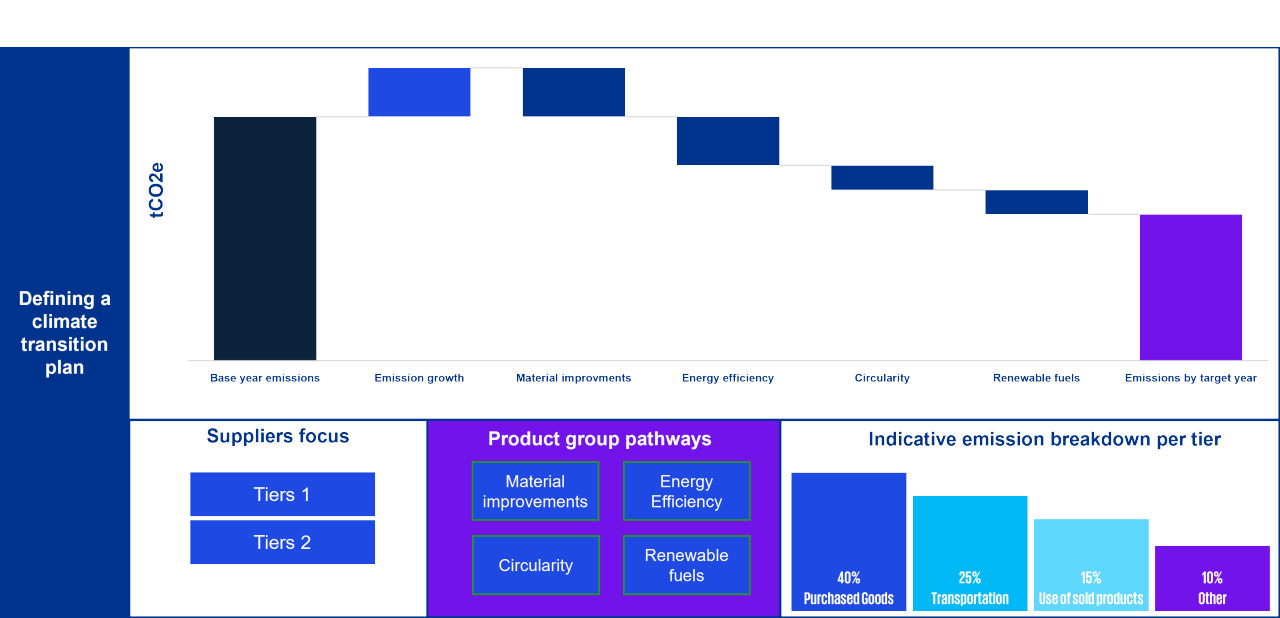 A clear climate transition plan requires linking emission reductions to concrete actions where reductions can truly be achieved. Source: KPMG
Climate transition planning is about more than regulatory compliance
In the EU, the CSRD requires companies that have transition plans for climate or nature to disclose them according to the standards set in the ESRS, and particularly in ESRS E1 (Climate Change) and ESRS E4 (Biodiversity and Ecosystems).
A growing number of frameworks describe how a transition plan should be structured. For example, the United Kingdom Transition Plan Taskforce (UK TPT) provides guidance on how companies should integrate climate targets into their business strategies, and based on this guidance, the Taskforce on Nature-related Financial Disclosures (TNFD) has developed a similar draft for how companies can work on their biodiversity and ecosystem transition.
A transition plan within climate or nature goes beyond merely quantifying impact. A well-developed plan considers the relationship between a company’s climate or biodiversity strategy and its overall strategy and business model, where aspects such as time horizon, financing, and accountability play a crucial role. Through a transition plan, companies can show stakeholders that they take the environmental crisis seriously and genuinely have the capacity to transition to a climate-neutral economy that halts and reverses biodiversity loss. This is particularly important as corporates increasingly need to unlock capital to fund their transition, and finance providers in turn require credible evidence that the companies they invest in are genuinely decarbonizing.
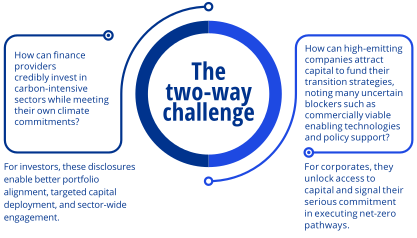 Strengthening the link between transition planning and finance is key to accelerating the decarbonization of the economy. Source: KPMG
How KPMG can support you with your climate and nature transition plans
KPMG supports you regardless of where you are on your sustainability journey, from companies just beginning to develop a sustainability strategy and in need of establishing foundational elements such as greenhouse gas calculations, target setting, and assessment of biodiversity and ecosystem impacts, to comprehensive transition plans where strategy, financing, and accountability are central components.
Transition plans for climate or nature can be developed either separately or as a joint effort. However, it is advantageous for companies to design their nature and climate transition plans in parallel to create synergies and prioritize actions that benefit both areas.
Beyond regulatory requirements, there is significant value in developing a transition plan as a company. Such a plan builds market and investor trust that target commitments will be translated into action. Expectations have evolved from requiring a commitment to demanding an explanation of how these targets will be met. A transition plan offers substantial opportunities for companies to reassess and adapt their strategy and business plans. This process can reveal value-creating opportunities, such as new revenue streams or increased resilience by proactively managing future climate-related risks.


