No one can deny Malta’s robust economic performance in recent years. Indeed, Malta has often registered strong figures in GDP Growth and employment rates (save for the expected COVID shock), that well outperformed many Member States across the EU. But this begs the question (or multiple questions for that matter) – can this level of growth be sustained forever, and at what cost? Is it being enjoyed equitably across all strata of society? And above all, does more economic growth necessarily result in increased happiness and well-being? The answer is complex and multi-faceted.
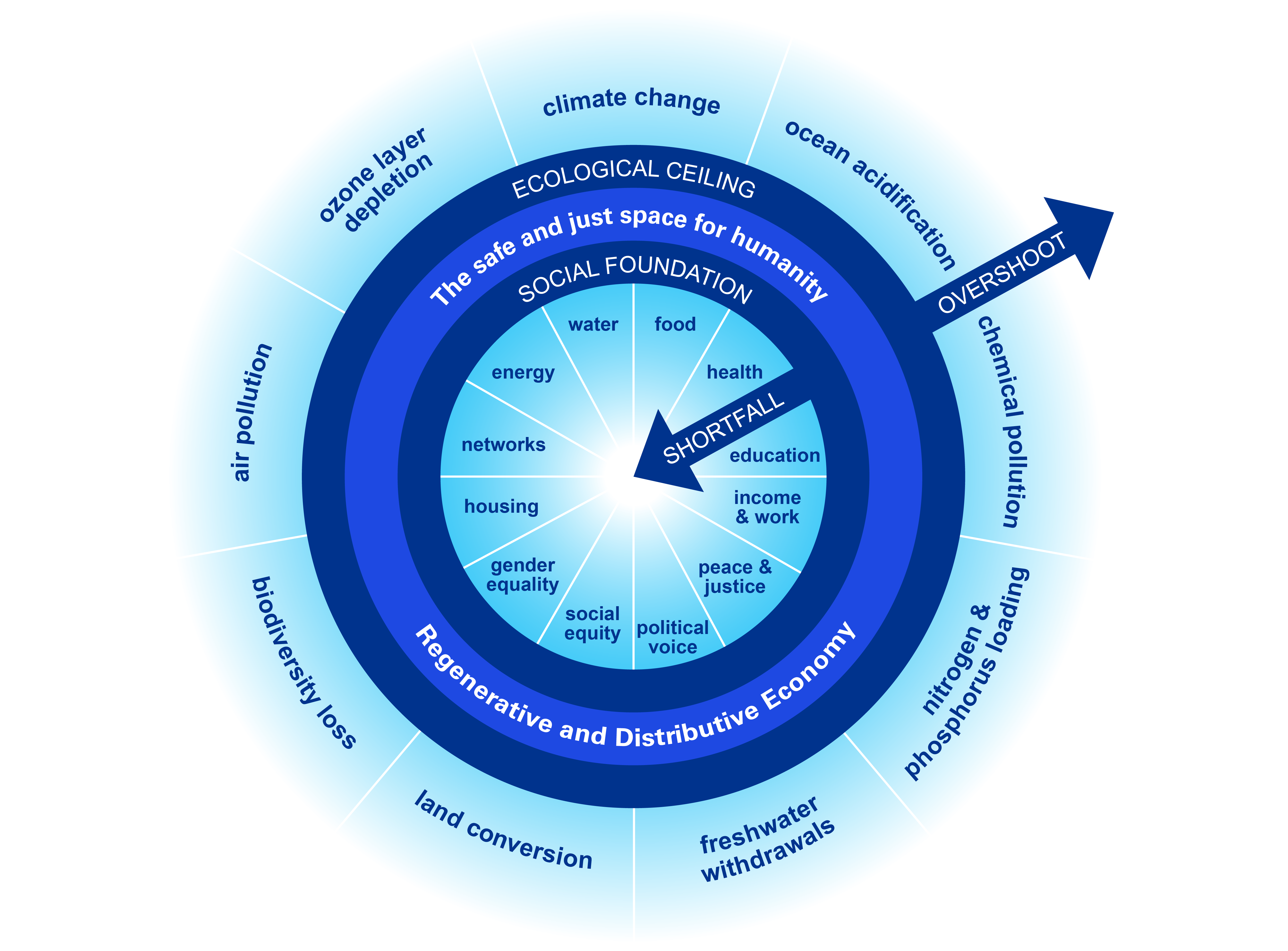
Enter Doughnut Economics. No, we are not suggesting engaging in a binge-eating frenzy from a smorgasbord of rainbow-sprinkled doughnuts. Not quite (but quite the mouthful, literary and literally!). Rather, this refers to an elegant visual framework for sustainable economic development.
This framework was initially introduced back in 2012 by Kate Raworth, a Senior Associate at Oxford University and self-proclaimed renegade economist, to promote a new perspective for 21st-century economists. It highlights the importance of aligning economic goals with global environmental objectives. The framework suggests that a healthy economy should not be predominately measured in terms of GDP growth, but rather should be measured in how well the economy is providing for all basic socioeconomic needs in an equitable manner through environmentally regenerative practices.
The framework is graphically presented by two concentric rings representing the ‘Societal Foundation’ and the ‘Ecological Ceiling’, with the doughnut-shaped area in between reflecting the space in which civilisation can prosper. Therefore, organisational design must be done with a purpose to guide society into the doughnut, where welfare is nurtured without overshooting planetary boundaries. A closely associated concept to the doughnut economy, long promoted by environmental economists, is the circular economy which intends to reimagine how to view the product value chain. From a purely theoretical perspective, the ambition of implementing the doughnut economy can come across as too daunting, but the good news is that this concept is not only achievable, but we have been, perhaps unknowingly, working slowly towards it for quite some time.