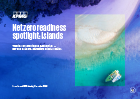
Small island economies (SIEs) are at the forefront of climate change. Their economies and livelihoods are already impacted by the effects of a changing climate due to rising sea levels, increasingly frequent and more powerful storms, reduced access to drinking water and damage to ecosystems.

      This spotlight edition of the KPMG net zero readiness series highlights SIEs and how they can attract private capital on their journeys toward net zero. It assesses 36 countries and territories on their relative preparedness and ambition to achieve net zero, and their ability to attract private capital to fund the transition to a sustainable economy — while highlighting examples of practices that are already being deployed.

      Which actions will enhance the appeal of SIEs as a destination for private capital?

      • 88%

        Would like to see a net zero strategy for SIEs that articulates the role of private capital.

      • 88%

        Would invest in green bonds underwritten by a multilateral institution.

      • 71%

        Would consider investing in blended finance projects on renewable energy.

      • 67%

        Would like SIEs to adopt international standards to monitor progress on blended finance projects.


      The capital markets can play a key role in funding the net zero ambitions of SIEs. Survey participants — comprised of decision makers at 24 large institutional investors and pension plans together managing USD28.7 trillion in assets — have provided insight into the reasons global investment portfolios are underweight in SIEs and the actions SIEs may take to create change.


      Malta’s economy has experienced rapid economic growth over the last few years. However, rapid growth tends to exacerbate environmental and social pressures, and impinge on quality of life. People are realising that whilst GDP growth is important, it does not equate to general well-being. Hence the renewed focus on ESG matters which underpin sustainable economic growth.
      Steve Stivala
      Steve Stivala

      Director, Advisory - Infrastructure, Public Policy and Strategy

      KPMG in Malta


      Malta has a low carbon development strategy based on scientific and economic analysis which sets a clear path towards decarbonisation and to move closer to carbon neutrality by 2050 as per the Paris Agreement. This is surely an important milestone and one which will guide Malta in this transition in various areas identified as key contributors in this pathway in particular renewables, energy-efficiency in buildings and transport and waste management. We are doing so because we want to encourage but also support, in effective ways our community to become more energy efficient and more sustainable in critical daily functions such as the use of household energy and transportation.
      Miriam Dalli

      Miriam Dalli

      Minister for Environment, Energy and Enterprise

      Malta


      Key takeaways

      Small Island Economies (SIEs) are working to respond to the threat of climate change, yet funding remains a challenge for many...

      • Small Island Economies (SIEs) are on the front line of climate change. All economies have a national ministry or department focused on climate change, however, they are at various levels of preparedness.
      • Most economies in this research have policies in place for sustainable development and many are taking innovative approaches to climate change, including being early adopters of sustainable finance.
      • More than half of the economies in this research get less than 10 percent of electricity from renewable sources, with electrification of transport being an area of focus.
      • Among the economies in this research only Fiji, Guernsey and the Isle of Man have a net zero commitment in law. A further seven have a net zero target as a declaration, pledge or policy: Antigua and Barbuda, Bahrain, Barbados, Jersey, Maldives, Malta and Singapore.
      • Barbados and Maldives have the most ambitious net zero target dates of 2030, with Antigua and Barbuda setting a date of 2040. More than half of the economies in the research have set 2050 as their target date.

      The global capital markets could help to provide SIEs with a solution, though action is needed to enhance their appeal...

      • Global capital markets are turning their attention to climate investing. Yet, SIEs do not currently feature in the investment portfolios of global capital market players, despite this being a USD3 trillion opportunity.
      • SIEs are caught in a Catch-22: they can’t attract private capital because they have a limited track record, and they have a limited track record because they can’t attract enough private capital. There remains a mismatch between what private capital requires and what these island economies can deliver.
      • The challenges that SIEs face cannot be resolved by capital market players alone. They need other players to act as flywheels that generate and accelerate private capital inflows over time. This would require a twin-track ‘build back bluer’ development strategy.
      • A twin-track ‘build back bluer’ development strategy should aim to de-risk opportunities for private investors in climate adaptation and mitigation projects via two avenues: bonds with backstops from multilateral institutions and blended finance vehicles that also involve philanthropists willing to provide catalytic finance.
      • Climate adaptation and mitigation projects could be part of an overarching strategy that aims to enhance three key enablers that can attract the inflow of private capital; a more conducive political environment, a credible national strategy on net zero and favourable business practices.

      Net zero readiness spotlight: Islands

      Net zero readiness spotlight: Islands

      The rise of small island economies — beyond net zero, attracting private capital

      Related content

      Survey on Sustainability Preferences in Real Estate in Malta 2022

      Survey of Sustainability Reporting 2022.

      Contact us

      David Pace

      Senior Partner

      KPMG in Malta

      Jonathan Dingli

      Partner, Head of Advisory

      KPMG in Malta

      Steve Stivala

      Director, Advisory - Infrastructure, Public Policy and Strategy

      KPMG in Malta