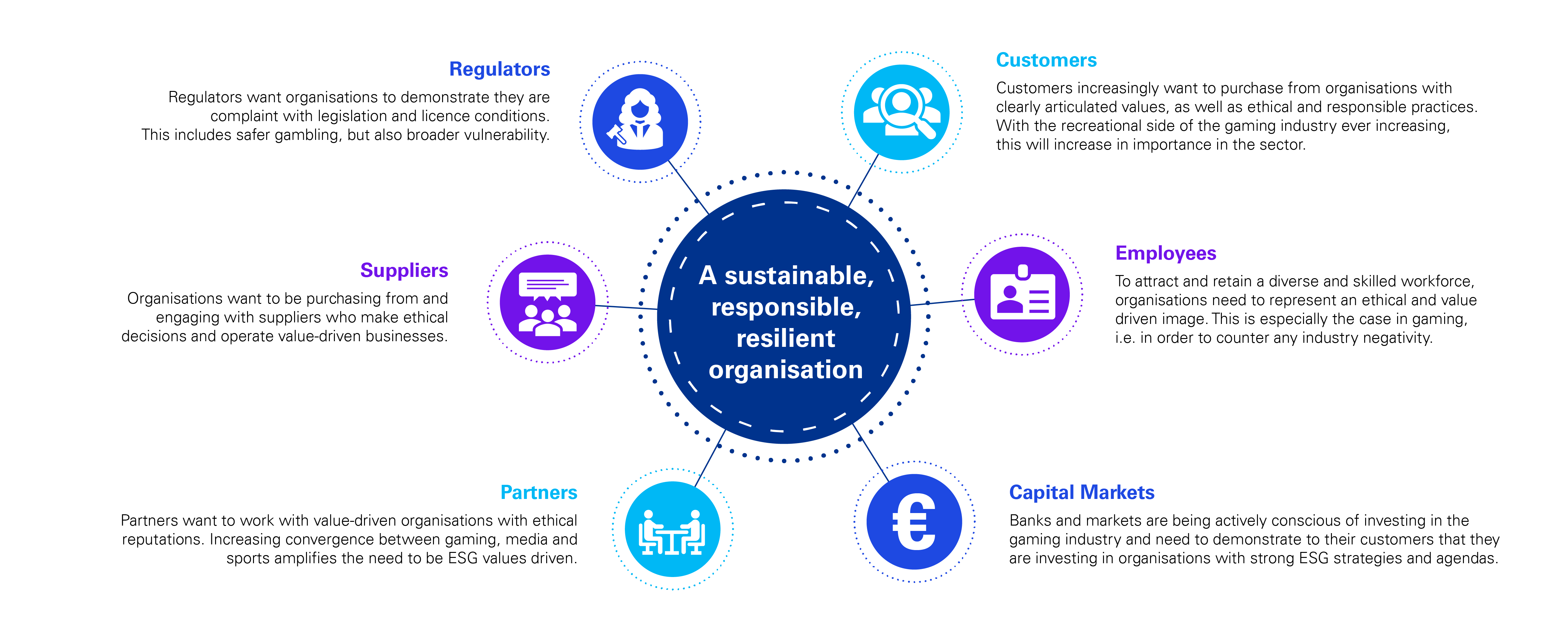
Arguably the ESG issue at the top of all gaming stakeholders’ agenda is responsible gaming and providing support for at-risk customers. In fact, this topic emerges as one of the top material issues within sustainability reports issued by the sector. Digital tools that detect problematic play and empower customers to play safely will be an important part of the solution.
Employee inclusion, diversity, and equity should also be near the top of CEOs’ agenda. However, to give an example, women are not achieving and progressing to senior positions in equal proportion to men in any industry. The perception is that women are much less likely to join the gaming sector in the first place, particularly in the growth area of online gambling – this despite more than 50% of graduates being female.1 However, research from McKinsey2 shows that diverse executive teams perform better: companies in the top quartile for gender diversity are 25% more likely than those in the fourth quartile to outperform on financial profitability, compared to industry medians. These statistics present an opportunity for the sector, which is still male dominated (with some notable exceptions at leadership level) to reflect on what more can be done to attract women to the industry, and to ensure that their work environment enables them to flourish and progress.
Naturally diversity is not limited to female representation, and there are aspects of diversity where the gaming industry is doing better than average – for instance, gaming companies in the UK have higher international representation, and a much larger percentage of people whose sexuality is anything other than straight than in the general population.3 Interestingly, the McKinsey study found that companies in the top quartile for ethnic and cultural diversity outperformed those in the fourth by 36% in terms of profitability, which suggests that gaming companies may already be reaping some financial benefits as a result of this aspect.
Additionally, many gaming companies already do a sterling job of supporting local communities – such as by sponsoring sports teams – under what was historically their Corporate Social Responsibility (CSR) programme. With ESG going beyond CSR, these initiatives now need to find their place in the overarching ESG strategy of the company.