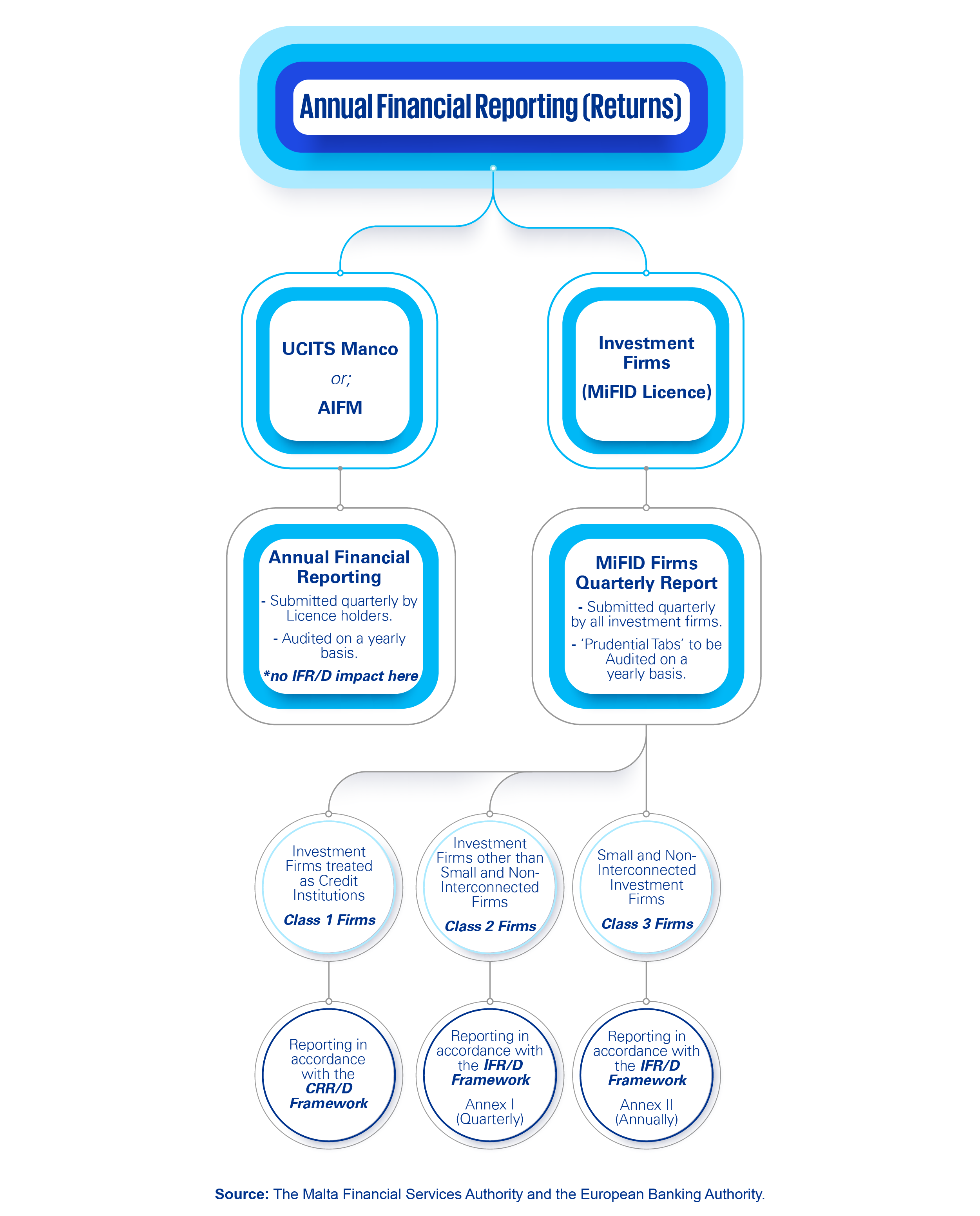
The new prudential regime introduced a range of new and/or enhanced disclosure and reporting requirements for in-scope Investment Firms. The purpose of these new requirements is to ensure that such firms are managed in an orderly way and in the best interests of their clients and to ensure the safety and soundness of Investment Firms while avoiding the imposition of a disproportionate administrative burden hence, introducing proportionate and risk-sensitive rules for Investment Firms. This effectively meant that most Investment Firms in the EU would no longer be subject to rules that were originally designed for Credit Institutions, with one exception to the largest and most systemic Investment Firms, which however, remains subject to the same prudential regime as European Credit Institutions (i.e. the CRR/CRD Framework).
The main changes brought forward with the new IFR/IFD Framework encompasses the Investment Firms’ supervisory review process, supervisory reporting, disclosure requirements, variable remuneration policies, governance, mandates related to economic, social and governance (ESG) risks and supervisory convergence. However, two major changes were in relation to the firms' classification and capital requirements and composition calculations.
The new framework established a reclassification system for Investment Firms according to their business activity and therefore the risks they are exposed to. Investment firms are now classified into three classes and one subclass, namely;
- Class 1 including the sub-classification of Class 1 Minus;
- Class 2 and;
- Class 3.
The largest systemic Investment Firms (Class 1 Firms) will continue to apply the current CRR/CRD Framework, whilst the new prudential regime will apply to Investment Firms that are not considered systemic by virtue of their size and/ or interconnectedness within the wider financial system, i.e. primarily Class 2 Firms. Small and non‐interconnected Investment Firms (Class 3 Firms) may receive regulatory requirements exemptions from their competent authorities, on an evaluation and case by case basis. Firms were expected to established their new classification and communicated this to the Regulator by Q4 2021.
Another major change is in relation to the firms’ own funds requirement and composition calculations, which is likely to be found to be more honourous under the new framework. The new capital requirements now introduce quantitative indicators (the “K-Factors”) to accurately reflect the risks which Investment Firms face. There are three groups of K-Factors: the risk to customers, risk to market access, and risk to the firm itself. Class 2 firms will be required to calculate their capital requirement using the K-Factors, whilst Class 3 Investment Firms will have to monitor the related metrics to ensure they have not reached their categorisation threshold. In the instance of a latter scenario, a re-classification exercise would need to be undertaken.