error
Subscriptions are not available for this site while you are logged into your current account.
close
Skip to main content

      The EU has agreed on changes to the Corporate Sustainability Reporting Directive (CSRD) and Corporate Sustainability Due Diligence Directive (CSDDD), including revised thresholds and reporting requirements. These changes significantly reduce the number of companies required to report.

      The European Sustainability Reporting Standards (ESRS) are evolving to make sustainability reporting clearer and more actionable. The latest draft introduces significant simplifications; shorter standards, fewer mandatory data points, and clarified guidance, while maintaining the rigor needed for decision-useful disclosures. 

      Here’s what’s changing and what it means for you.

      CSRD: Which companies remain in scope?

      • EU companies with over EUR 450m net turnover and more than 1,000 employees will remain in scope of the CSRD. Wave one companies that fall out of scope may be exempted from reporting from as early as FY25, but these exemptions can only be provided by member states via national laws after the EU has adopted the changes.
      • Financial holding companies* will be exempt, but their subsidiaries or subgroups may still need to report if they meet the scoping threshold.
      • All companies, including listed public-interest entities (PIEs) will be eligible for the group exemption if they are included in a consolidated sustainability statement.
      • Non-EU groups will only need to report if they exceed EUR 450m net turnover generated in the EU and have at least one EU subsidiary or branch with over EUR 200m net turnover, beginning in FY28 (reporting in 2029). Reporting standards for non-EU companies are not expected before October 2027 at the earliest.

      You can read more about CSRD scoping here: EU agrees Omnibus changes

      * Financial holding companies are defined in the directive as “undertakings the sole object of which is to acquire holdings in other undertakings and to manage such holdings and turn them to profit, without involving themselves directly or indirectly in the management of those undertakings, without prejudice to their rights as shareholders.


      Highlights from the new draft Simplified European Sustainability Reporting Standards (ESRS)

      This snapshot will help you understand where we stand with the ESRS today. Highlights from the draft ESRS changes are:


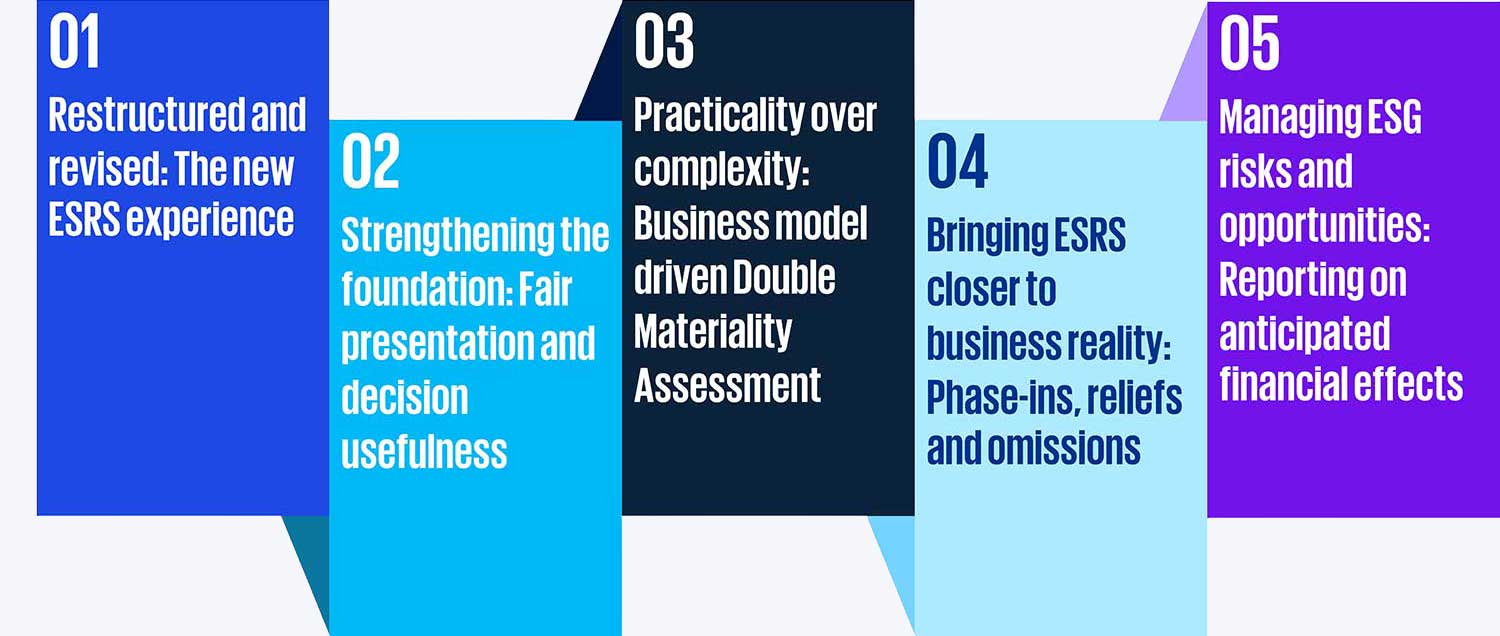
      Summary of proposed amendments:

      • ESRS have been significantly shortened in length, reducing from 257 pages (Dec 2023) down to 156 pages (proposed revision Dec 2025).
      • 60% reduction of the “shall” (or mandatory) data points across all standards. 
      • 100% reduction of the “may” (voluntary) data points which have been moved to a new Non-mandatory Illustrative Guidance (NMIG) document.
      • NB: Reduction of data points does not translate to equivalent effort reduction.

      Next steps for you?


      For wave 1 companies:

      • Conduct an impact analysis of action required (what are the “must” vs. “can” vs. “want” needs of your organisation).
      • Review any potential impact on KPI’s based on clarified definitions.

      For wave 2 companies:

      • Focus on your completing/upgrading your DMA using the latest guidance.
      • Leverage the simplified ESRS, but acknowledge there is substantial effort required to prepare for reporting.

      Summary of proposed amendments:

      • The sustainability statement should present decision-relevant information in an adequate and user-friendly manner. Decision usefulness of material information = Information whose omission, misstatement or obscuring, could reasonably influence decisions of users (of the financial statement or sustainability statement).
      • Apply the following considerations to provide faithful and decision useful information:
        • Use a materiality filter to an appropriate level of granularity.
        • Apply entity-specific considerations.
        • Aggregate and disaggregate where appropriate.
        • Use an Executive Summary to communicate key messages and appendices for more detailed information.

      Next steps for you?


      For wave 1 companies:

      • Confidently apply the materiality filter.
      • Use an Executive Summary approach to underline the narrative of your disclosures.

      For wave 2 companies:

      • Shape a consistent narrative of your sustainability disclosures from the outset.

      Summary of proposed amendments:

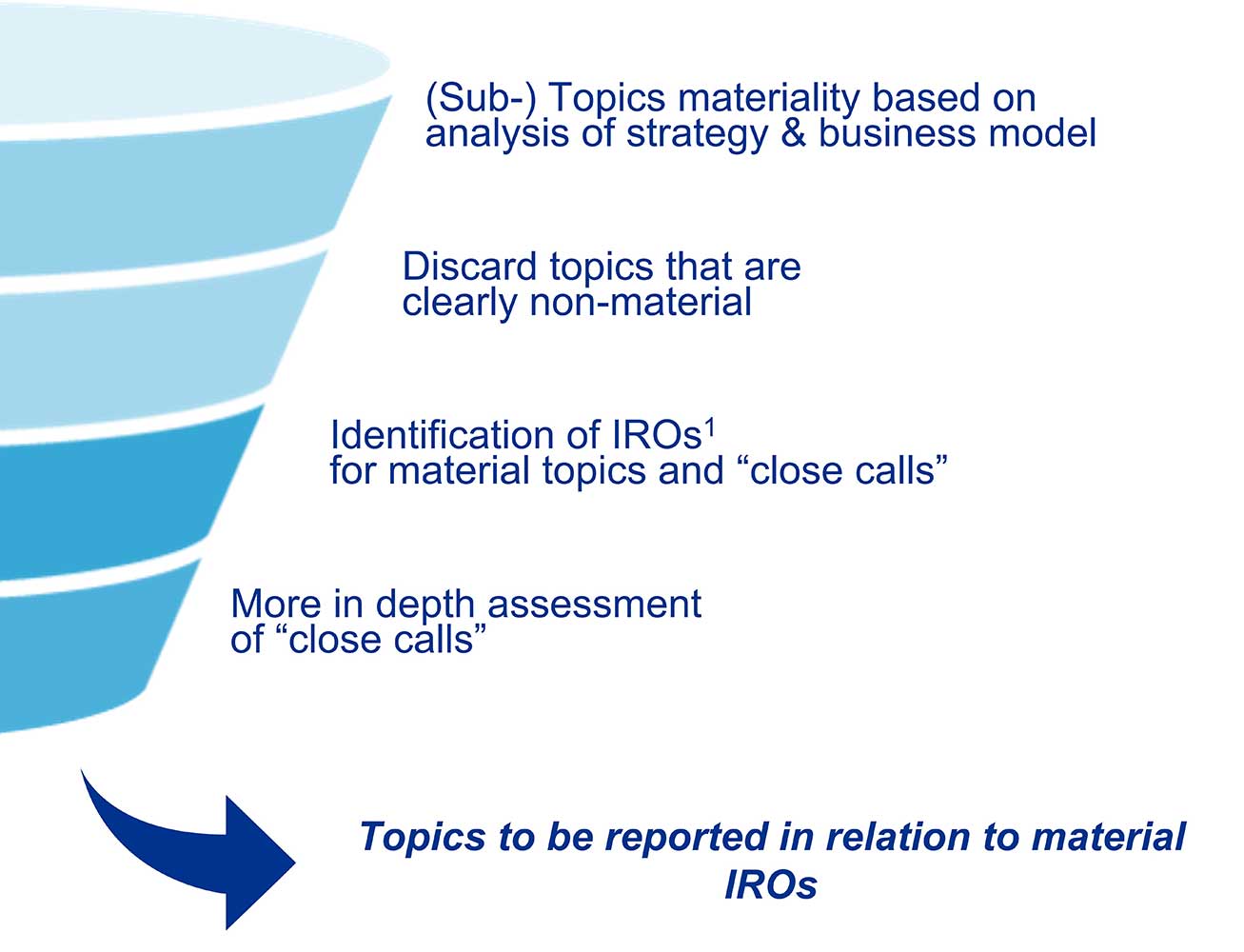
      • Top-down DMA approach is strengthened and reflected in the chapter structure:
      • Clarification/definition of positive impacts = The results of prevention, mitigation or remediation actions to address negative impacts the undertaking is connected to, or compliance with law and regulation, are not positive impacts.
      • Gross vs. net impact assessment has been clarified further.

      Next steps for you?


      For wave 1 companies:

      • Potentially adjust gross/net and positive impact approaches
      • Review top-down application to enhance efficiency (in future DMA update)

      For wave 2 companies:

      • Start/continue your DMA
      • Benchmark your sector in published wave 1 reports

      Summary of proposed amendments:

      • Reliefs that can be applied are clarified and to be reported under BP-1. Reliefs include:
        • “Undue cost or effort”, to balance cost and benefits.
        • Exclusion of activities in metrics if they are not a significant driver of IROs.
        • Report partial reporting boundary if metrics lack reliable data.
        • Exclude joint operations from metrics in E2, E3, E4 and E5 if there is no operational control.
        • Acquisitions and disposals
      • Clarifications on “without undue cost or effort” principle. Considerations include size, resources, technical readiness and no exhaustive search required.
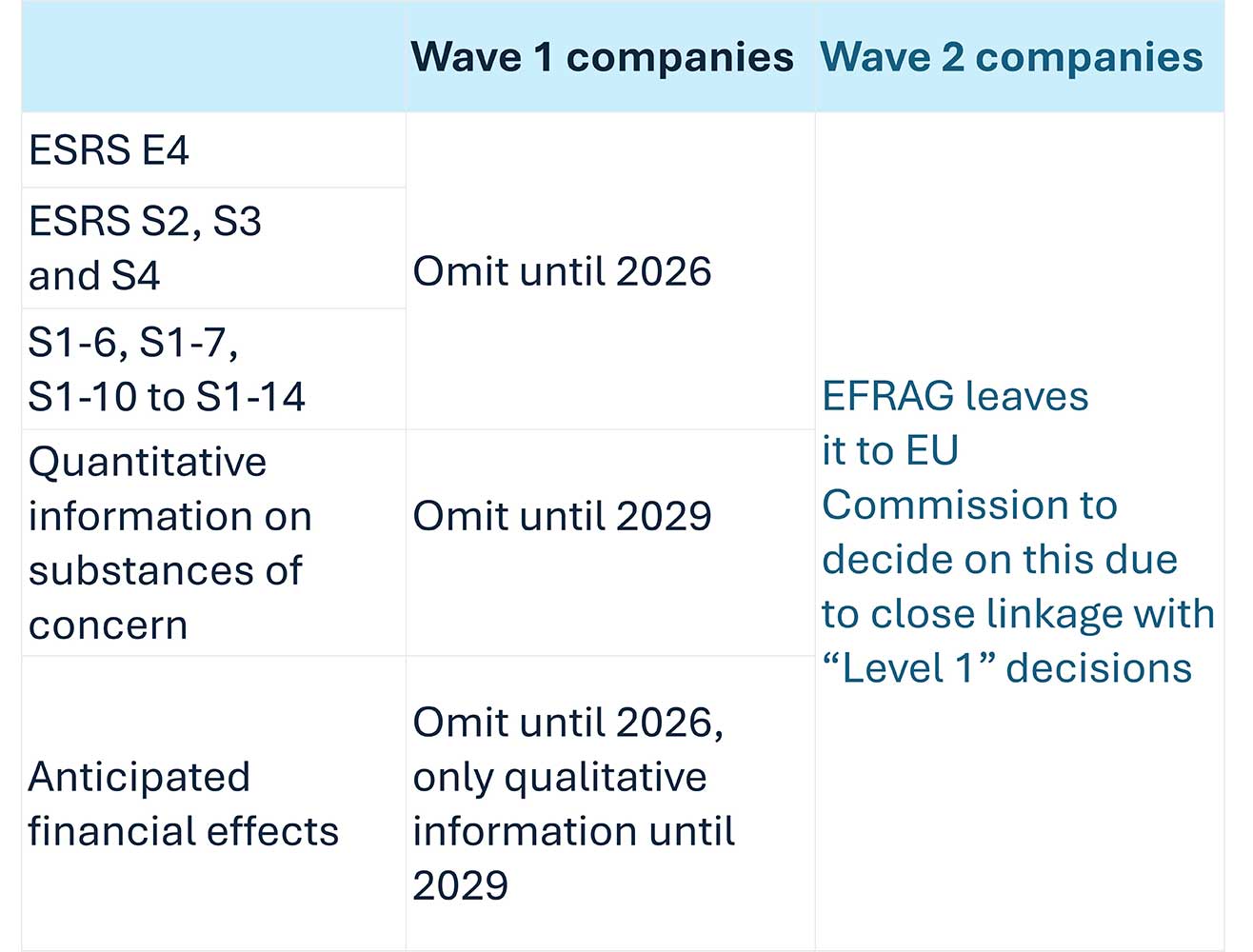
      • Extended phase-in reliefs and applicable years:

      Next steps for you?


      For wave 1 companies:

      • Balance burden of reduction vs. discontinuation/pause of previously reported datapoints.

      For wave 2 companies:

      • Plan use of reliefs and phase-ins and align with your auditor.
      • Start considering anticipated financial effects due to complexity and potential insights. 

      Summary of proposed amendments:

      • Required disclosure of current and anticipated financial effects for both qualitative and quantitative
      • Relief to omit quantitative reporting, if:
        • Effects are not separately identifiable;
        • Measurement uncertainty prevents the usefulness of information;
        • Lack of skills, capabilities or resources; and/or
        • Explanation and qualitative information required
      • Phase-in applies for wave 1 and 2:
        • Wave 1 companies can omit quantitative information about anticipated financial effects for financial years until 2029.
      • Quantitative information can include:
        • Single amounts or ranges
        • May be non-monetary

      Next steps for you?


      For wave 1 companies:

      • Streamline financial materiality results from initial DMA
      • Pilot quantitative assessment of major financial effects to gain valuable insights

      For wave 2 companies:

      • Review financial materiality.
      • Start qualitative assessment of major financial effects.

      Actions to take now if you are:

      • Large EU PIEs with more than 500 employees
      • Already reporting under ESRS
      • Continue to apply currently effective ESRS for your FY25 Report
      • Use an Executive Summary to emphasize the narrative of your disclosures
      • Apply materiality of information as a general filter
      • Monitor future developments as the revised simplified ESRS are finalised
      • Other large EU companies
      • Due to start reporting for FY27
      • Prepare to apply the revises simplified ESRS for your FY27 Report.
      • Shape a consistent narrative for your sustainability disclosures from the start.
      • Start, or continue to, develop your DMA approach by benchmarking your sector or business model in published Wave 1 reports. 

      For further details you can review our thought leadership here on Simplifying ESRS Understanding EFRAG’s Technical Advice.


      Get in touch

      KPMG Sustainable Futures is a dedicated cross-functional team of experts who help corporates and public sector clients with ESG and sustainability solutions, including reporting, strategy, energy and decarbonisation, biodiversity, sustainable finance, and transition planning.

      Whether your organisation is just beginning its sustainability journey, or a mature sustainability reporter, we have the knowledge and the people to support you.

      If you have any queries related to sustainability, please contact our team below.
       We’d be delighted to hear from you.

      Russell Smyth

      Partner, Head of Sustainable Futures and Corporate Finance

      KPMG in Ireland

      Lorraine McCann

      Managing Director, Sustainability Reporting Lead

      KPMG in Ireland

      Shane O'Reilly

      Managing Director, ESG Strategy & Transition Planning Lead

      KPMG in Ireland

      Sarah Moran

      ESG Advisory Lead

      KPMG in Ireland

      Discover more in Sustainability

      Something went wrong

      Oops!! Something went wrong, please try again

      Sustainable Futures

      Our dedicated decarbonisation & sustainability advisory team
      Turbine illustration