error
Subscriptions are not available for this site while you are logged into your current account.
close
Skip to main content

      KPMG in conjunction with Red C conducted this broad survey of Irish people and their attitudes to all elements of the energy transition.

      Ireland’s energy transition featured prominently in national discourse throughout 2025, reflecting both landmark progress and rising challenges.

      Major national milestones such as record solar PV and onshore wind generation were achieved, yet challenges persisted, such as extensive planning delays, grid capacity constraints, and surging power demand from electrification and data centre demand.

      For the third year, our research analyses Irish attitudes to all elements of the energy transition. It explores public sentiment, behaviours, and barriers related to climate action, renewable energy, and the energy transition.

      The findings present a nuanced picture. While strong majorities continue to support the development of renewable infrastructure and show willingness to adopt energy efficient behaviours, there is a subtle erosion in climate concern and rising scepticism about Ireland’s ability to meet its decarbonisation ambitions with rising awareness of the financial and delivery challenges of renewable infrastructure.

      Mobilising people, government, and industry stakeholders will be vital, in addition to decisive political leadership to effectively communicate the benefits of the energy transition to Ireland’s energy security and independence.

      James Delahunt

      Partner, Corporate Finance, Head of Energy & Natural Resources

      KPMG in Ireland


      At a glance


      Accelerating renewable energy adoption

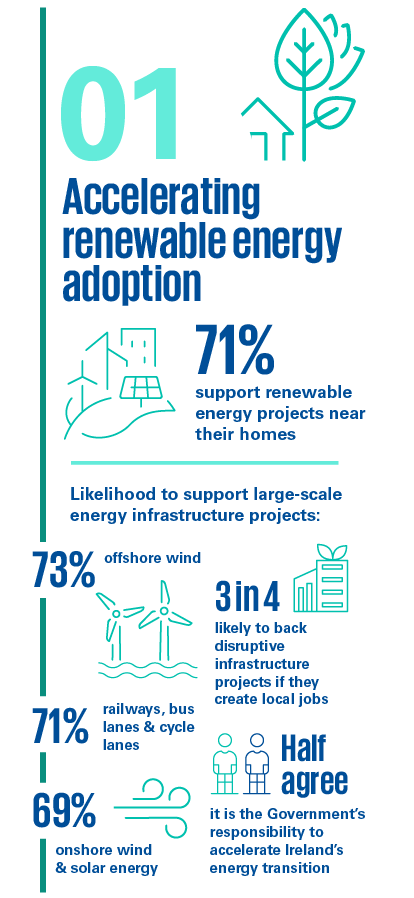
      Our research reveals that public backing for renewable energy projects remains remarkably robust, with 71% of Irish adults supporting renewable energy developments near their homes.

      Ireland’s commitment to renewable energy remains clear, but public sentiment in 2025 shows subtle shifts that policymakers and industry should note.

      71% now support the development of renewable energy projects near where they live, a modest decrease from 77% in December 2024, but still reflecting strong majority support. Notably, support is particularly pronounced among over-65s (77%) middle-income households (78%) suggesting that those with greater resources and longer-term perspectives maintain confidence in renewable energy as the path forward.

      Among those who oppose local projects, the profile of concerns is evolving. Impact on the local landscape, while still the most cited concern, has eased from 60% in 2024 to 54% in 2025, suggesting growing familiarity with renewable infrastructure. The rate of wildlife concerns remains broadly unchanged, at 51%; however, safety concerns have increased by 7% to 49% in 2025.

      Other reasons cited for opposition include impact on property (34%), pollution (27%), and blocked access routes (24%). This reinforces the importance of public engagement in early stages of development projects to optimise design and provide adequate safety and environmental assurances.


      Investing in infrastructure

      Ireland’s National Development Plan (NDP) prioritises grid reinforcement, offshore wind development, and low-carbon transport. Public sentiment in 2025 broadly supports this direction, with nuanced shifts from 2024.

      Our research shows 73% back offshore wind energy projects, down from 78% in 2024, and 69% support onshore wind and solar energy projects, down from 72% last year, signalling a modest softening for generation projects.

      Support for enabling assets is stable or rising for example, support for the construction of railway, bus and cycle lanes holds at 71%; electricity substations are at 53%, down from 56% in 2024.

      Meanwhile, enthusiasm for high-voltage power lines climbs to 40%, up from 36% last year, reflecting growing recognition of grid needs that are central to the NDP.

      Delivering net-zero depends on building large-scale disruptive infrastructure and bringing citizens with us through a clear vision of benefits for homes, communities, and jobs.
      Rodney Doyle
      Rodney Doyle

      Managing Director, Energy Transition


      The nuclear question

      Opinion remains divided over nuclear energy, but support is edging up in Ireland. Our research shows nearly a third (32%) of Irish adults back nuclear power plants, up from 28% last year, while opposition remains at around 45%.

      A striking 2025 finding is the gender gap: men show higher approval across infrastructure projects - in particular offshore wind energy projects 80% vs 66% for women. Similar trends are observed for high-voltage power lines 51% vs 28%, and nuclear power plants 45% vs 19%.

      International support for nuclear as part of the net-zero equation is also growing. At COP30 in Belém, Brazil, two additional countries joined the declaration to triple global nuclear capacity by 2050, bringing the total to 33.

      The declaration recognises nuclear’s key role in achieving net-zero greenhouse gas emissions by 2050. Endorsing countries include some of our nearest neighbours, France, the Netherlands, and the United Kingdom. 


      Prioritising local communities

      One of the most consistent findings across three years of research is that local economic benefits significantly strengthen support for otherwise controversial infrastructure projects.

      This year’s findings show again that local economic advantages remain the strongest drivers of support for disruptive infrastructure projects. Broadly unchanged from last year, 75% of adults are more likely to back projects if they create local jobs, and 71% are more likely to support initiatives that help local businesses.

      Local employment is the top motivator, with the strongest support among younger adults and older cohorts. 84% of 18–24s favour projects that create employment, while among over-65s, 80% cite both employment and business support as reasons to support renewable projects.

      Community investment also resonates strongly. 72% would back disruptive infrastructure projects that support investment in local infrastructure, and 69% favour investment in education and community facilities, such as schools and leisure centres.

      These findings reinforce a proven approach: pairing complex, high-impact infrastructure with local, near-term gains for local people can sustain support across demographic groups.


      Climate benefits matter

      Beyond local gains, climate benefits still matter, although slightly down year-on-year. 59% support disruptive infrastructure projects that reduce carbon emissions, compared to 61% in 2024, and 55% of respondents support projects that help Ireland reach our net-zero target, a decline from 58% in 2024.

      Enthusiasm is strongest among 18–24s and over-65s, suggesting that clear communication of decarbonisation outcomes, system reliability, and customer benefits can broaden the middle ground.

      Together, these insights point to a practical playbook for delivery teams to commit to creating local jobs, invest in community facilities, education, and infrastructure, and engage with communities and other stakeholders early and often on how projects reduce emissions, strengthen energy security, and support economic growth. 

      Ireland’s energy transition must deliver cleaner power while safeguarding energy security and economic growth. Engaging citizens is essential, so people understand the benefits - decarbonised electricity, a secure, resilient system and empowered customers.
      James Delahunt
      James Delahunt

      Head of Energy & Natural Resources


      Attitudes to the renewable energy transition

      Almost one third (31%) believe Ireland should prioritise renewables while retaining some fossil fuel sources, this suggests widespread recognition that a complete shift to 100% renewable energy is neither feasible, given current technology and infrastructure constraints.

      Nearly one in five (17%) think Ireland should phase out all fossil fuel generation as soon as possible and rely on 100% renewable energy sources. Uncertainty has grown to 14% (up from 12%), underscoring the need for clearer communication of trade-offs and benefits.

      Willingness to contribute to Ireland’s energy transition journey shows mixed movement. Overall, 45% are ready to invest money to generate renewable energy in their home.

      Meanwhile, 24% are willing to pay more for their power to facilitate energy transition and prepared to have a lower standard of living while energy transition is taking place. However, only 21% of Irish adults are prepared to pay higher taxes to facilitate energy transition, indicating that cost sensitivity remains a barrier.

      Responsibility remains clear in the public mind with half agreeing it is the government’s responsibility to accelerate Ireland’s energy transition, followed by energy retailers/providers (14%), energy distributors (13%), individuals/households (10%), and other Irish businesses (2%), with 11% unsure. 

      Securing Ireland’s energy future demands visible benefits for people and places, and sustained education and engagement to build durable public buy-in.
      Colm O'Neill
      Colm O’Neill

      Head of Consulting and Global Head of Power and Utilities


      AI’s role in Ireland’s energy transition

      For the first time, the report asked Irish adults about AI’s role in Ireland’s energy transition and the findings revealed several benefits, but overall public perceptions are anchored in efficiency.

      One third of adults think it could improve grid management and efficiency, followed by enabling smart home adoption (30%), but, there is low support for AI’s role in supporting electric vehicle infrastructure development (19%).

      Clear, practical communication and demonstrator projects can bridge this gap, turning efficiency focused interest into visible benefits for households and communities.

      Turning AI ambition into climate action

      As Ireland accelerates renewable energy adoption, AI is emerging as both a catalyst for decarbonisation and a new, dominant source of electricity demand. The KPMG report AI’s dual promise: Enabling positive climate outcomes and powering the energy transition surveyed 1,202 energy executives worldwide, including 109 in Ireland, on how AI is shaping sustainability.

      Irish energy business leaders are optimistic about the potential of AI to drive the clean energy transition. 97% of Irish and global respondents said they believe AI is a net positive for accelerating progress towards net-zero goals.

      Meanwhile, 96% of Irish and global energy executives say AI will positively impact efforts to reduce carbon emissions and 87% of those questioned said AI is central to them achieving their net-zero goals.

      According to Mike Hayes, Global Head of Renewable Energy, KPMG International and Partner, Climate Change and Decarbonisation Leader, KPMG in Ireland,

      “The exponential energy demands arising from the AI explosion are causing a lot of concern because of the consequential rise in emissions. However, this is only one part of the story – the other side of the story is that AI is having a transformative impact on solving a myriad of climate challenges; moreover, it has the potential to act as the critical catalyst to accelerate the energy transition and the evidence for this is becoming clear.”


      Encouraging low‑carbon behaviours

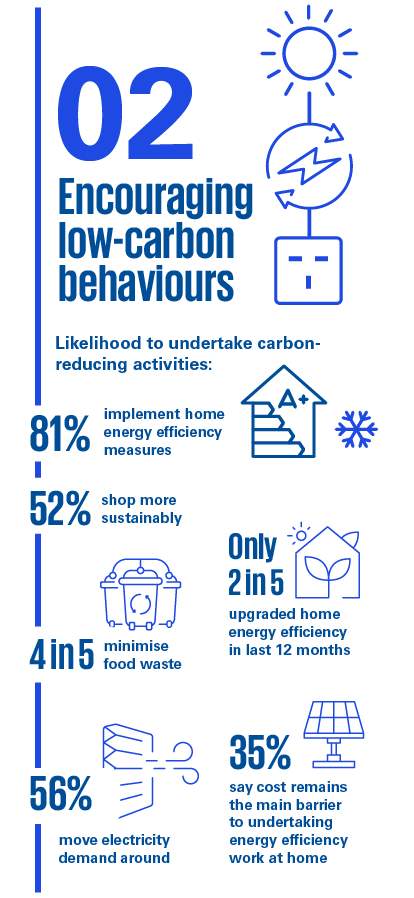
      A striking paradox emerges when comparing expressed willingness to adopt carbon-reducing behaviours with their actions over the past year. While 81% express readiness to implement energy efficiency measures at home actual behavioural change lags behind these intentions.

      Support remains solid for ‘medium-effort’ behavioural shifts: for instance, four in five are willing to minimise food waste to help reduce carbon emissions and over half (56%) would adjust their electricity usage to align with renewable availability (e.g., charging EVs at night or delaying dishwasher cycles) and 52% would shop more sustainably by buying second-hand or reducing consumption.

      These behaviours are attractive because they save money, require minimal sacrifice, and align with traditional Irish values of frugality and resourcefulness. They also don’t require substantial upfront investment or major lifestyle changes, making them accessible to households across all income levels. 


      Investment-oriented upgrades also resonate, with over half (52%) planning to improve home efficiency through insulation, new windows, or solar panels, indicating openness where paybacks are visible and incentives likely matter.

      Over half (52%) would increase use of public transport, cycling, or walking, but only 34% would fly less. These behaviours demand substantial lifestyle modification, higher costs, or significant inconvenience.

      The steady decline in willingness to change diet for environmental reasons (from 38% in 2023 to 31% in December 2025) is particularly noteworthy, potentially reflecting both “green fatigue” and growing awareness of the scale of dietary change required to significantly reduce carbon footprints.

      The minuscule support for aviation fuel taxes (19%) underscores Irish people’s unwillingness to bear direct financial costs for environmental benefits, especially when those costs are highly visible and linked to discretionary activities like holiday travel.

      Targeted incentives, accessible finance, dynamic tariffs and smart appliances, alongside improved transport infrastructure and pricing signals, could unlock further uptake, especially when communications emphasise co-benefits such as savings, comfort, health and convenience.


      The generational divide

      This year sees generational patterns sharpened. Older adults (55+) are more likely to adopt low-disruption, home-based actions, with 86% likely to implement energy efficiency measures at home and 86% minimise food waste.

      By contrast, younger adults led on demanding shifts: 18–24s were more willing to change diet (44%), showed openness to shifting electricity use with renewable availability (64%), 81% would increase cycling, walking or public transport, and 47% would purchase an electric or hybrid vehicle.

      Meanwhile, over- 65s are more willing to curb air travel and pay for greener fuels. The split is clearer: older cohorts favour passive, cost-saving measures; younger cohorts embrace mobility and lifestyle changes, underscoring the need for age-tailored policy and incentives.


      Intention versus action

      The findings suggest Irish adults are motivated in principle, but barriers like upfront cost, financing, and rental/ owner restrictions stop many from following through.

      While four in five say they are likely to adopt efficiency measures, three in five have not carried out any energy efficient measures at home in the past year.

      The gap is sharpest for upgrades: 52% report they intend to upgrade (insulation, draught proofing, new windows, solar, low-carbon heating), yet only a quarter (26%) upgraded their home energy efficiency through insulation, installing new windows, solar panels or low-carbon emissions heating systems in the last 12 months.

      The upfront cost of these renovations is seen as a significant barrier to retrofitting homes, with over a third (35%) saying that cost was the main reason for not undertaking energy efficiency measures at home, followed by cost of finance (19%), rental property/owner restrictions (17%), new house/previous improvements (9%) and uncertainty about cost-savings (5%).

      Cost pressures are most acute for 45–64-year-olds, while under-35s disproportionately face landlord and tenure limits. Only 3% cited increased property value as a primary motivation for retrofitting, suggesting that the long-term benefits of a green home may not yet resonate with the public, or that many households lack the finances to justify such improvements.

      Closing the intention-action gap will require targeted support to lower upfront costs, accessible finance, and tenure-specific solutions that enable renters and landlords to proceed.


      Attitudes towards heat and electricity

      One relatively positive finding, although still troubling, the share of adults who have gone without heat or hot water due to fuel costs falling to 19% from 24% in 2024.

      Switching increased marginally with one quarter changing energy supplier in the past 12 months versus 24% last year, still modest given the availability of better deals.

      Price awareness improved, with a third (32%) reporting they know the price they pay per kWh for electricity, up from 31% last year. While the direction of travel is positive, fuel poverty has not disappeared and remains a risk for all ages. 


      Motivations for retrofitting

      We asked respondents which factors would encourage households to retrofit. Reduced fuel bills are the primary driver (29%), followed by improved energy efficiency access to lower cost financing, and better information on government grants each motivate 9% of respondents.

      This suggests many are aware that grants exist but are unsure how to access them or whether they qualify. Clearer communication, eligibility guidance, and simplified application processes could unlock significant additional uptake.

      Commenting on policy supports, Ciara Wrafter, Tax Partner at KPMG in Ireland, said, “Budget 2026 introduced significant measures to accelerate home retrofitting, including a record €558 million for home energy upgrades and solar PV, and a three-year extension of the income tax deduction for small landlords who retrofit their properties, to 31 December 2028. These are welcome steps, but the Irish tax system can do more to incentivise property owners to adopt more sustainable behaviours.” 

      Budget 2026 introduced significant measures to accelerate home retrofitting, including a record €558 million for home energy upgrades and solar PV.
      Ciara Wrafter
      Ciara Wrafter

      Tax Partner


      Transitioning to electric vehicles

      Irish attitudes to electric vehicles continue to show the intention-action gap seen elsewhere in the energy transition. Many adults support lower carbon choices in principle, yet hesitation remains when it comes to replacing the car on the driveway.

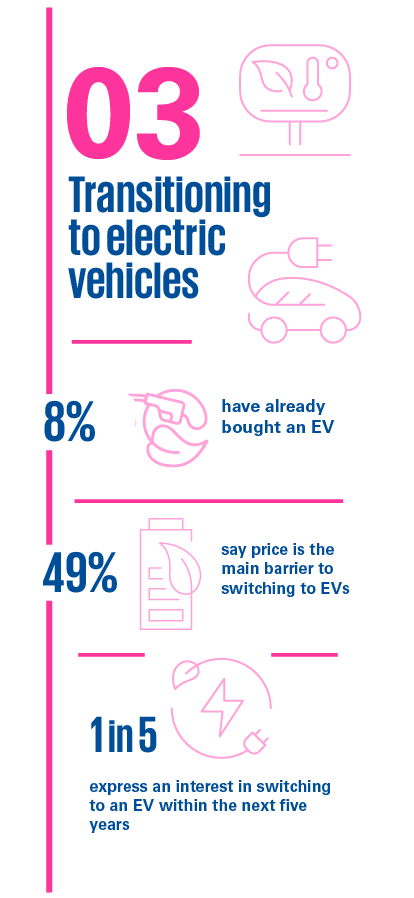
      Our research reveals EV ownership has more than doubled since last year and points to a cautious recovery with 8% of Irish adults having already bought an EV compared to 3% in December 2024.

      However, consideration is modest with just one in five people suggesting that they would consider switching to an EV in the next 5 years and over a third (36%) saying they definitely will not switch to an electric vehicle in the next five years, down from 44% in 2024.

      The generational divide in EV adoption is stark. Younger adults are leading with roughly a third of 18–34s saying they would consider purchasing an EV, versus about one in ten over-45s.


      Barriers to adoption

      Cost remains a key barrier to switching to electric cars. This year nearly half (49%) cited price as their primary reason for not switching, a decrease from 57% in 2024.

      Other barriers include worries about a lack of charging points (6%), the driving range of EVs (5%), concerns about new technologies (4%), being unable to install a charging point at home (4%) and uncertainty about cost-savings (3%). These findings underline the financial and practical hurdles consumers perceive in transitioning to electric vehicles.

      The picture is therefore one of real momentum on the road and continued hesitation in the driveway. The challenge for 2026 is to convert improved economics, policy support and network expansion into mainstream consumer confidence. 


      A rise in EV registrations

      Ireland’s EV adoption is best viewed in a global context. In the UK, up to end November 2025, 426,209 battery-electric cars were registered, 26% more than in 2024.

      Electric cars accounted for 22.7% of new registrations, up from 18.7% in 2024, making battery-electric vehicles the second largest fuel type after petrol (47%). Plug-in hybrids made up 11.1% of the new car market to date in 2025. There are now over 1.75 million fully electric cars on UK roads, around 5.2% of the roughly 34 million cars in use.

      In China, more than half of new cars sold are now battery-electric or plug-in hybrid, demonstrating that rapid EV adoption is achievable when the right conditions are in place.

      According to the Society of the Irish Motor Industry (SIMI), in Ireland total new car registrations in 2025 rose 3% year-on-year to 124,954, with hatchbacks remaining the top-selling body type. Of those, 23,601 new electric cars were registered, which is an increase of 35.1% from the 17,460 registrations seen in 2024.

      The figures show that petrol remains the most popular engine type for 2025, despite a decline in market share. Meanwhile, electric, hybrid and plug-in hybrid vehicles have gained momentum, accounting for over half (56%) of the market. Overall market share for the year saw petrol, hybrid and diesel accounting for 25.11%, hybrid 22.48%, electric 18.89%, diesel 17.09%, and plug-in hybrid 14.82%.

      The UK’s higher EV market share relative to Ireland reflects continued expansion of the public charging network, manufacturer supply, and fleet purchasing patterns, all of which support sustained growth. In Ireland, continued investment in charging infrastructure and targeted incentives will be important to maintain momentum, close regional gaps, and translate registrations into long-term emissions reductions.


      Policy supports and infrastructure

      Irish citizens are central to the transition, and clear information on EV benefits and accessible charging will be key to accelerating uptake.
      Emma O'Driscoll
      Emma O’Driscoll

      Audit Partner

      Budget 2026 and the National Development Plan (NDP) Review 2025 provide strong backing for EVs, but delivery on the ground must keep pace. Budget 2026 introduced welcome measures like the extension of the Vehicle Registration Tax (VRT) relief and Benefit-in-Kind (BIK) relief for electric vehicles to 2026 in the case of the VRT relief and 2028 in the case of the BIK relief.

      Other positive measures include the introduction of a new A1 vehicle category for zero emission cars which attracts a reduced BIK rate of between 6% and 15% and the extension to 31 December 2028 of the income tax relief for income arising from the micro-generation of electricity (i.e. home solar panels).


      Infrastructure obstacles


      Ireland’s infrastructure also faces major obstacles, with grid capacity struggling to keep pace with rapid demand increases driven by data centre expansion and increased electrification in heating and transport.

      However, the €275 billion NDP aims to address these challenges through major grid infrastructure upgrades to support both economic growth and renewables integration in tandem.

      The reviewed NDP reinforces the State’s transition towards a low-carbon transport system which specific focus on infrastructure, fleet electrification and regulatory reform.

      It allocated €24.3 billion to the Department of Transport and a significant proportion of this will be spent on funding for a “national build-out” of charging hubs to ensure dependable rapid chargers on motorways and destination chargers in regional towns.

      The NDP’s broader vision is to have nearly one million EVs on the road by 2030 with additional charging infrastructure to cater for growth.


      Financial supports for EVs


      Ireland provides solid financial supports through SEAI grants and VRT relief for example, drivers can avail of up to €3,800 in government grants from SEAI for purchasing a qualifying EV and towards the installation of a home charger, and total supports can reach up to €10,000 on eligible battery-electric vehicles, depending on the model and eligibility.

      SEAI estimates that drivers could save around €900 a year with an electric vehicle, for an average usage of 18,000 km.

      Despite strong policy supports, widespread EV adoption still faces hurdles including upfront costs, charging availability, and uncertainty around real world savings. Emma O’Driscoll, Audit Partner at KPMG in Ireland, stresses that community engagement is critical, “Irish citizens are central to the transition, and clear information on EV benefits and accessible charging will be key to accelerating uptake.”


      Addressing climate change concerns

      Climate concern is declining overall, but younger generations remain highly engaged. While many doubt the effectiveness of current efforts and see targets as unrealistic, younger cohorts expect C02 emissions to be cut by 2040 and are the most vocal that this action is insufficient.

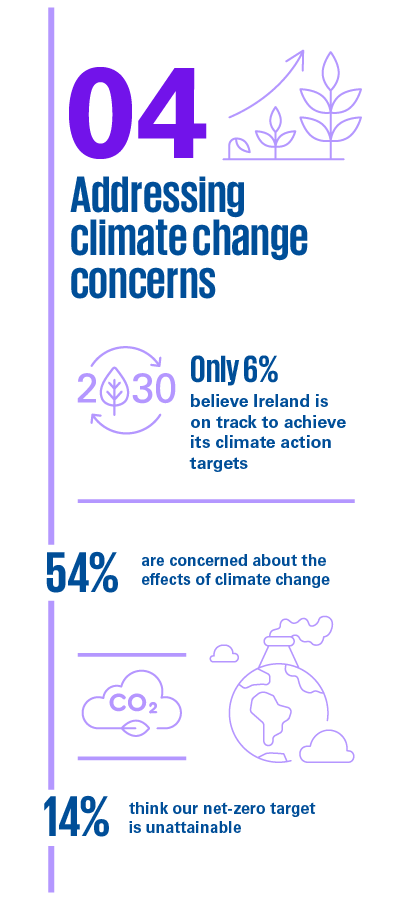
      After years of raising awareness about climate change, this year’s research reveals 54% of adults are concerned about climate change, down from 56% in December 2024. The share who are “not very concerned” has edged up to 18%. Another clear generational divide persists with over three quarters of 18–24s worried about climate change, compared with 58% of over-65s.

      By profile and place, concern is higher in Dublin (60%), urban areas (55%) and middle-income households (58%), and lower among rural residents (50%). These patterns point to differentiated engagement that will matter for policy design and communications.


      Attitudes to climate change 

      Even with a high likelihood of missing the 2030 target, we must not let this become an excuse to lose focus or ambition, but take comfort that emissions are still moving in the right direction.
      Russell Smyth
      Russell Smyth

      Head of Sustainable Futures and Corporate Finance

      Public concern about climate change has softened, and scepticism about Ireland’s ability to meet its goals remains high. In December 2025, 23% of adults said current efforts to reduce emissions will not be sufficient (down from 26% the previous year).

      Meanwhile, only 6% believe Ireland will meet the government’s 51% reduction by 2030; 19% expect the target to be reached by 2040, 14% by 2050, and 14% view it as unattainable.

      The Government has recently acknowledged that Ireland is likely to miss its 2030 emissions target by nearly half.

      As Russell Smyth, Head of Sustainable Futures and Corporate Finance at KPMG in Ireland, notes, “Even with a high likelihood of missing the 2030 target, we must not let this become an excuse to lose focus or ambition, but take comfort that emissions are still moving in the right direction.”

      Instilling confidence in our ability to meet these ambitious decarbonisation targets requires clear and transparent communication about how we plan to achieve them, coupled with concrete actions that deliver measurable progress.

      The rise in “don’t know” responses to 14% (from 10% in 2024) underlines the need for more consistent public guidance on the path to net-zero and what tangible progress looks like. Closing that gap demands heightened credibility: detailed plans, milestones, and reporting that show the trajectory year by year.


      A pivotal opportunity

      Accelerating the transformation of the electricity sector is crucial in order to support decarbonisation efforts across other industries. If investment in data centres is done correctly, they could become a critical component of Ireland’s net-zero strategies.

      The electricity sector continues to be central to Ireland’s net-zero pathway, and data centres represent a pivotal opportunity, if their growth is aligned with renewable energy and storage.

      Data centres consume substantial electricity; however, with the right investment and strategic planning, they can stimulate demand for new renewable generation and help balance the grid.

      For example, data centres equipped with battery storage could absorb surplus renewable power during peak generation and discharge to the grid at times of high demand, improving system stability while maximising the utilisation of renewables.


      Transforming the electricity sector


      According to Paul O’Brien, Tax Lead, Energy, Utilities and Telecoms at KPMG in Ireland, “Accelerating the transformation of the electricity sector is crucial in order to support decarbonisation efforts across other industries. If investment in data centres is done correctly, they could become a critical component of Ireland’s net-zero strategies.

      They have the potential to balance the increased demand for electricity with the provision of essential services to businesses and consumers. In addition, data centres present an opportunity to attract inward investment from some of the world’s leading companies.” 


      Meeting the challenge


      Realising the full decarbonisation potential across the power, transport and industrial sectors requires coordinated stakeholder action. Near-term action must focus on streamlining the planning process, increasing long-duration storage capacity on the grid to reduce reliance on fossil fuels during periods of low renewable generation, targeted support to address affordability for households and businesses, and closing the EV charging infrastructure gap, especially outside Dublin.

      Equally, clear, consistent communication that links policy measures to quantifiable outcomes like emissions reductions, capacity additions, and increased uptake rates can reduce uncertainty and strengthen trust.

      Educating and empowering individuals, businesses and communities to adopt sustainable practices remains critical. Incremental steps like improving energy efficiency at home and work, supporting renewable initiatives, and adopting low-carbon technologies can collectively move Ireland closer to its climate ambitions.

      The challenge is substantial, but with transparent plans, credible delivery and aligned investment, Ireland can rebuild confidence and accelerate progress toward its net-zero goals.


      Download the full report

      Powering Tomorrow 2026: Securing Ireland's energy future

      (PDF, 5MB)

      Get in touch

      KPMG professionals understand the energy transition. We can help you deliver on your ambitions for your business, your people and the planet.

      To learn more about how KPMG perspectives on energy and our fresh thinking can help your business, please contact James Delahunt. We’d be delighted to hear from you.

      James Delahunt

      Partner, Corporate Finance, Head of Energy & Natural Resources

      KPMG in Ireland

      Colm O'Neill

      Partner, Head of Consulting, Global Head of Power and Utilities

      KPMG in Ireland

      Russell Smyth

      Partner, Head of Sustainable Futures and Corporate Finance

      KPMG in Ireland

      Rodney Doyle

      Managing Director

      KPMG in Ireland

      Paul O'Brien

      Partner

      KPMG in Ireland

      Ciara Wrafter

      Partner

      KPMG in Ireland

      Emma O'Driscoll

      Partner

      KPMG in Ireland

      Michael Hayes

      Partner, Global Head of Renewables

      KPMG in Ireland

      Discover more in Energy

      Something went wrong

      Oops!! Something went wrong, please try again

      Energy & Natural Resources

      Prepare your business for climate change and digital transformation
      Hand plugging in electric car charger